0
0

British soldiers teach Afghan police how to live
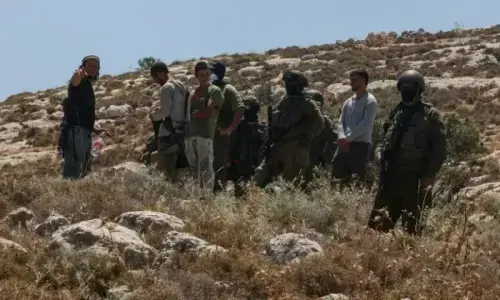
LASHKAR GAH (Afghanistan): British soldiers prod tiny packets of white powder lying in the dirt of an outbuilding at a small police station on the barren outskirts of Afghanistan’s southern town of Lashkar Gah.
Outside they find discarded syringes, vials, packets of pills and a small tin containing green-brown powder.
The visitors have reason to be suspicious: this is Helmand, which as a province, produces the most opium in the world, second only to the entire nation of Afghanistan.
It is an unpromising start to the surprise British visit.
Summoned, the commander of the mud-brick police post says the white powder is something he and his men drink to settle their stomachs. The initially suspicious brown powder turns out to be snuff.
The other items are medicines, including aid for bullet wounds from a Taliban attack a few days back, says commander Agha Wali, whose arm is in a sling.
Lashkar Gah is the capital of the province that has seen some of the worst fighting between the Taliban and the international coalition opposing them.
The Britons — from a police mentoring task team — don’t make too much of the powders and bottles but slip them into plastic bags for later inspection.
They also quiz the commander about a messy pile of new uniforms on the dirt floor of the same outhouse.
“If we had a room, we would hang them up,” Wali — who is not in uniform, although his men are — nonchalantly offers as an excuse, music blaring from the tape deck of his solitary police vehicle near his rough and ready bunch.
The British team, one of two operating in Helmand, needs to find out what the police have, what they need, how capable they are — and then assess how to help.
“This is only the second time I have seen evidence of drugs,” says Major Erik Bengtsson, who has visited two dozen police stations. “They tried to tell us it that it was medicine but I don’t believe it for one minute.” The British aim here is to coach the Afghans in survival and basic law enforcement tactics.“We teach them to stay alive,” Bengtsson says at a base of the 37-nation International Security Assistance Force.
“The police are dying at a much higher rate than ANA (Afghan National Army) and ISAF. Sometimes it is because suicide bombers are walking right up to them,” he says.
“We teach them how to search people and vehicles, how to spot an IED (improvised explosive device).” The mentoring also covers more mundane tasks such as how to write a patrol report, preserve evidence and run a police station.
In Afghanistan the police are more fighting soldiers than British bobbies.
Around 700 have been killed this year in attacks, the highest toll among the various security forces.
There is new emphasis on building up the police and army which were in a shambles at the end of the Taliban regime in late 2001 and are still under-strength and under-equipped.
Afghanistan’s allies have stepped up sporadic efforts to help: Britain will install more mentoring teams in Helmand; elsewhere police training is being carried out by the European Union and US security group DynCorp.
The Afghan National Police is seen as the least professional of the security forces, accused of setting up checkpoints to extract “baksheesh” or bribes, transporting opium and tipping off the Taliban, among other offences.
“The corruption needs to be stamped out, the drug abuse needs to be stamped out, all the nefarious activities. But there are some good eggs out there,” Bengtsson says.
“There is no reason they cannot be dragged up by the bootstraps.” Meanwhile, about 50km south, in the town of Garmser, five neatly uniformed policemen are at the first session of training by British soldiers, separate from the work of the mentoring team.A young captain, who has just returned to a heavily barricaded post after an encounter the Taliban, gets the men to strip their rifles and practise their shooting stances.
He needs to assess their professionalism as — with no Afghan army in town — the police will have to take part in operations side-by-side with foreign soldiers.The training will be a “safety net for us so we know their skills and drills are at a level where we would have confidence in them when we go out on patrol with them,” says Major Rupert Lewis, another trainer.
Policeman Mohammad Zaman, whose post is inside the fort, recalls when Taliban — several hundred of them, he says — overran Garmser town 18 months ago.
“They came from about four or five directions. We resisted them for one and a half days and then we withdrew,” he says.
“We had no ammunition, no reinforcement,” he says, adding that 16 of his colleagues were killed.
ISAF forces — then not based in the town — arrived about four days later and pushed out the attackers from the northern part of Garmser. But his family plot is in the southern part, which is still in Taliban hands.
“I am looking every day for a chance to go back to my farm. I am here to smash the enemy,” he says, when asked why he is a policeman.—AFP
| © DAWN Group of Newspapers, 2007 |