0
0

‘We are facing the failure of modernity’
Visitors’ Log
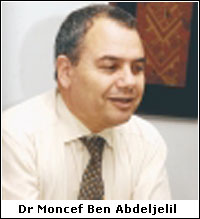 Dr Moncef Ben Abdeljelil speaks about the complex, controversial issues of early Islamic history with such ease and aplomb that he might as well be discussing last night’s football scores. Steering clear of polemic, the Tunisian scholar, who is the head of educational programmes at the Aga Khan University’s Institute for the Study of Muslim Civilisations in London and was recently in Karachi at the invitation of the AKU, talks about potentially divisive topics with a level-headedness that is sadly absent from many today who are labelled Islamic scholars.The author of several books and peer reviewed articles, one of his most interesting works is a paper in Arabic titled Alaqat Sufyan al-Thawri bi Jafar al-Sadiq written in 2003 about the interaction of Jafar al-Sadiq (AS), the sixth Shia Imam and Sufyan al-Thawri, a contemporary of the Imam who is revered in Sufi circles.
He said, “This article came about from my interest in early Shiaism. Within my early works I developed an idea that orthodoxy in Muslim thought – whether in Twelver Shiaism or Sunnism – was a later development after the division of the ummah. This article is the exploration of a field. It is a monograph of Imam Jafar al-Sadiq (AS) and Imam Sufyan al-Thawri, who is recalled by the Sunnis as a prominent figure. As for Imam Jafar al-Sadiq (AS), there is no doubt that he is venerated by all the Shia. He is also well-respected by scholars across all the faiths and religions.
“What I discovered is that these two personalities were interacting in a marvellous way. Imam Jafar al-Sadiq (AS) listened to what Sufyan al-Thawri was attributing to the Prophet (PBUH), while Imam Sufyan al-Thawri was also interacting with Jafar al-Sadiq (AS). At the end of the day I felt that this kind of interconnectedness between the two did not mean a division between Shiaism and Sunnism; it meant to me that all scholars at the time were moving within the same intellectual space. At that point most Muslims were lovers of Ahlul Bayt (AS), while the ones who were great lovers of Ahlul Bayt (AS) gave full respect to the other figures that were prominent sources in Sunnism,” he said.
When asked weather modern Western scholarship concerning Islam was still coloured by orientalism, Dr Moncef answered quite diplomatically.
“This is a very problematic question. Which orientalism are you talking about? If you’re referring to the huge concept that has been introduced by Edward Said – who himself revisited it many times – there is no doubt that orientalism is in the plural. It is the construction of perceptions about Muslims, Arabs and the orient. That perception is based on assumptions.
“Even among Muslims themselves people would be labelled as orientalists. So it’s not a matter of belonging to a nationality, a country or a language; it’s a matter of belonging to an approach towards understanding Muslim histories or cultures or religion itself. The big issue is that Muslims feel any study that would depict the past of Muslim cultures or Islam itself in a way that would match what the primary sources would say, that kind of perception would be accepted.
“If you find within all the studies – whether in the West or even within the Muslim world – that this kind of description or perception of Muslim history, culture and Islam does not match the genuine primary sources, they would not be accepted. This is the gap people have been talking about,” he claimed.
Dr Moncef Ben Abdeljelil was also asked whether the widespread discontent in the Muslim world and the resultant violent reaction that is sometimes directed against outposts of perceived western imperialism was either purely political, or did it have a spiritual background to it?
“I think it’s both. People are hopeless. Everyday they see many kinds of injustices. The global situation does not seem fair to Muslims. The expectations from the world (were high) when you think about the values of 1789’s French Revolution, values such as human rights, individual respect, equity between nations etc. Then if we look within the western world (today) there is a gap between the implementation of these values and the theory. It is disappointing. I, as well as many thinkers, have been saying that we are facing the failure of modernity.
“But in the Arab world and also the Muslim world, I feel people are frustrated from within, and not because of the West. We have inner contradictions. We have to talk about corruption in our societies. We have to talk about poverty, inequity and injustice. We have to talk about all the challenges Muslim societies are facing from within and could not find any alternative to. Were these (things) also imposed on us or were we so fragile and ready to take all the impositions (hoisted) upon us? This is another matter,” concluded Dr Moncef.—QAM
Double one seven
 “Pakistan Railways forms the lifeline of the country.” This is at least what the PR claims according to its official website. No doubt, as far as the rail network is concerned, it was very well designed by our British masters many decades ago.
Now, after years of neglect, new trains have been launched, railway stations have been given a much needed facelift, and above all an e-ticketing system has been introduced, as the officials say, to cope up with the fast changing demands of the business. However, the picture is not all that bright, as a friend recalled his problems starting right from the time when he called 117, the much-publicized railway enquiry number, to obtain simple information about trains. His ordeal went like this.He was at his office one evening when his mother asked him to reserve a seat for her in one of the trains to Khanewal. Having no access to the internet, he could not use the e-ticketing option. For information about train timings and fares, he kept dialling the number just to hold the receiver and hear the continuous, monotonous tone. He left for the City Station to get the enquiry and reservation done. To his utter surprise, it wore a deserted and rather scary look at night, with all its lights turned off and the windows of all the counters closed. A man in civvies approached him and told him that everything at the station gets closed at night and he better visit the next morning for an enquiry.
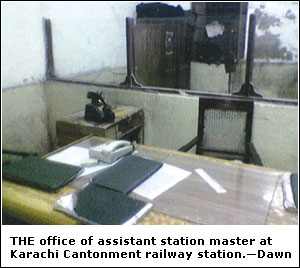
Feeling disgusted, he moved to enquire about the timings from the Cantonment Station, on the gate of which he was charged Rs10 as the parking fee. Although Cantt Station looked better with all its lights on, he could not find a single staffer on duty to ask about the fares and timings except the platform’s ticket checker, who did not know the exact fares. He did find two policemen with cigarettes in their hands, puffing away. When he asked them about a responsible officer of the railways to get the basic information, he was told to visit the assistant station master (ASM).
With his tolerance level being tested to its limits, he took brisk steps towards the office of the ASM as he thought about complaining about all the sufferings he had been undergoing that night. In no time, however, he found out that it was not all that easy as there was no officer on duty. He waited for the ASM outside the office for 20 minutes until he decided to return home with a heavy heart.
Just at that moment, he saw a police constable writing something in a register in the office of the railways police. The friend knocked at the door and was permitted to come in. The constable, close to his retiring age, asked with a smiling face how he could help him. After getting all the required information about the train timings and fares and thanking the policeman, my friend, after this dreadful experience, decided never to buy a railway ticket, what to talk of a journey by train in future.—HA
Whose opinion?
Newspapers and magazines routinely publish ‘public opinion polls’, but their accuracy about the portrayal of public sentiments is highly questionable.
In a country where ‘public opinion’ does not matter much in most issues like the right to freedom of expression, the right to protection of life and property, the right to economic freedom and, above all, the right to exist, is it right to say that the public resents a particular ruler or favours a public office holder? Why don’t the pollsters collect figures on public resentment about persistent power outages, water shortages, lack of access to public health facilities and soaring prices of daily use items?
One can only wonder from where these wonderful organisations get their data.
For ultra-rich Pakistanis, it really doesn’t matter who is ruling as long as they get to share the loot. The middle class is in the midst of a battle for survival and it simply cannot spare time to take part in random surveys. The poor cannot afford to express their views about their likes or dislikes out of fear for unexplained ‘disappearances’.
If no one is willing to lend an ear and a voice to the pollsters, one can only wonder if they are psychics, capable of penetrating into people’s minds.—Ghouse Mohiuddin
 Perhaps one of the minor victims of the tumultuous events that have rocked the nation and the city in recent times is culture. And I say minor, mind you, because compared to the other issues that afflict us – spiralling prices of basic commodities, barbaric violence, the unstable political situation – culture indeed seems insignificant.
But regardless of its place in the bigger scheme of things, culture has also suffered in the current circumstances. And one of the most major victims of Karachi’s cultural scene that has had to lay low as of late is the KaraFilm Festival, perhaps the country’s only international film festival of repute. Indeed, there has been criticism of the festival (and perhaps some of it justified) with nitpickers nagging about the rise in ticket prices, as well as the increasing focus on Bollywood fare of the more plastic variety.
But we have to take what we can get and the fact remains that Kara is the only platform in the city where local film buffs can satiate their appetites for quality international cinema, while renowned foreign film-makers can also interact with local artistes and experience a face of Pakistan that is all too often obscured by headlines of suicide bombings and other calamities, both man-made and natural.
Plus, it is a forum where budding local film-makers can exhibit their shorts, documentaries and animated films and gauge the audience’s reaction.
But sadly, it looks like Kara 2007 will not happen as following the Oct 18 attacks on Benazir Bhutto’s convoy, the festival’s organisers announced that Kara was being postponed. Considering the hairy situation that prevails in the country, it appears that this postponement will be indefinite, as it is highly unlikely that any foreign artiste would like to venture into this neck of the woods with an emergency in place.
As for Kara 2008, let’s hope that things smoothen out by then so that Karachi’s film buffs can again regale themselves with quality world and local cinema. As for the other cultural and literary events that were experiencing a sort of renaissance in Karachi, well, it all really depends on how quickly things return to normal, or as normal as can be in these abnormal times.—QAM
Compiled by Syed Hassan Ali
Email: karachian@dawn.com
New do’s and don’ts for personal security
 As if they were careers of some deadly infectious disease citizens are being warned to keep themselves at a distance from the police and other men in uniform. This is the general advice from our elders and seniors now a days and it is being given for our personal security for which the state is no more responsible or is unable to ensure. Even the security men have instructions not to stand in groups and if a suspicious man — we all fall in that category by the way — comes across, intercept him only from a distance. So, those who were supposed to provide security have become vulnerable themselves, in fact a living danger for those living with them and those in their immediate vicinity.
It would not be an overstatement to say the police and other security personnel were never any good at protecting life and property, a job they had long ago surrendered to the private security agencies that have been mushrooming and grooming under the retired officers of the armed forces.
Earlier the advice used to be about things one could not talk about. Don’t say this, don’t say that, don’t write that as that was not in the national interest. Nobody really knew what the national interest meant. Even writing on corruption stories, reporting against indecisiveness of the senior officials and government leaders on matters of daily life were sometimes described as endangering national interest. One’s life could come under threat in the national interest even if a retired military official had the audacity to sell the Pakistan embassy building in Indonesia. In fact, selling of a national asset at a throw- away price would not be against the national interest but telling the nation about the sale used to be a crime and against the national interest.
“Don’t write that people in Pakistan are poor even though official figures say so because this is not in the national interest”, we were told a few years ago. We were dubbed as Pakistan enemy by a federal secretary for telling the nation that India was developing dams on Chenab and Jhelum rivers to Pakistan’s disadvantage and they were talking about “wheels within wheels”. Everybody had a different definition of national interest to his advantage and we were left wondering whether Gen Muharraf’s definition of national interest was correct or that of Gen (retd) Hamid Gul’s or Gen (retd) Aslam Beg’s for that matter and so on. That was the past.
Today it is different and terrible too. A bomb is a reality and nobody can disagree that it can explode in a lawyer’s procession where chief justice of the country is going to speak shortly, it can destroy a bus in a high security zone and it can hit in close proximity of the Army House in Rawalpindi, tight security arrangements notwithstanding. And when this is struck by a suicide bomber sacrificing his life as well, the threat could obviously not be underestimated.
But the killing of 40 plus people in Karachi on May 12 just because some of them were going to welcome the chief justice and his accompanying lawyers was not the result of a suicide bomber. So are the mind-boggling reports based on intelligence tips that six suicide bombers have entered Islamabad? Who has seen them, where have they gone and why were they not intercepted when they travelled hundreds of miles and welcomed in Islamabad? Perhaps, the rights of the purported suicide bombers have also been curbed under the emergency and they have gone into hiding. Our friends would even get tips that an explosion is expected on such and such day at this or that place and the forecast turns out to be true. Unbelievable, isn’t it. So effective is the intelligence network and so accurate the information. then what was stopping us from preventing the attacks.
Thank God, every threat has been dealt with effectively since November 3. At least there is no intelligence report to suggest that.
That is the real threat that would not allow popular political parties to take out processions and rallies. At least this is their face saving. Why the parties that claim to have support of more than 36 per cent voters in a population of 160 million are not able to produce 16,000 in a public rally or a procession to defy official ban. Agreed that PML-N does not have enough street power, but where is the popularity of People’s Party or the organising ability of the Jamaat that could paralyse Lahore to protest Vajpaee’s arrival. Why Imran Khan is handed over to police and why every politician is in jail except our beloved Benazir Bhutto who will need a lot of time and effort to undo the bad mouthing arising out of the “deal and national reconciliation ordinance”. Interestingly, this security threat is not for “future” prime minister Pervez Elahi who can address as big rally just as he wants and wherever he wants.
There are about 1,400 registered journalists in Rawalpindi and Islamabad, who are normally not known for street politics. Yet, here they are with a gathering of at least 400-500 against the media curbs every day outside media establishments. Young students of elite schools join hands, protest against the emergency, eulogising ousted judiciary, followed by groups of civil society activists representing different non-governmental organisations, the very people who supported Musharraf when he promised to give rights to the grass root people. Security has never been a problem for the lawyers who mobilised public in big numbers during the recent movement and that’s why leading lawyers continue to go to jails, notwithstanding the fact how peaceful they have been.
Then there are small children who want to shower flowers on and present bouquets to the deposed Chief Justice Iftikhar Muhammad Chaudhry. What security problem they are going to pose that they are manhandled, bundled into police trucks and driven away. There are newspaper photographs of policemen arresting and manhandling women. This most disgraceful manner in which the security agencies — both in uniform and in plain clothes — are shown handling the situation remain unnoticed by those who pose themselves as champions of enlightened moderation, wear designer suits and preach great values in sophisticated foreign accent and who have done so much for improving social and living standards of the people and yet claim to be representing the middle class. Had that been the case before November 3, pat would have been a Supreme Court suo motu notice. That is the cost of challenging the status quo but the fight should go on.
| © DAWN Group of Newspapers, 2007 |