0
0

 KARACHI, Nov 14: It is thought-provoking to revisit the first few months of Pakistan’s existence at a time when it is at yet another critical juncture, which is why ‘Jinnay Lahore Nahin Vekhya’ comes at such an opportune moment. Presented by Tehrik-i-Niswan and the Pakistan Arts Council, Karachi, the play opened on Wednesday and like ghosts condemned to restlessness, the triumphs – but mainly the tragedies – of partition were recalled through Asghar Wajahat’s script.
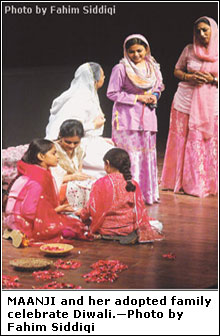
The play follows a family from Lucknow that arrives in Lahore at a haveli allotted to them as abandoned property, only to find that the old mother of the erstwhile Hindu owner remains in residence. Having lived in the mohalla all her life and being a respected member of the community, she holds on to the only home she has known. The immigrants’ attempts to get her to leave the haveli (and Pakistan) proving unsuccessful, the young master calls in the local goons. While it takes little time for the family to embrace the old lady as their own Maanji, it takes even less for the pehlwans to decide that Pakistan is reserved for Muslims alone.
The beauty of the play lies in the points of religious philosophy, nationalism and ethics, to say nothing of Lahori traits versus those of the Urdu-speaking immigrants, embedded in this simple story. These are discussed through the ethos and poetry of the poet Nasir Kazmi, who is one of the central characters. His views, particularly as they apply to an old woman’s right to remain in her hometown, are told through couplets and verses interspersed through the dialogue. Significantly, portions of his poetry recalling the dilemmas of the newborn Pakistan are also used to divide the scenes. Vocalist Daniel Wiliat turned in an excellent performance singing the lines penned by Kazmi, which in turn became the voice of conscience.
Directed by Sheema Kirmani and Anwar Jafri, the play made good use of a minimalist approach towards set design. A number of different spaces and levels were created with an impeccable aesthetic, while blocks and simple props ensured that set changes were fast and effective, perfectly timed to the duration of the piece being sung by Wiliat. Similarly, the lighting was professionally done: the stage was adequately lit without light spilling over, while the sparing use of colour screens and shadow added depth and intensity to the emotion of various scenes.
The opening night performances were, on the whole, competent and effective, which was only to be expected since the bulk of the cast was comprised of professional stage and television actors. Salim Meraj, in the lead role of Salim Mirza, the gentleman from Luknow, stood out for the flow of his diction and the absolute comfort he displayed in his part. Similarly, Saife Hasan in the role of Nasir Kazmi also delivered an admirable performance, managing to nicely blend the outraged citizen with the ironic poet, switching with equal ease from being a young wanderer of the city streets to a philosophical idealist. Mahvash Faruqi as the old Hindu woman delivered a nuanced performance with depth and emotion. And while my Lahori ear cringed at her Punjabi accent, I suppose the Urdu-isation of that melodious language was perhaps necessary since the play had to be made accessible to an Urdu-speaking audience. Hafeez Ali in the role of the pehlwan was convincing in his threatening posturing and tendencies towards violence, although the colour he chose to give to his character appeared to have been influenced more by Maula Jutt than the actual Butts and Bhattis of Lahori Gate. Given that we are familiar with the reality of Pakistan sixty years after its creation, the play constitutes a sad reminder of the fact that many of the problems besetting the country today have their roots in the rhetoric of 1947. The last scene is particularly relevant: outraged that the area maulvi (played by Adnan Shah, also known as Tipu) upholds the religious and moral rights of a Hindu woman in a Muslim country, the ghundas stab him to death — as we see happening in Swat, the voice of moderation is silenced while the goons grow beards. It seems that as Pakistan was born in tears, so will it die.
The play will be performed at the Arts Council Theatre, Karachi, until Nov 18.