0
0

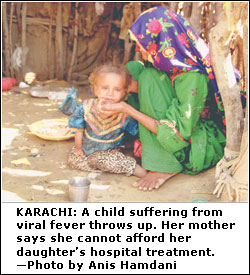 KARACHI, Nov 9: Death continues to stalk the inhabitants of Deh Allah Bano, a remote coastal locality in Keamari Town bordering Hub. While the viral fever epidemic that reared its head over two months back has dealt a bitter blow to the resources of the impoverished locality and has resulted in 14 fatalities — three in the past as many days — no active government assistance is in sight.
Thirty-five-year old Karim Buksh, father of six, and 12-day-old Sonia Maula Baksh died in Mohammad Alu Village and Haji Siddique Village in Deh Allah Bano, respectively. Sonia was suffering from fever while Karim Baksh was chronically ill and reportedly diagnosed with hepatitis.
The only government dispensary in the Gabopat union council, comprising 10 dehs including Deh Allah Bano, has been closed for decades and the residents claim that the town health office medical team has rarely visited the affected villages.
“We are part of the city, aren’t we?” they wonder, expressing utter disappointment over government apathy towards the fast-deteriorating health crisis. A recent survey of five villages — Mohammad Alu, Haji Ibrahim, Haji Noor Mohammad, Ali Baksh and Khair Mohammad Yaku Goth — showed that almost every home was afflicted with disease and hunger and there were widespread complaints of fever, vomiting and shivering.
Their major problem, though, has been transporting the sick to any health facility. Every day, dozens of people hire private vehicles jointly for a thousand rupees or catch a bus that charges Rs20 for a trip to Mauripur.
“The women of the affected localities are selling their ornaments and the men their animals to generate transport funds to take patients for medical treatment in the city. Others are taking loans from launch owners to pay the medical bills,” said a 70-something man who had taken his two grandchildren to the Civil Hospital Karachi for medical treatment.
Although the viral fever has been identified in many cases as malaria, the residents claim that people have not been cured from the disease despite taking prescribed medicines.
“We feel better as long as we are taking medicines but as soon they are finished the disease strikes again,” they said, adding that the epidemic had shown little signs of being receded over the past months.
“Two of my grandchildren have come back home after being admitted to the CHK for two weeks. But they still have fever,” said Fatima, a resident of Haji Noor Mohammad village, one of the worst-hit villages where people claim that they are unable to find private vehicles to take the patients to Mauripur.
The Gabopat union council with a population of around 250,000 people enjoys no basic facilities or civic infrastructure. The inhabitants live in small huts close to their cattle and survival depends on fishing and scanty cultivation. With no government aid in sight and depleting resources, many women and men are now turning to begging in increasing numbers. The residents demand that the government reopen the health unit in their locality and provide them with means to support their families.