



 0
0

KWSB pulling out of troubled waters
THE water and sanitation board is all set to make its presence felt. In a bid to recover long pending water charges by bulk consumers, it has mustered courage to cut connections of defaulters. Hopefully, water will not be supplied until the respective institutions that include the Defence Housing, Authority, the Clifton cantonment, Pak Steel, Pakistan Railways, flour mills, and several other local and foreign manufacturing companies, clear their dues.
Thank God, the action drives home the point that it is not always the poor and underprivileged don’t pay dues; that most are accused of begging or stealing to get water without paying dues. This also defies the common notion that people living in squatter settlements have mostly flouted civic services. There are approximately 5000 bulk consumers of the KWSB that include both federal and provincial departments, most of which have not paid water charges regularly, landing the KWSB into huge losses of almost rupees 6 billion. The various departments of the government of Sindh collectively owe the KWSB over Rs2,760,511,834 since 1991.
Sources inside the KWSB say that meetings have been held and reminders sent to government departments time and again for payment, but not much headway was made as repeated calls have been met with indifference. A drastic step of cutting connections altogether might stir the defaulters out of slumber, if only these organizations show some remorse and pay their dues.
The KWSB has focussed energies on restructuring plans to counter deteriorating finances and infrastructural glitches. The KWSB has realized it has too many issues at stake with too little money in the kitty. Consumers today are faced with an inefficient system of criss-crossed dilapidated water pipes. Many areas receive contaminated water as the sewage and water pipes running side by side all over the city have begun to pour into each other. Besides, recovery of dues has been one of the weakest areas at the KWSB which is why finances remain at the lowest ebb. The KWSB holds around 35 billion rupees worth of assets; energy costs come to around 1.5 to 1.8 billion rupees annually, while salaries, maintenance and other relevant costs make for 1.1 billion rupees annually.
The Water Board is carrying out a detailed evaluation of its services through citizen report cards (CRCs), an idea of Dr Gopakumar Thampi from Bangalore. With the World Bank bearing some of the brunt, a set of nine of the 18 towns have been selected to carry out the survey to determine the level of consumer satisfaction and quality of service. The survey will start from mid-November and results will be disclosed in February next year.
What will happen once all the big fish are made to pay all their dues? Will all evils be finally nibbed at the KWSB? Water has been considered a right and not a valuable resource, which is why it is taken for granted. Any tax or payment levied on the resource is normally met with resentment. Corruption and nepotism have also disfigured the shape of an important civic body. A good 40 to 50 per cent of water is misused or wasted against a supply of almost 650 million gallons per day (MGD) to Karachi. Experts and sources in the KWSB say that water supply is largely sufficient to meet Karachi’s demand. The CDGK claims to have mended almost 80 per cent of the sewage lines. Many areas in Karachi like Lyari however, still yearn for a decent water supply beyond an average of 4 to 5 hours of water supply every day.
These are difficult times. There needs to be more sensitization and awareness of the fact that water fit for human consumption is fast diminishing due to global warming in the world. Water is almost 3 per cent all over the world to feed a burgeoning population. The issue of permafrost — the thawing of ice tops of mountains that are the most crucial sources of water in the world — was addressed at the World Climate Summit held recently at New York. At the international stage however, the key players, including the developed countries, the USA topping the list, showed little concern about doing away with major irritants like the Kyoto Protocol. This demonstrates their indifference: the rest of the world can die of gas emissions or no water. How better can the cliché ‘might is right’ be understood?
Water should be the key issue today on the agendas of political parties for the forthcoming elections, if there are to be any. Also, the citizens should know what to ask for. At a presentation made recently in Karachi, Dr Gopikumar Thampi quoted the example of a slum in Mumbai. The residents had run the CRCs in their area on major civic concerns before elections. When political candidates came to the area with a list of offerings on their agenda, the residents gave them their own list and wanted to know whether they will be fulfilled if they vote for the candidate. The recent awakening of the power mongers that it is the people who matter the most in a democratic set-up, such a tool may come in handy to understand that we have had enough of our fill of suffering.
Innovativeness in theme and medium
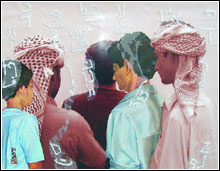 KARACHI: A look at Masuma Halai’s work at Canvas Art shows how innovative this artist happens to be not just in the choice of her themes but also in the selection of her material. The first painting, I use the word somewhat reluctantly, has her own face moulded in plaster (the material which orthopaedic surgeons use to keep the limbs in cast) stuck in the frame with tissue paper and in the background is her childhood photograph. Scrawled all over the composition are dates which are milestones in her family’s and in her own history, such as the birth date of her great grandmother in Morocco, grandfather in Mozambique, mother in Rajkot and father in Karachi, not to speak of her own birth in Karachi (the year I conveniently forget).
Another interesting composition is one which shows five people attired in turbans of which three are photographs and two paintings. From a distance one can’t recognise which one is what. That speaks to some extent about her command over drawing, a subject which this NCA graduate teaches at the Indus Valley School of Art and Architecture. She has embroidered an organza cloth that has found a place for itself in the composition. What are no less interesting are the alphabet in Arabic with their corresponding letters in English and Hebrew. “Why Hebrew?” some one asked her. “Because there is phonetic connection among the three languages, and also because Hebrew letters are just as aesthetic in appearance as the ones used in Arabic,” comes the answer.
In yet another composition one can see the Arabic scarf — Kaafiyah — vying for space with a Hebrew Kaballah-inspired motif. The other meaning of the word is “the tree of life”. One can see dates and olives dotting the compositions and presumably Masuma Halai, is trying to show that the two parties at war with each other have lived peacefully in the past.
She has used not just canvas, photographs and plaster but also graphite, scarves, linen, needle point and newspapers, to just mention a few. And all this she does with remarkable dexterity. Nothing looks jarring or out of place. It only shows her obsession with experimentation.
Masuma Halai admires the works of Shazia Sikandar and Aisha Khalid – both miniaturists. Why, one may ask. “Because they always come up with new ideas and they experiment on almost a regular basis,” she answers.
Masuma doesn’t do miniatures but her compositions are just as detailed as miniatures happen to be. There is no one she respects more than Salima Hashmi, who was her thesis in charge and who has inspired her no end.
Halai graduated from the National College of Arts in 1991 but has had only three solo exhibitions. She took it lightly when she had two children. It was only after they started going to school that the young mother started painting with a renewed zeal. Her exhibition at Canvas will be on till the 15th.
| © DAWN Group of Newspapers, 2007 |



























