0
0

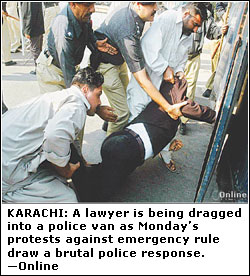 KARACHI, Nov 5: At the City Courts, Monday began with relative calm but soon deteriorated into an illustration of the police powers strengthened under emergency rule and the fundamental rights lost by ordinary citizens. While outside on M. A. Jinnah Road, the endless din of snarled traffic rose into the air, inside the buildings lawyers bore the brunt of official fury at their protest against the recent events in the country: one by one, the police dragged lawyers from the first-floor Bar Room to the police vans waiting outside.
Two days after the imposition of emergency by General Pervez Musharraf as the chief of the army staff (COAS) under the Provisional Constitutional Order (PCO), dozens of lawyers gathered in the City Courts to protest and face the brutality that appeared inevitable. Despite the imminent threat to their personal safety, they stood firm. “Our struggles will continue,” Karachi Bar Association President Iftikhar Javed Qazi was heard to say, even as a couple of policemen were manhandling him while trying to put him under arrest.
Mr Qazi’s arrest came a few minutes after the police stormed into the Bar Room where lawyers had been chanting anti-government slogans in line with a strike call issued by lawyers’ organisations across the country. Before the protest gathered momentum, the police conducted a raid and this time showed no mercy towards even pro-government lawyers. Deputy district attorney Zahida Zainab was among lawyers arrested in the City Courts.
By 10am, the police had rounded up some 17 protesting lawyers, both men and women. At that point, lawyers managed to lock all the entry gates to the court, leaving hundreds of thwarted policemen standing outside. Scattered in different blocks of the court, the lawyers started gathering in the Bar Room again and chanting slogans.
After a while, policemen broke the locks of the gates and stormed into the Bar Room again, this time with redoubled anger and force. Charged up by their earlier actions, the police baton-charged lawyers and scuffled with members of the legal fraternity. Over four hours later, when some calm was restored, lawyers said that an estimated 50 of their colleagues were arrested from the City Courts.
However, officials refused to confirm these numbers and insisted that the situation had remained completely calm. “No comment on this particular issue,” said Capital City Police Officer Azhar Ali Farooqi. “Throughout the day, the law and order situation remained peaceful and absolutely under control.”
Meanwhile, a source close to the police confirmed 21 arrests from the City Courts and warned that the figures may go up. “These 21 are only those whose names have been entered in the register as arrested,” he told Dawn. “The police have deliberately kept several names unregistered, so the actual number of the arrested can be much more.”
Amongst those who were seen being whisked away by the police and taken to various police stations were Mushtaq Jahangiri, Arshad Rauf, Saleem Bhatti, Riffat Nasim, Subhana Sheikh and Naheed Afzal.
After the police action, lawyers who had managed to escape arrest gathered once again in the Bar Room and an urgent general body meeting passed a resolution. Advocate Munsif Jan, a senior member of the Karachi Bar Association, read out the resolution which was subsequently passed unanimously.
“We condemn the brutal police action,” said Advocate Jan. “The lawyers will continue boycotting the court and no one will appear before a judge who took oath under the PCO.”
The secretary of the Karachi Bar Association, Naeem Qureshi, remained inexplicably out of the picture throughout the day. In the evening, he called from an unknown location and condemned the police action in the City Courts. “If our members are arrested under the Maintenance of Public Order (MPO) ordinance, they should be produced in court under Section 188 of the Criminal Procedures Code on Tuesday,” he said, adding that the arrested lawyers would get released on bail and not seek exoneration from the government. Mr Qureshi also vowed to continue the court boycott.
If lawyers continue their protest against emergency rule under the PCO, warnings issued by the administration suggest a repeat of Monday’s violent episodes today [Tuesday]. “We will replicate our arrangements,” said the CCPO Mr. Farooqi. “The police will have a zero tolerance towards anyone holding demonstrations and protest gatherings.”
Meanwhile, nearly 50 lawyers were arrested from the premises of the Sindh High Court, including Salahuddin Ahmed, son of the relieved chief justice Sabihuddin Ahmed, former Federal Shariat Court judge Shafi Mohammadi, Najeeb Jamali, son of Justice Anwar Zaheer Jamali (since then relieved of his duties), Zahid Ebrahim, son of senior lawyer Fakhruddin G. Ebrahim, Kashif Piracha, Aslam Butt, Masood Khan, Omar Lakhani, son of Sindh Bar Council vice-chairman Amin Lakhani, and Khilji Abdul Wahab. They were taken to the nearby Artillery Maidan police station where the police offered to release a couple of them at the request of senior lawyers but they refused, insisting upon the release of all their colleagues. Pakistan Bar Council member Rasheed A. Razvi courted arrest in the afternoon after being told that he was wanted by the police under the MPO.
Police resorted to a mild baton-charge to disperse lawyers rallying outside the clients’ cafeteria at the SHC. The cafeteria was later raided and cleared of protesters.
No proceedings took place in the Sindh High Court since lawyers boycotted cases before the 13 judges who have so far taken oath under the PCO. Among the cases previously scheduled for hearing on Monday was a suo motu inquiry into the May 12 killings in Karachi. Only two members of the seven-judge bench, Justices Azizullah Memon and Ali Sain Dino Metlo, have survived the PCO.
Justice Mohammed Afzal Soomro was the first to be sworn in under the PCO as the new chief justice. The other judges who have taken oath are: Justices Munib Ahmad Khan, Mrs Yasmeen Abbasi, Mrs Qaiser Iqbal, Mohammed Moosa K. Leghari, Azizullah M. Memon, Nadeem Azhar Siddiqui, Ali Sain Dino Metlo, Mahmood Alam Rizvi, Abdur Rehman Farooq Pirzada, Dr Qazi Khalid Ali, Dr Rana M. Shamim and Khwaja Naveed Ahmed.
Their inter se seniority could not be known as a new seniority list will be issued in due course. Justice Munib Ahmed Khan is, however, tipped as the new senior puisne judge. Justice Leghari was the last to take oath on Sunday night and is due to retire on December 31 unless elevated to the Supreme Court.
More judges, particularly former members of the judicial service who served as district judges, may be persuaded to take oath. The SHC has a sanctioned strength of 28, which was achieved only recently.
Justice Sabihuddin Ahmed, who became a judge in 1997, Justices Osmany and Jamali of the 1998 batch and Justice Mushir Alam of the 1999 batch were not invited to take an oath under the new PCO and stand relieved. The relieved CJ is virtually under house arrest as he was not allowed to come out of his Khayaban-i-Mujahid, DHA, residence on Monday morning and neither were his bench and bar colleagues allowed to see him.
The SHC Bar Association members held a general body meeting to vent their resentment against state of emergency and removal of judges by prescribing a new oath. They said the emergency, in fact, amount to martial law with the difference that while the previous ones were aimed against politicians and their rule, this one was targeted on the judiciary.
The speakers, including Pakistan Bar Council members Abul Inam, Rasheed Razvi and Mohammad Yasin Azad, Sindh Bar Council vice-chairman Amin Lakhani, former SHCBA president Akhtar Hussain and human rights activists M. Mushafay, said the proclamation of martial law in the garb of emergency was the regime’s reaction to the success achieved by the lawyers in the first round of struggle again military domination. The regime could not brook the unanimous Supreme Court judgment in the chief justice’s case and struck with full might when it got an opportunity. They said the second round of the campaign was going to long drawn. It would require not only unity among lawyers but also mobilization of the entire civil society. They said they did not recognize the judges who had taken oath under the new provisional constitution order.
The meeting endorsed the decision taken by the apex Bar organizations to boycott all court proceedings for an unprecedented three consecutive days from Nov 6 to Nov 8. But the Bar representatives urged the lawyers to come to the bar room and hold protest meetings every day. More decisions about the future course of action were discussed by the Pakistan Bar Council and the Supreme Court Bar Association and would be made known in due course, they said.