



 0
0

 The pound soared to its 26 year high against the dollar midway through last week as it shot to $2.798 on Wednesday. On the same day the US Federal Reserve cut the interest rates by a quarter points to 4.5 per cent as the Bank of England leaked at about the same time its intentions not to change its rates either way before the next year.
And before the week was over. oil and gold prices were also fluctuating heatedly on the higher side with the black gold hovering between $90-94 a barrel and the precious metal baying to cross the barrier of $800 an ounce.
There certainly is an upheaval in the currency and commodity markets and official managers appear to be finding it almost impossible to tie up the loose ends that have been sent flying in all directions by the credit crunch which followed the sub-prime debacle in the US.
There is still a question about whether or not the world economy has successfully weathered the credit crunch, or as some believe its five-year of high growth cycle has finally come to an end. What is expected to be followed is an intense turmoil in the developed markets. But the emerging markets led by China, India and the Middle East are expected to serve as stabilising influence providing the developed markets the much needed breathing space.
The announcement by the Fed follows a rate cut six weeks ago which saw borrowing costs fall for the first time in four years and by a half-point to 4.75 per cent.
The two cuts, one after the other in such quick succession are meant to revive the US economy which is entering a recessionary mode. It was perhaps in anticipation of this second cut that Mr Rodrigo de Rato, the outgoing Managing Director of the International Monetary Fund had earlier in October said that he expected the dollar to slump further.
Analysts said there was plenty of scope for more gains by sterling against the dollar with markets pricing in further rate cuts by the Fed either by the year end or early next year.
The dollar’s debacle against the pound has also been fuelled by less certainty over the timing of any cut in UK rates. Despite aggressive rate cuts by the Fed, the Bank of England’s monetary policy committee has taken a more cautious “wait-and-see” approach to assess the impact of the credit crunch on the economy.
The serious threat posed to the US economy by its deepening housing crisis and the escalating oil prices is said to have prompted the US Federal Reserve to cut interest rates for a second month in a row. In a statement, the Fed said that its action should “help to forestall adverse effects on the economy” from recent market turmoil and stimulate growth.”
The dollar’s decline came amidst gains made by the US economy earlier when it was boosted by the robust third quarter GDP growth data. Its latest losses saw the euro scale new peaks as high as $1.4472, while the dollar’s trade-weighted index against six leading rival currencies fell to an all-time low of 76.605. The expectation that Governor Mervyn King of Bank of England and the rest of the Monetary Policy Committee will leave rates at 5.75 per cent were bolstered Tuesday by comments from Monetary Policy Committee (MPC) member Kate Barker, who indicated that attitudes on the committee toward interest rates have not changed much since August.
A wider gap between UK base rates and the lower level of official rates in America puts upward pressure on the pound by increasing the appeal of sterling-denominated holdings.
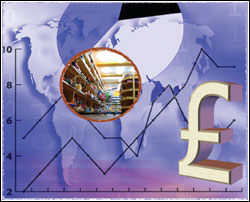 While the British tourists and the buyers of imported consumtpion goods see the strenghtening of pound against the dollar as a good news but it is not being welcomed by UK companies that export goods to the US.
Last week the CBI said that it was hurting the manufacturing industry and warned that factory orders had fallen unexpectedly this month.
Since unlike the yen or the Swiss franc, the dollar is not backed by a country with a large current account surplus or a large stock of savings ready to be deployed abroad, there is said to be little chance of the dollar making a come back soon. And the volatility in global markets appears to have risen structurally following the recent subprime mortgage crisis and will likely continue to rise next year.
The dollar’s trade-weighted index has already sunk to a historic low and there are fears that the greenback’s decline could accelerate if the ongoing downturn in the housing market threatens to drag the economy into a recession.
The dollar is said to be weakening among other things because of diversification activity as China manages the renminbi against the dollar by buying the euro.
It is believed that at some point, the Chinese will desire a stronger currency in trade-weighted terms and when that happens, official buying of euros will dry up and the relentless downward pressure on the dollar will cease.
The sliding dollar and escalalting oil prices appeared at one point last week to drive gold through $800 an ounce for the first time since 1980.
The cut in the interest rates by the Feds is expected by the precious metals traders to cause the gold price to soar as high as $850 an ounce which was reached in January 1980. Gold is also used as a hedge against inflation therefore, those fearing the oil prices to go beyond $100 would most likely go for gold to save their reserves against price escalation.
According to media reports, spot bullion on Tuesday moved 0.6 per cent lower to $789.05 an ounce, just below its 28-year high of $794.40 reached earlier in the week as some traders booked profits.
Meanwhile, experts said, gold prices would move above $800 an ounce around the new year going upt to $832 in 2008 and above $1,000 in 2010.
In the past weeks, it was noticed that every time the gold prices took a slight dip, there was a rush for buying. It had almost appeared as if some one was sitting there wiating to keep the gold prices pushing up. The speculation was since the biggest gainers from rising gold prices would be the miners, it was they who were behind the attempts to keep the commodity price on the higher side.






























