



 0
0

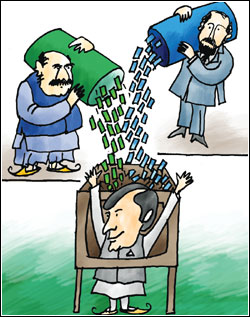 The Punjab government is all set to receive a soft term credit facility to the tune of $1.550 billion from the Asian Development Bank (ADB) to be disbursed over a period of five years for deepening the governance and economic reforms initiated in 2004, achieve the Millennium Development Goals (MDGs) and to improve administration of justice in the province.
Out of the total loan amount, the Manila-based multilateral lender is providing $750 million to the province for undertaking the second phase of its economic and governance reforms under the umbrella of its flagship – the Punjab Resource Management Programme (PRMP). Launched in the late 2003 to carry out policy reforms to improve governance for rapid economic growth, the PRMP, in the words of senior ADB official Ramesh Subramaniam, is regarded within the bank as a model programme for its replication in other parts of the world in future.
Another $400 million will be provided to the province for improving the administration of justice. The previous financial assistance provided by the bank under this programme, according to officials, could not produce the desired results because it was carried out through the federal government.
“It is now being felt at the ADB that the programme will give better results if the access to justice reforms programme is implemented directly by province (under the direct guidance of high court) itself,” says an official involved in loan negotiations with the lender.
The remaining sum of $400 million will be disbursed to Punjab to facilitate its effort to achieve the MDGs, which the government has repeatedly claimed in the recent past to achieve in all areas except in public health care.
The provincial government completed in March this year the first phase of governance and economic reforms programme with the financial assistance of $400 million from the ADB. Some of the achievements of that reforms programme include the development of strategies for managing province’s huge expensive debt accumulated in the 1990s, reducing incidence of poverty (Punjab-Poverty Reduction Strategy Paper) and enhancing spending on areas and sectors that can have greatest impact on poverty (Poverty Focused Investment Strategy).
In order to ensure the critical elements of continuity and certainty in the availability of resources for the medium term (three years) development projects, the Medium Term Development Framework (MTDF) was devised. Planning and budgeting processes were linked together through Medium Term Budgetary Framework (MTBF).
Other important achievements included establishment of a pension fund and a GPIF to make the pension and provident fund liability a self-sustaining, off-the-budget item with a view to freeing up financial resources for enhanced spending on pro-poor social and economic sectors. A provincial procurement authority has also been set up.
In the second phase of its reforms programme, government plans to improve provincial public pension and GP fund administration, strengthen linkages between budgeting and expenditure and planning over a medium-term of three years through the development of a Medium Term Expenditure Framework (MTEF), undertake provincial civil service reforms with a view to improve the efficiency and output of provincial bureaucracy for better public service delivery and facilitate growth of private sector as engine of economic growth and as a partner of the government in the provision of quality services to the people of the province.
The PRMP reforms programme seeks to reduce poverty through substantial improvement in public service delivery in the province with particular focus on pro-poor sectors by restructuring the systems and the government’s business processes for efficient and effective management of public resources. The focus of these reforms remains capacity building and effective use of people – both civil servants responsible for delivering services to the people, restructuring of institutions and their functions, creation of fiscal space for rescuing resources for pro-poor sectors.
The provincial government used the major portion of the loan – around 80 per cent of the proceeds – received during the first phase of the reforms programme to retire expensive federal cash development loans (CDLs) to create fiscal space for increased spending on the pro-poor sectors.
The loan to be received by government for the second phase of reforms programme – to be called as the Punjab Government Efficiency Improvement Programme (PGEIP) – will also be used to swap the expensive federal loans and capitalise the recently established provincial pension fund as well as the General Provident Investment Fund (GPIF).
Officials admit that there has been a strong resistance to reforms programme, but say, the situation is changing fast. “It is not easy to reform or change; to get the people agree to change is always the most difficult part of any reforms programme. But the situation is changing and departments have begun to own the reforms agenda,” says a senior PRMP official.
“We have been asked to carry out comprehensive assessment of the reforms implemented so far so that we know as to how much distance has been covered and how much is yet to be covered,” he says. “Several departments also want it. That reflects a change in the mindset within government.”
In spite of different development initiatives in social and economic sectors and an expensive image-building media campaign run by government to project its achievements ahead of this year’s general elections, Punjab’s development level remains far below its actual potential and social indicators continue to lag.
The Pakistan People’s Party alleges that the governing Pakistan Muslim League has already spent Rs8 billion – Rs5 billion during three months from July to September alone – on the
Continued on P.IV






























