0
0

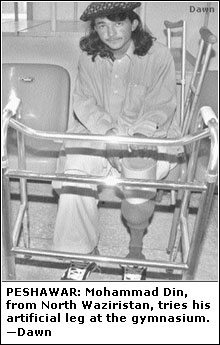 PESHAWAR, Oct 29: In a small gymnasium of Pakistan Institute of Prosthetic and Orthotic Sciences (Pipos) 17-year-old Mohammad Din sits on a chair waiting for his turn to get an artificial limb. Severe pain almost drained life out of him when a technician made the first attempt to put his amputated leg in the prosthesis.
“I went to the mountains hunting wild pigeons when a small bomb exploded under my feet near a security picket. I had my left leg chopped off,” said the boy. He did not know who had planted the ‘hidden killer’.
“I don’t know who buried the explosive there, but local people believe that it may have been the security forces,” he said.
The teenager is one of the victims of the bloody conflict going on in the North Waziristan Agency. He had come from Lawara Lataka village near Miramshah.
Another amputee, Jan Mohammad from Azam Warsak area of South Waziristan, was on gait training in the gymnasium. He had fallen prey to a landmine when clashes raged between foreign militants and tribesmen led by pro-government militant commander Maulvi Mohammad Nazir in April.
“I was taking water from a spring when a landmine went off,” recalled the 26-year-old, who was fighting along with Maulvi Nazir to flush out Uzbek militants from the area.
There was another young tribesman from the Darra Adamkhel Frontier Region, whose right leg had been cut off below the knee. He was shifting explosives when they went off accidentally, according to the victim.
“My family has borrowed Rs 40,000 for my treatment and has no money to pay for clinical charges,” says Mohammad Din.
Jan Mohammad is lucky to get free treatment in the Combined Military Hospital and he has received Rs40,000 as compensation from the military authorities, because he is a supporter of Maulvi Nazir.
But victims like Mohammad Din, who neither support the government nor the militants, have not been compensated.
The government is yet to launch any rehabilitation plan for the victims of the conflict which has claimed the lives of hundreds of innocent people. Scores of people have been maimed because of fighting and improvised explosive devices (IEDs).
On the other hand, international relief organisations have no access to the tribal area to collect data about the wounded people in order to help them and make arrangements for their rehabilitation.
Sources said that over 800 people wounded in the war had been treated during the past two years.
IEDs are the most commonly used weapons in Waziristan. Security personnel and tribesmen have fallen victim to these devices. Landmines, a legacy of the Afghan war, are also easily available in the region, maiming unsuspecting passers-by.
Mohammad Din arrived at Pipos one-and-a-half years after he was injured. He would get an artificial limb with financial assistance of the International Committee of the Red Cross (ICRC).
“ICRC has been providing technical, financial and medical assistance to the affected in Peshawar, Dera Ismail Khan, Tank and Bannu etc.,” said Humira Ahmad, legal adviser to the committee.
Doctors at Pipos said that the number of amputees was on the rise because violence had spilled over from Waziristan to other areas. Many affected people from remote areas do not reach Pipos as they lack information about the free help and there are others who cannot even afford transportation and other expenses.