



 0
0

Public parks shrink as businesses expand
Public parks whether natural, semi-natural or specially developed, are declared bounded areas of land set aside for some purpose, primarily as public places for recreation. Parks commonly resemble savannas or open woodlands, the types of landscape that human beings find most relaxing. Grass is typically grown to allow for the enjoyment of picnics and sporting activities. Trees are chosen for their beauty and to provide shade. This is the basic principle the world over and Pakistan is no exception.
City fathers used to allocate large tracts of land for the young and old to enable them to spend some spare time out of their busy schedules to relax and enjoy quality time in the open air and away from the four walls of their offices or homes to remain fit mentally and physically. Such public places are open to all and sundry without the divide of haves and have-nots, although recreation facilities like golf clubs and country clubs for the rich may have better facilities and maintenance.
Take for example the Islamabad Club or Rawalpindi Golf Course which have grown in size and developed extravagantly and are undoubtedly the beauty of the twin cities. The public parks in areas for the commoners in the twin cities of Rawalpindi- Islamabad, have reduced dramatically in number and size because such open spaces become readily available for encroachment by influential people, whether belonging to the government or to the private sector, in the name of development.
Liaquat Bagh, perhaps the city’s largest public park, has shrank to less than half of its size to what it was when the first prime minister of Pakistan, Liaquat Ali Khan, was assassinated here. Obviously, a site responsible for the death of the country’s founders ought to be punished. It has been encroached upon by Rescue 15 and MCB-sponsored ugly brown walls on the Murree Road side, by Rawalpindi Development Authority’s water supply service on the Liaquat Road side, and buildings developed for office use of RDA and the Press Club on the Nullah Leh side. All of these, great causes and in national or public interest, as you please. On its back, there used to be a beautiful municipal park always full of flowers and grass that has almost been sacrificed to another noble cause of construction of Rs17 billion expressway named after the only great leader of the city and for providing ‘hitch-free’ link between the old and new GHQ.
The case of the Jinnah Park near Rawalpindi courts and the GHQ, has been different. It is known as the hanging-site of the first elected prime minister of today’s Pakistan, Zulfikar Ali Bhutto. An expensive and large tract has been carved out of the park and allocated to a McDonalds to offer fast food to the growing mummy-daddy generation of the civil and military bureaucracy. Interestingly, a petrol pump just across the road could be closed for security reasons — and rightly so for having been used for attacks on the President of Pakistan — but a modern and liberal clientele of McDonald’s with tens of cars parked on the main busy road in the midst of security zone seem to pose no security threat. On the other side, a huge complex of five cinemas — Cineplex — is a welcome addition for the bored Pindiites but that too at the cost of a public park reduced to half its original size. The remaining half would possibly be taken over by the city managers for parking or some other ‘public good’.
Those who grew up in Rawalpindi can recall, for example, that there used to be a middle-sized public park in Satellite Town’s B-Block near Madni Masjid where children used to enjoy swings and slides not more than two decades ago. The facility is no more available to the residents. The self-proclaimed “Sir Syed of Rawalpindi” was kind enough to approve and construct a girls school in one corner and a degree college on the other side and in the process also took over the facility of community centre and got that amalgamated in the college building. A great public service for the daughters of the area! The cause was so ‘noble’ that nobody had the courage to object. In between the two educational institutions, one can now see the parking lot of the defunct Rawalpindi Municipal Corporation’s dumpers used for city’s garbage disposal. That too is a public service much more important than a public park.
Almost half of the Commercial Market Park and Nawaz Sharif Park in Rawalpindi have been converted into so-called amusement parks and given over to private parties to be run on commercial basis notwithstanding the fact that both facilities were developed out of public money for public purpose. Even the remaining halves of the two parks do not offer free access to the general public. The city managers who are paid out of the taxpayers money have handed over these facilities to private contractors who have themselves assumed the power of taxing the public. The rates of entry tickets have been arbitrarily doubled and set at Rs10 instead of five. Their upkeep is, however, far from satisfactory and some facilities have even turned hazardous like open holes, broken swings and rusted exercise facilities that were installed at public expense but were never properly maintained.
In the federal capital too, the likes of McDonalds, Hot Shots and Mini Golf clubs have all the freedom to slice off huge chunks of public parks as the authorities look away. Why can’t the poor multinationals like McDonalds afford to have their businesses set up at the corner of F-10 Markaz just outside western gate of Fatima Jinnah Park or western corner of Blue Area which happens to be just across the other side of the same park?
But then how could they get free publicity for violating state rules and earn names for bribing the bureaucracy and the political leadership. The question, however, remains whether as citizens we have given up our right to have more recreation facilities as the national kitty improves as claimed by our corporate prime minister who at the helm seems bent upon offering such facilities to multinationals in the name of attracting foreign direct investment. Are we going to enjoy the benefits of growth only by eating burgers at the cost of negative growth in civic and recreational facilities? Are we ready to let our public amenities be spoiled by uncontrolled development and for whom?.
Neighbourhood groups around the world are joining together to support local parks that have suffered from urban decay and government neglect. Rules are framed to make public parks readily accessible to the residents and public at large; to prevent use of public parks for personal or commercial or industrial use or storage of personal property which interferes with the rights of others to use the public parks for which they were intended; to provide equitable opportunities to use camp grounds through a reservation and enforcement system; to prevent abuse and misuse of public parks and facilities, especially to prohibit temporary or permanent housing. Why this is not the case in Pakistan or Rawalpindi-Islamabad for that matter?
Just peanuts
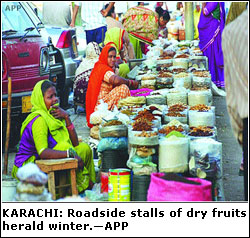 With the rocketing prices of dry fruits such as pine nuts and pistachios driving the common person nuts, it is the lowly peanut he or she is left with to munch on during chilly evenings.
And as the winds in Karachi are getting a little nippy during the evening, streets vendors may be seen at every nook and cranny of the city, with their pushcarts piled high with peanuts, rolling the pods in their sand-filled iron pots heated by kerosene or LPG stoves.
Peanuts can be bought at Rs120 to Rs150 a kilo, depending on the variety and area where they are sold.
The vendors buy peanuts in bulk at Jodia Bazaar, these days available at Rs3,000 to Rs3,500 for 40 kilograms. Pine nuts and pistachios are as expensive as Rs950 a kg.
Peanut seeds stripped of their thin reddish inner cover are also available in polythene bags at big stores. These are used as an additive in various dishes and bakery items.
Although peanuts are preferred roasted, some vendors burn them in the process, forcing buyers to demand them raw instead.
The peanut is cultivated at places throughout the country though it is not a very lucrative crop. Unlike chick-peas, or channa, it grows underground and its small plant withers away as the seeds along its roots gradually mature.
It is supposed to have originated in Central and South America, but its biggest producer now is China. As elsewhere in the world, Chinese peanuts have flooded Pakistani markets also. The Chinese variety has bigger pods and more seeds, and is rather expensive, but the local, smaller peanuts are far tastier.
Another reason for the popularity of peanuts is that the shell is easy to snap open. You may enjoy a handful while reading a magazine or watching TV, but think twice about fulfilling your peanut fix while driving.—Naseer Ahmad
Need for speed?
On an unfortunate afternoon when I was driving home through Sharea Faisal, another woman in a Khyber with visibly little control over her driving abilities happened to take the same road. Her control over the car’s speed and movements seemed to diminish with every passing moment and in a bid to overtake several cars and get into the first lane, not only did she badly hit a man on a motorcycle, making him practically fly off the vehicle, but also ended up hitting numerous other cars.
Eventually, her car halted for a few seconds but she was quick to start the car and took off at an even faster speed. Who would want to get caught for hitting the whole world and nearly killing someone? But then again, which dunce would be on Sharea Faisal when speed is something beyond their control?
I was hopping mad and wanted her to stop and explain what she had just pulled off. Quickly, my own and two other vehicles chased her and hounded her into stopping. At that moment it was what we felt we had to do or else she would have just run off. I got out of the car and so did the other two persons while the errant women driver refused to come out. I could not help screaming at her and asked her why she was on the road when she had no control over her car. To everyone’s shock, she smiled and said ghalati hogai (it was a mistake). One of the men suggested we let her off the hook since she was a lady. At this point I really lost it.
Being a woman is no excuse to behave irresponsibly. This is not only something for the men to realize but more importantly women should be the first to understand it. Anyway, I kept questioning her about her less-than-stellar driving skills, which caused her to burst into tears. Suddenly she came up with the excuse that her mother was on her deathbed and so she was in a hurry to reach her.
I didn’t buy it, but the other people actually believed her and suggested that we don’t call the police and let her go. I thought this was pathetic. Not once did she offer to do anything about the man she almost killed.
Gender is an excuse for nothing. One should drive carefully and respect the sanctity of human life.–Qurat ul ain S.
Poetry in motion
Though Karachi has many unique aspects to it, some of them are more unique than others. If you happen to have a keen eye for details, then there should be no doubt that the buses, rickshaws and taxis that we have in the city must be amazingly interesting, whether you are in them or watching them from the outside.
Not only is the glitter and gaudy body work eye-catching (or an eyesore, depending on your perception) but the poetic messages found on the interior and exterior of public transport vehicles serves as a sort of folk poetry, for in the words of Wordsworth, poetry is “the spontaneous overflow of powerful feelings.”
One of the most interesting couplets that I found on the back of a rickshaw was Soch tu ghor tu kar kitna tujhe chaha hai, hum tu apne bhi kabhi itne talabgar na they.
Though serious poetry buffs might baulk at the mention of these verses and they might not follow any meter or poetic rules, yet these verses pretty much reflect the driver’s experience and lifestyle.
There are quite a few phrases that do seem quite relevant to the bus culture and have funny underlying meanings as well such as Pappu yar tang na kar, Jalney walay tera moon kala, Haran de rasta le, Dekh magar pyar se etc. Similarly, one of the most interesting phrases written on the back of a rickshaw was Mein bara ho kay Pajero banoon ga.
A lot of money is also spent on the chamak patti and other decorations that spruce up buses.
Many commuters, including this writer, often wonder why the condition of buses is not improved instead of decorating them with these bells and whistles. But I guess transporters and the government just do not have enough will to change that state of affairs.–Meera Jamal
Compiled by Syed Hassan Ali
Email: karachian@dawn.com
The changing face of Islam in UK
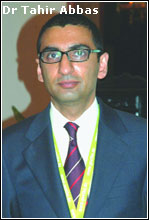 A fair chunk of academics have the tendency to clothe rather clear concepts in confusing claptrap, so much so that simple things become nearly incomprehensible to common people. But Dr Tahir Abbas of the University of Birmingham clearly does not belong to this group.
And as his lucid lecture, delivered recently at an international conference held in Karachi on world cultures and religions on the issues of integration showed, he discussed weighty matters in a style that was, well, almost conversational.
The good doctor is a reader in sociology and founding director of the University of Birmingham’s Centre for the Study of Ethnicity and Culture and has authored books on British Asians and British Islam. Himself a second-generation Muslim Briton, he spoke with a vision and clarity about issues affecting the British Muslims.
One of the particularly interesting comments he made was that the July 2005 bombings in London served as a sort of watershed event where a new generation of British Muslim leaders emerged.
“The new Muslim leadership are the ones that have evolved after the 7/7 experience. They are second and third generation individuals – men and women. They are people with professional backgrounds and degree-level qualifications, people who have a rooted experience in the British context and yet also an appreciation of the Islamic world.
“They’ve travelled and have read widely. It’s a different body of people; more savvy, intellectual and better organised. They are more open to working with other groups within the umbrella of Muslims than the first generation might have been, who were perhaps a little guilty of (having) more parochial and narrow interests,” said Dr Abbas.
Reports have surfaced in the press that the British state has sponsored an organisation of so-called British Sufi Muslims. This group’s Sufi credentials have been questioned and critics have labelled it a rather contrived set-up pushing an official agenda. With a bemused chuckle at the sound of this description, Dr Abbas replied thus about his thoughts on the organisation:
“I would not necessarily use those words myself. However, it is true that since 7/7 a number of organisations have been given an extra push by the state including the Sufi Muslim Council, but also the British Muslim Forum, British Muslims for Secular Democracy, the Progressive Muslims’ Association etc.
“I think it’s an attempt to bring on the next generation of leaders and to give them a sense of engagement within the state apparatus to broaden out the existing profile of engagement. Prior to 7/7 the focus was on the MCB (Muslim Council of Britain) predominantly, and the MCB was rather hastily created in 1997. It has had some impact but there have been some limitations,” he said.
There have also been quite a few Muslim groups in the UK which have preached a somewhat confrontational version of the faith. Yet they choose to remain in Britain rather than leave and resettle in the Muslim world, in many parts of which freedom of expression is almost non-existent. Does this not seem a little funny?
Citing the example of the British version of Hizbut Tahrir (HT), a group that claims the only solution to the Muslims world’s woes is the establishment of a trans-national caliphate, he says that: “In the UK, HT is very, very polished. After the events of 7/7, the utterances they have made in the media seem to be perfectly acceptable. In the background they have their ideology well-intact and they have their way of tapping into communities through various university societies and organisations, but their public face is reasonably acceptable from the point of view of how it’s perceived by the majority.
“In other parts of the western Europe they are banned, as in Egypt. So HT has this baggage for sure. And yes, perhaps if they feel the only solution is an Islamic caliphate and only that will solve the problems of Muslims, then perhaps being in Britain isn’t really the way forward for them,” said Dr Tahir Abbas.—QAM
Somersaulting Razzaq should be prepared to face the music now
TO many, Abdul Razzaq’s decision to reverse his self-imposed retirement from international cricket the other day may have come as a pleasant surprise. But there is more to it than meets the eye.
This unexpected volte-face from the all-rounder, who turns 28 in five weeks’ time, was not forthcoming, especially after his outrageous war of words - both against the Pakistan Cricket Board and its national selection committee — 13 days after he was overlooked for the inaugural World Twenty20 Championship in September.
Razzaq took the drastic course [of retiring] after the three-man selection committee, headed by Salahuddin Ahmed Sallu, unanimously agreed that he was neither at his peak nor ideally fit to merit inclusion in the South Africa-bound squad for the most grueling version of the game. Razzaq, however, despite his lack of performance — he averages 17.30 with the bat and took only 12 wickets at 39.33 in his last 15 One-day Internationals — took it for granted that he would be an automatic selection for the Twenty20 event.
Incensed, and perhaps disillusioned, the protesting all-rounder took a swipe at the selectors and accused them of “elbowing him out of international cricket”.
“I’m mentally disturbed over the treatment meted out by the selectors who treated me like a newcomer. I have taken this decision under protest since I also believe the selectors want to drop me from Tests and ODI cricket as well,” he said soon after quitting international cricket on Aug 20.
The disgruntled cricketer felt “hurt” when he pointed out that he had not received a word from the PCB since his decision to retire. “I’m deeply disappointed at the attitude of the [PCB] officials since no one bothered to contact me after I was dropped.”
To their credit, the selectors made it clear at the time that Razzaq was only being dropped for the Twenty20 Championship but would “definitely” be considered for both Tests and One-day International cricket later.
Not long afterwards, Razzaq added more fuel to the fire when he grumbled that as long as the current selectors and the cricket board officials were around, he would stick to his retirement.
Moreover, he opted not to sign the central contract offered by the PCB, and instead joined the breakaway Indian Cricket League (ICL).
But now that he has reversed his decision, it is being said in knowledgeable cricketing circles that, contrary to his version that his close friends persuaded him to retreat from his stance, it were his worst fears of isolation and a sad end to his career that compelled Razzaq to take a somersault.
Another reason for Razzaq eating his own words could be the recent vote of confidence given to Dr Nasim Ashraf for the next three years by President General Pervez Musharraf, the PCB’s patron-in-chief.
He could also be mindful about the dwindling future of the Indian Cricket League which may not even see the light of day after the Board of Control for Cricket in India (BCCI) successfully nullified its impact by announcing its own Indian Premier League.
The emergence of promising Sohail Tanvir as a potential threat to his throne as team’s prime all-rounder may also be playing on Razzaq’s mind. Sohail, the 22-year-old find of the World Twenty20 Championship last month, has definitely got the talent to become a genuine world-class all-rounder in the near future.
Razzaq may still have a lot to offer for Pakistan cricket, but his washing of dirty linen in public has surely not been forgotten nor overlooked by the cricket board. And with the board finally acting tough over the disciplinary issues which was amply evident in Shoaib Akhtar’s case, Razzaq should be prepared to face the music now that he has made himself available for national duty after creating a lot of bad blood in the first place.
| © DAWN Group of Newspapers, 2007 |



























