



 0
0

 KARACHI, Oct 25: The Human Organ Transplant Authority (HOTA) has allowed as many as 19 hospitals and institutions in Karachi, Lahore and Rawalpindi to carry out transplant activities on a temporary basis, without undertaking any physical inquiry of the manpower, equipment, specialised services and other relevant facilities.
This was disclosed by HOTA administrator Maj-Gen (retd) Abdul Qadir Usmani while speaking at a press conference at the Sindh Institute of Urology and Transplantation on Thursday.
He said the authority had received in all 19 applications from institutions, providing details about human resources, facilities and support facilities available with them, and granted interim registration to all of them.
According to Mr Usmani, HOTA, set up about a month back, had sent a pro-forma to 31 hospitals and institutions to fill in to get themselves registered in line with the provisions of the Transplantation of Human Organs and Tissues Ordinance 2007. However, besides the HOTA selected institutions some other health-care centres also downloaded the pro-forma from the health ministry’s website and submitted it for registration, it was added.
“Since HOTA is still in its infancy and is waiting for necessary finances and manpower for its working, it was deemed fit to defer the physical inquiry of the health premises in question and to issue interim certificates of recognition to all applicants, enabling them to practise operative surgery in transplantation of human organs or tissues,” the administrator said, adding that HOTA might begin the inspection visits in the next six or so weeks.
Referring to the apprehensions expressed during the conference that HOTA acting in a haste had also enlisted a few institutions which had earned a bad name in the past for their alleged corrupt or unethical practices in the name of kidney transplantation, Gen Usmani said there might be some weight in the apprehensions, but the authority’s problem was that it could not effect a law or impose any penalty retrospectively.
He said HOTA was required to entertain all cases and judge the performance of the transplant institutions under the organ transplant ordinance only. The accordance of registrations to 19 health institutions, including 12 from the private sector, was not a final decision and the list would be updated periodically by excluding or including institutions.
The administrator said that HOTA was also considering establishing three evaluation committees on a regional basis in Karachi, Lahore and Islamabad initially to ensure that no organ or tissue was retrieved from non-related living donors without its prior approval.
These committees, whose number could be increased in future, will also determine brain death of a person and examine the fitness or otherwise for transplantation of a human organ into another body.
Answering a question, he said a draft act on organ transplantation had already been sent to the national assembly for its consideration and enactment at the earliest; otherwise the prevailing transplant ordinance could also be revalidated by the president for a further period.
Those who also spoke at the press conference included Prof Farrukh A. Khan, president of the Transplantation Society of Pakistan, who said that those who could not afford the cost of any organ for transplantation would be helped through an exclusive fund.
In reply to a question about the chances of exploitation of patients by private hospitals, SIUT director Prof Adibul Hasan Rizvi said that the life of private organ transplant and dialysis centres depended on the performance of the government sector health facilities.
“We should improve the standard of the public sector health institutions and also ensure a national registry of transplants on a priority basis, which could help check many of the human organ transplant-related problems in the country,” he added.
Earlier during the day, a seminar on “Curbing commercialism and increasing transplant activity” was organised by the SIUT, which was also attended by senior doctors and members of the judiciary.
Prof Francis Delmonico of the International Transplant Society, USA, spoke about the success of ethical transplantation in the United States and held that the practice helped in increasing the availability of donor organs.
Prof Mehmet Haberal from Turkey spoke on the success of cadaver organ transplantation in his country, which has the law and infrastructure for retrieving organs.
Prof Faisal Shaheen, president of the Saudi Committee of Organ Transplantation, said that cadaver organ donation had been practised in Saudi Arabia for many years. Donation by deceased was allowed in Islam and it had been approved by almost all Muslim countries, he added.The other speakers, including federal health secretary Khushnood Lashari, lauded the role of the SIUT in what they termed a long battle in getting a set of laws on cadaver donations for the benefit of the people of the land.
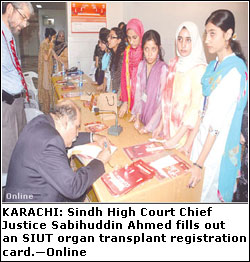
In the meantime, about 750 individuals from Karachi and other parts of the country, including medical professionals, members of civil society and the judiciary as well as SIUT employees, filled out a SIUT-prepared card at a ceremony on Thursday and committed themselves to donating their organs, said a spokesman for the SIUT.





























