0
0

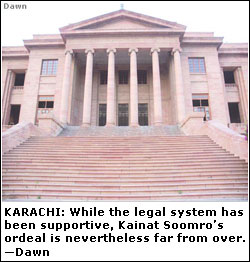 KARACHI: The suffering of Kainat Soomro was only beginning when, on January 10 this year, four men of Jatoi clan raped her. Heinous as that crime was, no less atrocious was the attitude of police officers as she sought to register a case against her assailants and seek some semblance of justice. In the months since then, 13-year-old Soomro and her family have had opportunities to settle the case out of court but the courageous girl and her supportive family refuse to accept anything less than justice, which they hope the courts will dispense.
A student of Class VIII, Soomro was abducted when she went to buy bangles for her niece from a nearby shop. The shopkeeper used anaesthetics to render her unconscious and “he and his fellows raped me for three consecutive days,” says Soomro in a choked voice. “Later, I was taken to another place where other men raped me.”
The young girl managed to escape and was brought back home by a driver who knew her father. In the relevant medical report, doctors confirmed that she had been raped yet the police, when approached, refused to take any steps in this regard. Soomro’s misfortune was doubled by the fact that her rapists were men who were influential in her hometown of Meharh in Dadu district.
‘No official help forthcoming’
The tragedy is that like many other victims of this crime, months after the attack it is still Soomro and her family who continue to suffer, rather than her assailants. Nearly a year later, she still awaits the court verdict while her entire family are threatened of dire consequences of their continued pursuance of the case.
“The police were never cooperative and initially refused to file a report,” complained Soomro. “My family and I went on hunger strike and held a protest demonstration for days, after which some notables took up our case.” Her statements were borne out by her father, Ghulam Nabi Soomro. “They refused point-blank to register the case,” he told Dawn, claiming that even after the case was filed, the police tried to force the family to agree to an out-of-court settlement.
With the help of her lawyer, Zia Awan, Soomro got her case transferred from Meharh to Karachi. “Our lives were in danger there,” she said as a tear trickled down her cheek. “We can’t live there any more.”
Indeed, society has much to answer for in terms of the continued ordeal being faced by Soomro and her family. The engagements of two of her sisters have been broken by the intended in-laws because “they don’t want to marry girls coming from such an ill-famed family,” explained Soomro. “The people of our area used to sympathise with us earlier but they have now been pressurised into going against us and telling us to quit our battle for justice since it has already brought enough trouble.”
Currently, Soomro and her parents live in Lyari where, thankfully, people are hardly aware of who they are.
While justice moves with its customary ponderousness, the media have in the past months taken up Soomro’s cause and the family feels that this has been invaluable. “Had it not been for the media, the police would not have been under any pressure to file my case,” said the young girl. “The investigation officer would not have been suspended. The media highlighted the issue and gave us hope.” Her father added that the court’s role has been no less supportive. “When the rapists claimed that she had married one of them, the courts termed this false evidence as null and void since my daughter is only 13 years old and marrying a minor is illegal in itself,” he told Dawn. “It was the court’s orders that helped us lodge the FIR.”
Support needed desperately
As they pin their hopes on the judiciary and the due course of the law, however, Soomo and her family have been reduced to dire financial straits. Before the crime was perpetrated against his daughter, Ghulam Nabi Soomro used to be the president of the transporters’ association and earned nearly Rs800/- a day. “Now, we are no better than gypsies,” he said bitterly. “We have no money and very soon, we will be without a house too.”
In the early days of their struggle for justice, the Soomro family were helped along by the NGO War Against Rape (WAR), which donated edible items worth Rs5,000 a month, while the Edhi Foundation provided them with a house. “Now, both WAR and Edhi say they cannot continue to support us,” said the family. “We don’t want a home or money for life, we just need support until justice is served and we can return home.” Ghulam Nabi added that “my children are no longer able to attend school and we are living in extreme conditions. Most importantly, the criminals who attacked my daughter must not go free since they may target somebody else.”
Despite the government’s many claims to having taken steps to curb violence against women and help the victims, the Soomro family’s experience shows an uncaring official attitude. “The government has done nothing so far,” they said bitterly. “Officials just talk big and do nothing; people like us suffer endlessly.” The family were promised infrastructural and financial support by the president of Pakistan, the chairman of the Senate and many others. To date, however, they have received nothing. Meanwhile, the young victim, one of Pakistan’s many, has been diagnosed with stones in both her kidneys but refuses treatment until she is avenged by the courts. “I don’t need a favour from anyone,” she maintained. “I merely want justice; I seek punishment for those who wronged me.” Since she was attacked, Soomro’s life has come to a standstill with no aim other than seeing her rapists behind bars. Kainaat Soomro’s ordeal is still far from over and even if the justice she seeks is dispensed, the horror of what she suffered will never quite leave her or her family. At the moment, however, she is finding that having found the courage to speak up against her victimisation, the road to justice is nevertheless lined with thorns. It remains the responsibility of state and society to ease Soomro’s burden and ensure that her belief in the power of the courts and the civil society was not misplaced.