



 0
0

In a culture of violence
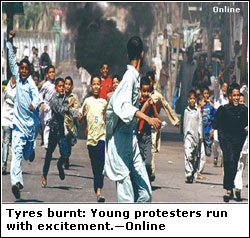 The public in general and those of us associated with the media in particular have become largely desensitized to tales and images soaked with blood and brutality. After the initial shock, we soon follow the events as keenly as we would a cricket match, as the nice people on TV give us the blow-by-blow.
The situation was pretty much similar as explosions rocked the People’s Party’s welcome parade for its formerly self-exiled leader Benazir Bhutto on Karachi’s Sharea Faisal a little after midnight on Friday, Oct 19, 2007.
The revelry seen throughout the day abruptly gave way to chilling scenes of chaos and disorder. But after the smoke cleared, another kind of chaos descended onto the city, though in bits and pieces.
As the new day dawned on Karachi, the city experienced a largely voluntary shutdown, with citizens taking the measures no doubt out of respect for the dead and injured, but, methinks, also out of fear of the unknown, lest the angry mobs decided to dispense blind justice in awami style and torch a few dozen petrol pumps or commercial establishments of choice in the process.
The shutdown extended to Saturday as well, while things inched towards normalcy on Sunday. However, one photograph this writer came across on the newswires on Saturday seemed to symbolise the senseless, periodic cycle of violence this society and this city seem to get stuck into.
As I believe pictures speak a thousand words, I’ll let the photo do the talking. Yet for the sake of clarity, these youngsters were ‘protesting,’ the attack on the PPP procession by burning tyres and preventing the flow of vehicular traffic, and seemed to be having a ball of a time doing it.
Nothing unusual about that. We are used to small-scale riots and acts of arson. That’s become part of the Karachi city-scape. And burnings and blockades happened throughout the city on Saturday wherever the PPP has supporters. The rage is understandable, but looking at the ages and smiles of joy on these pint-sized protesters’ faces, I, for one, was disturbed far more than when I saw the images of human remains after the bombings.
Why? There are several reasons. Firstly, what possible political cognisance could these kids, who look like they belong in primary school, have? Secondly, is disrupting civic life and instigating acts of violence the best form of protest for a civilised society to pursue? Violence begets more violence, and if these are the methods of protest these kids are adopting today, God help us when they choose to vent their rage upon attaining adulthood. But who’s to blame? Their parents? The government? The party? Society? I think all of us shoulder the blame.
When these children (the photo looks like it was taken in Lyari), have no access to clean water, healthy entertainment outlets, proper education and a peaceful environment, can they be blamed for turning into amateur arsonists?
When they’ve probably grown up watching their parents taking the same route to express their outrage when things turn ugly, what other avenues of lodging protests could they be aware of?
And when they see that peaceful protests get you nowhere whereas setting alight public and private property will almost instantly solve your power, water or other myriad problems, who needs fusty old pacifism?— QAM
Journalists’ security
The death of an ARY cameraman in the Oct 18 bomb attack has sparked a fresh wave of concern in the journalists’ community. Arif Khan was killed while covering PPP chairperson Benazir Bhutto’s homecoming when a suicide bomber blew himself up at Karsaz on Sharea Faisal close to her specially-built vehicle.
In the present competitive world of the electronic media, cameramen try to take the best and closest possible shots, exposing themselves to various dangers. It was reflected in the death of Mr Khan who might have travelled with the slow-moving convoy for a long time. A cameraman of DawnNews and some other journalists were also injured in the attack. Professionally, the luckiest of them all was the one whose camera was focused on the spot where the explosion occurred and managed to capture the blast on tape.
Reporters and photo-journalists cannot escape the hazards associated with their profession altogether. But in the current violence-ridden conditions, greater measures for their protection are needed. There should be official security in place for them and they should have better equipment to cover the event from a distance.
Besides, people exposed to danger should get better pay and perks as well as extensive life insurance coverage, as was suggested at a gathering on Saturday. Benazir Bhutto has also echoed this demand.—NA
Aesthetic sense
There was a time, which now seems eons ago, when Karachi used to look beautiful with its trees of various species. Now, most of the trees have been removed while the government has taken little notice. It is a pity that the government says one thing — “plant trees” — while it does, or for that matter allows, exactly the opposite: their removal.
Very recently I saw at least a dozen big trees near Purani Numaish, in the vicinity of Quaid-i-Azam’s mausoleum, whose tops had been axed off, leaving them looking like ugly headless giants. Where was the need to do this, as many trees in this metropolis had already been uprooted and destroyed during the thunderstorms and rains in July this year?
It was only last year that I had seen many trees being denuded in North Nazimabad. A journalist friend who lives there told me that the government turned a blind eye to all of this.
When trees are shorn, it not only gives the locality a barren look but also deprives it of its aesthetic beauty, which had been brought by the flowers of various colours and verdant leaves. Besides, some flowers and leaves have their own distinct smell. But the worst that is done by cutting and destroying these trees is that the habitat and food of countless species of birds is destroyed. Many birds build their nests in these trees, where they lay their eggs and take care of their chicks. Several also get their food through the nectar from flowers and fruits and nuts that grow on these trees.
There is a good likelihood that with the destruction of these trees we are also destroying the population of various species of birds or at least minimising it to a great extent.
Whenever it rains, the trees seem to turn brand new and bring a smile to our forlorn faces. The chirping of birds and the flitting of squirrels adds further to our happiness. But it seems that those in power have other things in mind. I wonder when better sense will prevail and the trees, birds and squirrels will be left alone. — Mohsin Maqbool Elahi
Compiled by Syed Hassan Ali
Email: karachian@dawn.com
Who paid for the costly Salam?
The misuse of public money for personal gains has re-emerged in the federal capital with the start of the election season. The open, blatant and gross misuse of government money is there for everyone to see but no one seems to notice and challenge the trend. The common man who pays the taxes can do little to stop his hard-earned money being spent with reckless abandon to prop up the electoral fortunes of a selected group.
The one-sided election early this month of President General Pervez Musharraf for another term set the stage for the publicity campaign with a full page “Salam Pakistan” coloured advertisement in national dailies. The provincial governments followed suit with the likes of har qadam - khushali ki taraf (every step towards prosperity), and gifts from such and such government for the people, as if these were paid for by a chief minister out of his own pocket.
One may not be surprised to see school buildings constructed with government funds being used for private businesses in many parts of the country. It is not just federal and provincial governments either. Even district and local governments are putting up big signboards everywhere claiming that they are making a road, developing a street or fixing a tubewell. Isn’t that what the devolved governments are supposed to do and paid for?
“What we have here is institutionalised tort and institutionalised injustice, nothing less,” commented a senior government official adding that except fuming from inside there was nothing they could do to challenge or stop such a state of affairs because everything was deeply entrenched in the system.
The official media — Radio Pakistan and Pakistan Television — was once used to be criticised for one-sided government propaganda despite being run on public money. That criticism was now out of fashion as the distinction between use and misuse of public moneys was not made any more.
Almost all the traditional checks and balances have either been weakened or side-stepped. A host of parliamentary committees practically play no role to check misuse of public money and public accounts committee concludes its deliberations by regularising irregular expenditures while we, the private media — both print and electronic — by complicity, become part of the game. The voters who become tools in the elections are powerless against the massive propaganda campaigns run on money taken from them that could be much better spent on health, education, welfare or defence.
The government has many legitimate avenues to inform the public about the things they are doing for them and publicise the outcome of its policies and “the lists of goods” they have delivered, like the increase in GDP, reduction in poverty and improvement in living standards of the common people. But mostly these expenditures are made for self promotion and party projection at the cost of the common people.
“Taxpayers’ money should not be used in this partisan way to prop up the interests of one individual, a party or a conglomerate of parties set to benefit jointly,” says a government official who used to teach “public policy” at the Pakistan Administrative Staff College. And it sounds hypercritical when the government introduces National Reconciliation Ordinance to withdraw all corruption cases with one stroke to prolong presidential tenure and yet the prime ministers asks the people to “defeat corrupt elements and plunderers of the national exchequer” by using the power of their vote most judiciously in the general elections.
In theory, the governments are formed by the people in the hope that such big establishments will protect their common interests and protect them from predators. The people vote and pay taxes in the hope that the money will be used wisely for common benefit and not to harm them or to reward those who harm them. In Pakistan, however, these hopes falter repeatedly when the control mechanisms fail and the opposite happens and those in power misuse their taxes for personal gains and protect misdeeds of past and present to safeguard their own future. As the saying goes “There is no art which one government sooner learns of another than that of draining money from the pockets of the people”. Is it not like stealing the people of their money and using it against them.
Until a few years ago, civil servants were penalised for using official cars for personal use. Today, it is a recognised norm that official facilities could be used for private purposes. Official cars are in use of civil servants as junior as grade-17 and 18 although they are not entitled to such facility under the rules and those entitled to one staff car are using three on an average.
In its real sense, the misuse of public funds starts when public funds are not expended for an authorised public purpose and expenditure is only made for a public purpose when its benefit to the public or the public interest is established rather than private purposes and private individuals. It is for common wisdom to judge if a large picture of a military ruler (Pervez Musharraf) saying “Salam Pakistan” or a group of rulers (Musharraf, Shaukat Aziz, Shujaat Hussain and Pervez Elahi) claiming “every step towards prosperity”, has a public purpose or private purpose but definitely these ads are paid out of public money raised through regressive taxes on petroleum products, personal incomes and even on purchase of eatables.
But then the people have given up their basic right to protest against misuse of public funds. Individuals who until recently served the government and remained part of unauthorised expenditures have been made to lead organisations like Auditor General of Pakistan and National Accountability Bureau. Can they be the judge of their own deeds?
| © DAWN Group of Newspapers, 2007 |


























