



 0
0

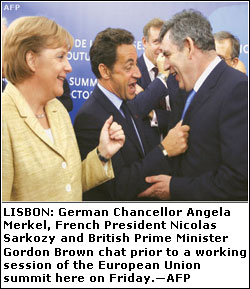 LISBON, Oct 19: EU leaders broke more than two years of political deadlock on Friday morning by approving a new treaty of reforms filling the void left by the bloc’s aborted constitution.
The European Union’s Portuguese presidency said the agreement closed the chapter on a crisis that has gripped the EU since French and Dutch voters rejected the proposed constitution in mid-2005.
“With this accord Europe has emerged from its institutional crisis,” Portuguese Prime Minister Jose Socrates told journalists shortly after the deal was clinched at a Lisbon summit.
Mr Socrates said that leaders would formally sign what will become the treaty of Lisbon in the Portuguese capital on Dec 13.
The treaty aims to give the first serious update to the EU’s decision-making architecture since 10 mostly former communist countries joined in May 2004 followed by Bulgaria and Romania in January this year.
“In this case we’re really talking about a historic agreement and it really gives the European Union a capacity to act in the 21st century,” European Commission chief Jose Manuel Barroso said.
EU leaders sealed the deal after overcoming Polish and Italian gripes about the treaty in last-minute wrangling on the sidelines of the two-day summit which opened on Thursday.
Poland had threatened to veto the deal if the treaty does not give authority to the so-called “Ioannina” mechanism, named after the Greek city where it was agreed upon, which allows a minority of nations to temporarily block EU decisions. But after tough bargaining, President Lech Kaczynski said that “Poland got everything it wanted. I’m very happy this business is behind us.”—AFP




























