



 0
0

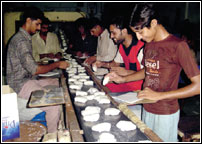 Despite an onslaught of multinational companies (MNCs) in soap manufacturing industry, Gujranwala’s local soap industry is flourishing day by day and penetrating not only the local but other markets of the country.
The local soap industry has almost captured the laundry soap market and now heading to outshine MNCs in beauty, detergent bar and washing powder markets.
Within four years, the number of local soap factories has increased from 30 to 50, including four big units, while two new big units are under construction, thus increasing direct labour from 200 families to 1,000 families and indirect labour from 4,000 families to 6,000 families.
Similarly, number of soap selling outlets has increased from 1,700 to 3,200 with a 30 per cent annual growth and number of retailers has increased from 60 to 160.
Iqbal Jarral, who has been an engineer of the soap industry for the last 26 years, told Dawn that the local soap industry’s daily production had increased from 1,000 tons to 5,000 tons, including 4,000 tons laundry soap, 900 tons toilet soap and 100 tons detergent bar.
He said the overall local monthly demand was 2,000 tons, being met 10 per cent by the local industry, 40 per cent by national and 50 per cent by the MNCs, while the 80 per cent of the local laundry demand was being met by the local industry.
He said the local industry had brought the MNCs’ sale to the lowest level and national industries’ to 20 per cent of monthly 1,500 tons demand of laundry soap in the local market by increasing its market share from 40 per cent to 80 per cent, and within next five years more than 90 per cent of local laundry market would be captured by the local industry.
He said the local industry was lagging behind in toilet (beauty) soap as its share in the local market was just 30 per cent of the monthly local demand of 500 tons because of refined quality of MNCs’ products and a lack of finishing machines in the local industry.
He said the local industry’s share of detergent bar in Gujranwala market had risen from zero to 30 per cent of a monthly demand of 150 tons within four years when Gujranwala had no detergent powder manufacturing unit to meet the Rs25 million monthly local demands.
He said the industry had a competitive edge of getting raw material, including caustic soda, sodium silicate and cottonseed oil from Pakistan, while the price fluctuations of the imported raw material, including palm oil, coconut oil, perfumes and palm kernal oil, had affected the growth of the local industry.
He said obsolete technology had been the main hindrance in growth of the local industry in beauty soap and detergent bar manufacturing, but now the industrialists were equipping their factories with modern technology to compete with multinationals.
Hanif Butt, a local industrialist launching a new soap plant worth Rs100 million, told Dawn that he would try to outclass MNCs in beauty soap, detergent bar and detergent powder market by manufacturing high-quality products and launching strong marketing and economical skills.
Anees Butt, the owner of a soap industry, said a hike in prices of raw material increased the overhead charges and soap prices of MNCs, but the local industry decreased its profit margins to get more market share and installation of the latest technology. He said this would enable the local industry to counter the high quality competitive edge of MNCs especially in manufacturing beauty soap.
He said many small units were making detergent powders in Gujranwala, but its increasing demand had fascinated many industrialists and within the next two years the local soap factories would give a tough time to MNCs by producing high-quality and cheap detergent powders.



























