0
0

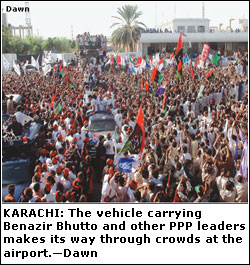 KARACHI, Oct 18: Stock prices soared at the Karachi Stock Exchange on Thursday with the KSE-100 index closing 165 points up, which many market participants attributed more to the celebration of a possible ‘stability’ of the economic policies and less to the fondness for former prime minister Benazir Bhutto.
The market remained bullish the whole day, which was quite in contrast to the return of another former prime minister, Nawaz Sharif, on Sept 10. Interestingly, the stock market that day gave a cool reception to Mr Sharif, with an 187 points decline until he was sent back to Saudi Arabia. As the Sharif’s plane rose from the runway of the Islamabad airport that day, the KSE index soared by 250 points.
Stockbroker-turned-investment banker Arif Habib distinguishes the two. “The Sept 10 event was feared by the investment community to have the potential of generating ‘controversy’ while Thursday’s development has been taken to be a step forward to building of consensus,” he said and added that for all his faults, the economic policies of President Gen Pervez Musharaff had been looked upon favourably by the market.
He was also more charitable to other major political parties. “Both the Pakistan People’s Party and Pakistan Muslim League (Nawaz) have been advocates of free-market economy and have promoted foreign investment and privatisation during their terms in office,” says Mr. Habib.
Several analysts thought that the arrival of Ms Bhutto could ensure continuity of the economic system and dispel a good deal of uncertainty that had shrouded the country for the last many months.
Sartaj Aziz, who was the finance minister in the Sharif government, admitted: “Stability is of relevance”.
He said that the business people were charmed by ‘stability’ and an absence of uncertainty. They possibly saw the upcoming political transition as a sign of things remaining the same, but he cautions: “The broader dispensation may not be that easy to put together.”
He also argued that the stock market had always rallied on the change of government since investors put their faith in continuity of policies.
In comparing the return of the two former prime ministers, Prof Iqbal Ismail, a veteran stockbroker was more straightforward: “In the first instance the arrival on Sept 10 raised the level of tension in the minds of investors and in the second instance on Thursday, the investing public was relieved of the stress”, he says.
Muzammil Aslam, group economist KASB Securities, stated that the arrival of Ms Bhutto was under a process of understanding, termed ‘deal’ with General Musharraf, while the PML-N leader was thought by the business community to have returned with a different mindset, aimed at uprooting the present government through use of force, which could have led to street riots.
He says: “The strong economic fundamentals have been complemented by political ease as a result of which the markets have rallied”.
Many analysts subscribed to that view, believing that although the sharing of power between the leader of Pakistan’s biggest political party and the army looked like an ‘unnatural proposition’, many of the primary concerns of the market had, nonetheless, been addressed. “Barring the few cases in the Supreme Court, what else remains to clear the uncertainty that has plagued the market?” asks one analyst.
Many market participants thought that the process of privatisation of major entities which had been put on hold could now start afresh. One analyst said that a part of the reason for the current bull-run in the equity market could be the flow of liquidity in all emerging markets, including Pakistan’s, following interest rate reduction in the US. He expected a greater inflow into the Pakistani bourses with the reduction in the country’s political risk premium.