



 0
0

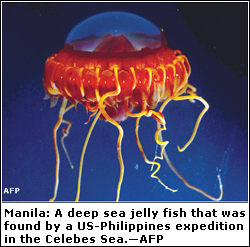 MANILA (Philippines): US and Philippine scientists may have discovered new marine species in the world’s most biologically diverse region, their expedition leader said on Tuesday.
Dr Larry Madin, who led the Inner Space Speciation Project in the Celebes Sea south of the Philippines, said scientists had been to one of the world’s deep ocean basins in search of organisms that may have been isolated there for millions of years.
Madin, of the Massachusetts-based Woods Hole Oceanographic Institution, or WHOI, said the Celebes Sea is at the heart of the ‘coral triangle’ bordered by the Philippines, Malaysia and Indonesia – a region recognised by scientists as having the greatest degree of biological diversity of the coral reef community of fish and other marine life.
The deepest part of the Celebes Sea is 5,000 meters. The team was able to explore to a depth of 2,800 meters using a remotely operated camera.
“This is probably the centre where many of the species evolved and spread to other parts of the ocean, so it’s going back to the source in many ways,” he told a group of journalists, government officials, students and US Ambassador Kristie Kenney and her staff.
Madin led the project that involved WHOI and National Geographic Magazine in cooperation with the Philippine government, which also provided the exploration ship.
The expedition included over two dozen US and Philippine Scientists and a group from National Geographic, including underwater photographer Emory Kristof who teamed with noted underwater explorer Robert Ballard of WHOI in 1985 to find the wreckage of the Titanic.
The team returned to Manila on Tuesday after spending about two weeks in the Celebes Sea off Tawi-Tawi, the Philippines southernmost provincial archipelago. Madin said they had collected about 100 different specimens, including several possibly newly-discovered species.—AP





























