



 0
0

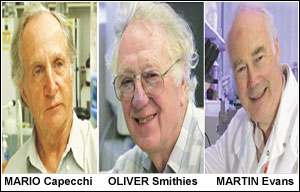 STOCKHOLM, Oct 8: Mario Capecchi and Oliver Smithies of the United States and Martin Evans of Britain won the Nobel Prize for Medicine on Monday for their work in creating ‘knockout mice,’ the 21st-century test bed for biomedical research.
The trio were honoured for discovering how to genetically manipulate mouse embryonic stem cells, leading to lab rodents that replicated human disease, the Nobel jury said in its citation.
Their “ground-breaking discoveries concerning embryonic stem cells and DNA recombination in mammals... led to the creation of an immensely powerful technology,” the committee said.
The discovery is technically called gene targeting but is commonly known as gene ‘knockout’. Engineered mice provided researchers with a lab model that yielded insights into the fundamentals of diseases ranging from Alzheimer’s to cancer and the response to new drugs, the jury said.
Thanks to their work, scientists could now determine the role of specific genes, a breakthrough that had ‘revolutionized life science,’ it said.
“Gene targeting in mice has pervaded all fields of biomedicine. Its impact on the understanding of gene function and its benefits to mankind will continue to increase over many years to come.” To date more than 10,000 mice genes -- approximately half of the genes in the mammalian genome -- have been knocked out.
Disabling, or knocking out, a gene is a two-step process. The first is to snip out a functioning gene from the animal’s genome, using chemical ‘scissors’ such as an enzyme. The next is to replace that gene with the modified one -- the gene whose flaws will cause the disease to be studied.
The big challenge is getting this introduced stretch of DNA to find the corresponding slot in the chromosome and then fit in snugly.
Little more than two decades ago, the prevailing wisdom was that the task was impossible in mammalian cells and that the DNA would insert itself in the chromosome almost randomly.
The Nobel laureates found a way to do this. In the 1980s, Evans isolated mice embryonic stem cells -- the all-purpose master cells whose manipulation could create in theory any mutation of choice.
In the meantime, Capecchi and Smithies, working independently of each other, found a way to target genes by a technique called ‘homologous recombination’. ‘Homologous’ means that the introduced DNA sequence lines up with its mirror target sequence in the mouse chromosome, while ‘recombination’ means the incoming and target sequences break and then rejoin.
“The award is very exciting and particularly appropriate,” observed Steve Brown, a leading scientist at the Mammalian Genetics Unit of Britain’s Medical Research Council (MRC).
“Our ability to knock out -- to lose the function -- of a gene in the mouse genome has been absolutely critical in understanding the genetic basis of human disease in all areas.”
Evans, born in 1941 and knighted by Queen Elizabeth II, is the director of the School of Biosciences and professor of mammalian genetics at Cardiff University in Britain.
Italian-born Capecchi, who celebrated his 70th birthday on Saturday, is a human genetics and biology professor at the University of Utah, while British-born Smithies, 82, is a professor of pathology at the University of North Carolina.
The physics prize is to be announced on Tuesday followed by the chemistry prize on Wednesday. The literature prize will be announced on Thursday and the peace prize on Friday. The economics prize wraps up the season on Oct 15.
The award ceremony will take place in Stockholm on Dec 10.—AFP





























