0
0

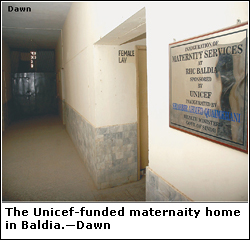 KARACHI, Oct 7: For the executers of the Women’s Right to Life and Health – a Unicef project being run in the city – Baldia Rural Health Centre’s experience was a sheer disappointment. Despite their best efforts and support with provision of all required facilities for basic obstetric care last year, the health unit has failed to launch maternity services.
Located in UC-7 of Baldia Town, the health centre was founded in 1980s as a dispensary. Since there was no maternity home or government hospital in the town, the health centre was envisaged to deliver maternity services. Though rooms for doctors, nurses and patients were built on the first floor of the building in later years, the project owing to official neglect could not be completed.
Last year, Unicef extended its support to the health centre under its project, Women’s Right to Life and Health (WRLH), which was aimed at improving the status of maternal and newborn health by helping the existing government health units remove lacunas and ensure maternity services available to local population round the clock.
Under the project, being run in 12 hospitals and maternity homes, support was provided in all problematic areas that had remained an obstacle in the provision of maternity services. That included a labour room equipped with all necessary paraphernalia, for instance, delivery tables, oxygen cylinders, surgical equipment, trolleys, a baby warmer, a suction machine, bedside screen as well as a stretcher and a wheel chair.
To solve the chronic problem of water shortage at the health unit, a fiber water tank was installed. The international donor agency also provided support in renovation of the building, setting up a private ward, deputing two midwives and arranging monthly visit of a gynaecologist who could motivate and guide the staff properly. Despite the donor agency’s heavy investment of financial and human resources, Baldia Rural Health Centre failed to have a single delivery and made little progress.
Former project manager Mumtaz Ahmed said: “For us, Baldia RHC experience is an utter failure. We tried to fulfill all their needs, but the result was naught. There is a need to ponder why an adjacent private hospital successfully runs maternity services while this health unit has failed to have a single delivery despite having a strong government-foreign donor’s assistance for a complete year,” he observed.
Reasons of failure
Elaborating upon the reasons why the project couldn’t take off, WRLH Project Director Dr Shershah Syed said the government didn’t provide them with the skeleton staff needed to run the maternity home, a problem common at all maternity homes of the city.
“We are failing to run maternity homes in Sindh because of government’s lack of political will. The government is too busy in mega projects and seems to have no interest in improving the health status of the poor women,” he said.
Support withdrawn
Upon seeing no progress, the WRLH eventually withdrew its support some months ago. One midwife has already left the place on finding a better job since her expertise were not being utilised here.
Today, the two-floor building of health centre with a plenty of locked rooms stands as an evidence of wasted resources. One can still see the plaque placed on the first floor announcing the inauguration of maternity services by former health minister Shabbir Ahmed Qaimkhani.
With an average of 45 patients at the OPD daily, the health centre offers little to the poor who have to spend a lot of money on diagnosis and treatment at private concerns.
Shouldering burden
When asked about the state of affairs, Baldia Town Health Officer Dr Arif Niaz admitted that shortage of staff was the real problem. However, he said, the RHC was the only dispensary in the entire town whose SNE (Schedule for New Expenditure) had been approved. The SNEs for four other government health units in the town still await approval. Thus, the budget allocated and doctors and staff deputed for this health centre were distributed among all the rest.
“I have been trying for years to get the SNE of other government health units approved, but to no avail,” he regretted.
The health officer said though a hospital structure was constructed in the area he was not sure when the project would complete and the hospital would be functional.
Demanding immediate approval of SNEs and timely delivery of medicine stocks, he said, “We appeal to the government to get the four health units, under the occupation of Rangers and some nazims, vacated so that public could get relief as the town having about 800,000 population had no other government hospital and maternity home.”