



 0
0

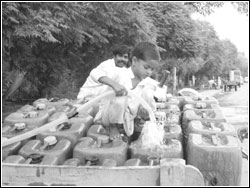 FAISALABAD, Oct 6: The business of water vendors is on a surge after the City District Government and Water and Sanitation Agency (Wasa) failed to supply potable water to residents throughout the district, particularly in the city area.
The district has a population of six million people and is a hub of textile industry. Its mercantile activities contribute substantially to the national economy, but in the return people are yet facing acute dearth of drinking water supply.
They complain that water being supplied by Wasa and other agencies is injurious to health because of its outdated and rusty pipelines and perforated drainage system causing a persistent mix-up of drain and clean water. Also, sewerage system sometimes collapses and grubby water inundates various localities, leaving the underground water unfit for human consumption and the citizens exposed to the outbreak of gastrointestitis, diarrhoea and such other diseases.
Current production capacity of water in Faisalabad is 65 million gallons per day (MGD) suctioned from wells located in the old bed of River Chenab. Water is then pumped from this field to a reservoir near Sargodha Road from where it is supplied to consumers for at an average of six hours a day.
However, most dwellers have started buying water from vendors, who fetch water from private motors installed along the canal on Sumandari Road.
Despite repeated announcements by Wasa that water being supplied by it is safe and fit for human consumption, people seem frightened and reluctant to put their faith in such claims. Thus, the masses prefer consuming water being supplied by private vendors, causing a swift boom in this newly-emerged business.
Several private entrepreneurs have installed pumps along the canal road. They have also employed youth to deliver water canes at customers’ doorsteps. Donkey carts and motorcycle rickshaws are major means of transportation of water canes from pumps to the city areas. A 15-litre gallon is being sold at Rs20 at pumps on canal road while at Rs 30 at the customers’ doorstep.
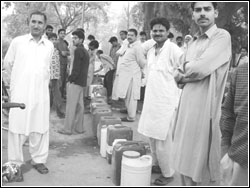 The water suction motors are installed with the help of shopkeepers running their businesses on the canal road while Faisalabad Electricity Supply Company facilitates the entrepreneurs by allowing them to hang their electricity metres on trees.
Nasir Habib, who sells water on a donkey-cart, says his business is flourishing every passing day.
“Earlier, I was jobless. Somebody then tipped me about this business. Now I can earn a handsome amount as my clientage has increased and I have employed two boys to supply water to customers at their doorstep,” he said.
Apart from Nasir, there are several others engaged in this business, which is likely to witness more boost in the near future.
The vendors have displayed their rate lists on their carts or transport vehicles with claims of supplying fresh water. Some of them also use loudspeakers to inform the people about their arrival in the area so that most of the people benefit from the facility.
Taps installed by the University of Agriculture Faisalabad (UAF) are another source of clean drinking water for residents of Gulberg, Ghulam Mohammad Abad, Awami Colony, Mohammadpura, Gobindpura, Raja Town and other localities.
The UAF administration, however, charges nothing as its officials are of the view that in this way they are serving the humanity and indeed earning the blessings of Allah Almighty.
On the other hand, condition of rural areas is much pathetic as compared to the city areas and residents of four newly-created towns-Tandlianwala, Jhumra, Samundri and Jaranwala-are yet relying largely on brackish groundwater as majority of their villages don’t have piped water supply facility.
There are about 820 villages in the district of which 700 are in underneath belt of brackish groundwater and only 150 villages have piped water supply schemes. A few villages are being supplied potable water with the Asian Development Bank-funded Punjab Community Water Supply and Sanitation Project.
Nearly, 65 per cent of the villages have no access to potable drinking water and their dwellers have no option except to consume salty groundwater.
The polluted water supplied by Wasa claimed the lives of 11 people, including five children, on May 17, 2006 in Ghulam Mohammadabad in the vicinity of D-Block while scores of gastro victims were also taken to hospitals and private clinics in next few days. Four people also expired in Roshan Sani, a village in Jaranwala town, from where Federal Minister for Privatisation Wasi Zafar and Punjab Minister for Communication and Works Chaudhary Zaheer have been elected.
District Nazim Rana Zahid Tauseef had admitted that brackish water was the cause of these deaths. He had also confessed that scores of inmates in the district prison had no access to potable water.
The city district government has done nothing to restore public confidence, persuading them to fearlessly consume water being supplied by Wasa.
Wasa Director Resources Khadim Hussain told Dawn that the agency was supplying 10 MGD water to its consumers thrice a day. “We have installed 17 tube-wells on Rakh Canal Branch and 29 on Chenab well field area to supply potable water to citizens.”
Regarding surge in the business of water vendors, he said most of the people like to have bottled water and that’s why they might have lost their trust in water being supplied by Wasa.
However, he said all Wasa staff members use the same water they were supplying to the consumers.


























