0
0

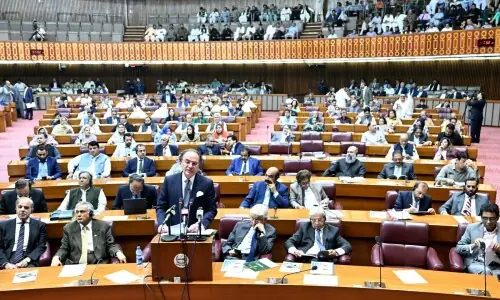
ISLAMABAD, Oct 4: A limping National Assembly on Thursday seemed forced by a fast changing political scenario to wait for what could be a swansong session before a controversial presidential vote and its demise.
The lower house was earlier due to meet on Thursday morning with its first task being a formality to allow the use of its chamber for the Oct 6 presidential election.
But the planned session, despite the date given by Speaker Chaudhry Amir Hussain and ministers – though no formal presidential order was issued – failed to take place as things moved fast on political and legal fronts, including raised hopes for a political package offered to the Pakistan People’s Party and the Supreme Court hearings of challenges to President Pervez Musharraf’s candidacy for another term.
The 342-seat lower house is the core of the 1,170-member, but 702-vote, presidential electoral college that also includes the 100-seat Senate and four provincial assemblies, but was truncated by the resignation of about 85 members of parties seeking to block General Musharraf’s election.No official explanation was immediately available for not holding the session on Thursday, nor another date was given although ruling coalition members forming a majority in the house were present in the capital in anticipation of what could be the last business of the house before it completes its five-year term on Nov 15.
But political sources said the government seemed to be waiting for PPP’s final response to a proposed national reconciliation ordinance negotiated with PPP chairperson and former prime minister Benazir Bhutto and an expected decision on Friday by a 10-judge Supreme Court bench on a demand by two rival presidential candidates – PPP’s Makhdoom Amin Fahim and former Supreme Court judge Wajihuddin Ahmed – to stay the Oct 6 vote before ruling on General Musharraf’s alleged disqualifications.
While the presidential decree, likely to meet some of the major PPP demands for what the party calls a smooth transition to full democracy, was still being awaited, it could not be issued while the National Assembly was in session, in which case the package must come in the shape of bill requiring a long procedure for its passage by both houses of parliament to become effective as law.
If the court did not issue a stay order, the president could summon the National Assembly to meet early on Saturday just before the start of the presidential election to pass a resolution to allow the vote by its members and those of the Senate to be held in the lower house chamber from 10am to 3pm, the sources said.
Since other opposition parties grouped in the All Parties Democratic Movement have opted out of the vote to deprive it of legitimacy, the PPP parliamentary groups in the National Assembly and the four provincial assemblies are to meet in Islamabad and their respective provincial capitals to be told of their party’s response to the reconciliation ordinance after receiving the government draft.
Ms Bhutto said in London on Thursday after chairing a meeting of the PPP central executive committee and the federal council that her party would not resign from the assemblies if it were satisfied with the ordinance but would not vote for President Musharraf either because of his being in uniform as army chief.
The government’s preoccupation with the presidential election has been responsible for the delay in National Assembly session already having faltered on a mandatory calendar this year as no time is now left for completing 130 “working days” of being in session in a parliamentary year as required by the Constitution. After having been in session only for 78 days, it remains short of 52 days with only 42 days of its life left until Nov 15.