0
0

 JOHANNESBURG: An accident that trapped thousands of workers deep inside a gold mine may energise South Africa’s powerful labour movement, hardening its resolve to win concessions from business and tilt government to the left.
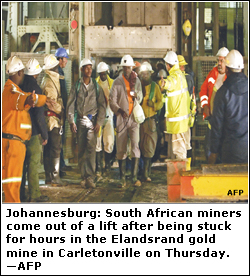
Unions, emboldened by a wave of strikes that have disrupted the South African economy and shaken the ruling African National Congress, on Thursday seized upon the incident at Elandsrand mine outside Johannesburg to push for a better deal for workers.Some 3,200 miners were stranded underground at the Harmony Gold operation on Wednesday when a lift cable was cut.
Rescue crews laboured through the night to save the workers and had reached more than half the group by Thursday afternoon.
There have been no reports of deaths.
The National Union of Mineworkers (NUM) was quick to attribute the mishap to corporate negligence, accusing Harmony, the world’s fifth largest gold miner, of endangering safety by running a 24-hour operation.
Harmony dismissed the allegations of negligence, describing the accident as a wake-up call for the company and the country.
The ANC, under pressure from leftist allies to return to the socialist principles that marked its apartheid-era programme, sensed the mood and weighed in, expressing concern about reports of poor conditions and maintenance at the site in Carletonville.“If true, this puts the spotlight again on the crucial question of safety in our mines,” the party said in a statement.
Officials with the Congress of South African Trade Unions (COSATU), the largest labour federation in the country, were not immediately available for comment. They were busy in a meeting to decide the future of COSATU President Willy Madisha.
It is expected that Madisha, a relative moderate who is seen by trade unionists as too friendly with President Thabo Mbeki’s government, will be replaced by a more radical leadership.
RED FLAG OVER RAINBOW NATION?
Labour’s growing militancy in South Africa has been spurred by a belief that the interests of workers, the unemployed and the poor have been sidelined in favour of policies benefiting the business community and a predominantly white elite.
The African powerhouse’s resource-heavy economy has boomed under Mbeki, growing at five per cent in 2006 and expected to come close to that mark again this year. Yet millions live on the margins with poor government services.
Even those with relatively well-paid jobs are finding it hard to make ends meet. Inflation — the annual rate has risen out of the central bank’s 3 per cent to 6 per cent targeted band — has made milk and other commodities less affordable for many.
Workers have vented their anger in the streets, demanding large pay increases and improved benefits. A strike by public servants earlier this year saw tens of thousands walk off the job. Hospitals and schools were brought to a near standstill.
Political analyst Keith Gottschalk said the lengthy industrial disputes and increasingly strident anti-government protests were connected to the labour movement’s sense it had been sideline by Mbeki after struggling to put the ANC in power.
“COSATU and the unions have resented the way they’ve been marginalised in policy making since 1996,” Gottschalk, head of political studies at the University of the Western Cape, said.
A new era of labour ascendancy — unions played a major role in undermining the white minority government in the 1970s and 1980s — could have major implications for the ANC, which is mired in a bitter succession race and pondering its direction.
The party, which will elect its next leader at a congress in December, is badly split between a camp that favours continuing with Mbeki’s centrist policies and others who want to see greater state intervention in the economy.
Mbeki has hinted that he will run for a third term as ANC president. It is expected he will face a stiff challenge from ANC Deputy President Jacob Zuma, who is supported by the trade unions and South African Communist Party.
Meanwhile, the private sector and foreign investors watch uneasily, worried about the future but unwilling to confront the labour movement head on.
—Reuters