0
0

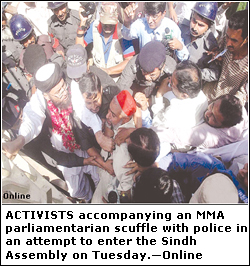 KARACHI, Oct 2: Muttahida Majlis-i-Amal leaders submitted on Tuesday resignation papers of seven of the eight MMA members of the Sindh Assembly to Speaker Syed Muzaffar Hussain Shah, who said a decision about the resignations’ acceptance might take up to three days.
The resignations were tendered in compliance with a decision of the All-Parties Democratic Movement, an alliance of several opposition parties, to protest against the acceptance of the nomination of President Gen Pervez Musharraf for his re-election in uniform in the Oct 6 presidential election.
MMA and PML-N leaders Dr Mairajul Huda Siddiqui, Qari Sher Afzal, Qari Mohammad Usman and Saleem Zia, MPAs Maulana Omar Sadiq, Nasrullah Shaji and Hameedullah, presented the seven resignations to the speaker in his Sindh assembly chamber. The four MPAs who were not present in the assembly were Begum Kulsoom Nizamani, Maulana Ahsanullah Hazarvi, Hafiz Mohammad Naeem and Yunus Barai.
When the speaker asked why the four MPAs had not come in person, Maulana Omar Sadiq, who was their parliamentary secretary, explained Hafiz Naeem and Yunus Barai had gone to perform Umra after handing over their resignations. Kulsoom Nizamani was on her way to the assembly and could drop in any moment, he added.
Regarding Maulana Ahsanullah Hazarvi, he said as his eyesight had weakened, which restricted his movement. His resignation could be verified over the phone or, if necessary, he could be brought into the assembly, Mr Sadiq added.
When a journalist asked him why MPA Abdul Rehman Rajput, a member of the Jamiat Ulema-i-Pakistan (Noorani), was neither present nor his resignation was submitted, MMA leader Dr Mairajul Huda Siddiqui said the MPA was on his way from Hyderabad and he would submit his resignation himself.
Of the seven MPAs, whose resignations were submitted to the speaker, Maulana Omar Sadiq, Hafiz Naeem and Maulana Ahsanullah Hazarvi belong to the JUI-F, and Kulsoom Nizamani, Nasrullah Shaji, Hameedullah and Yunus Barai to the Jamaat-i-Islami.
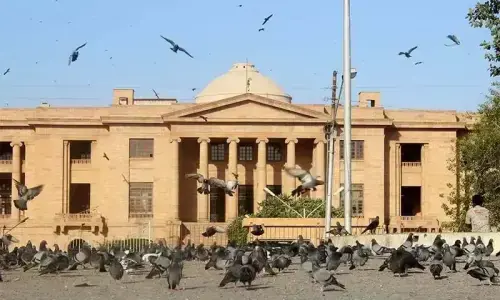
Earlier, the administration took strict security measures around the assembly building, cordoning off both entry points -- the Sindh Assembly Square and the Arts Council Chowk. Vehicular traffic was not allowed by police to go past the two points while members of law-enforcement agencies were roaming about in plainclothes.
On the outer main entrance to the assembly, a heavy police pose wielding bamboo sticks were deployed. Fire tenders and mini-buses were also parked in the vicinity of the assembly building.