



 0
0

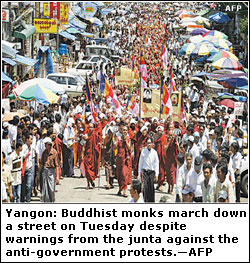 YANGON, Sept 25: Myanmar’s junta announced the imposition of a dusk-to-dawn curfew in the country’s two main cities on Wednesday after pouring security forces into Yangon to try to end the biggest protests against military rule in nearly 20 years.
Troops and police armed with rifles had on Tuesday surrounded the Sule Pagoda in Yangon, the focus of two days of mass demonstrations led by thousands of maroon-robed monks.
In another possible sign of a looming clash, a well-placed source said detained democracy leader Aung San Suu Kyi had been moved to the notorious Insein prison on Sunday, a day after she appeared in front of her house to greet marching monks.
Loudspeaker announcements in the former capital, Yangon, and the second city of Mandalay said the curfew would run from 9pm to 5am local time.
The announcements also said both cities would be under direct control of the local military commander for 60 days.
Some analysts said the junta was caught off guard by the speed with which sporadic marches against a sharp hike in fuel prices in mid-August had mushroomed into mass demonstrations against 45 years of military rule in the Southeast Asian country, formerly known as Burma.
As the international community urged the generals to avoid a repeat of a bloody crackdown on protests in 1988 and the United States announced fresh sanctions against the junta, the U.N. human rights investigator for Myanmar said he feared “very severe repression.”
“It is an emergency,” said Paulo Sergio Pinheiro, singling out China as a regional power that would play a “positive role” to defuse the crisis and calling for “quiet diplomacy” by other countries, including the United States.
On Tuesday evening, security forces moved in on the Sule Pagoda after hours of peaceful protest by tens of thousands of people who turned up despite the junta’s threat to use force.
The area around the pagoda, which includes the City Hall, was the scene of the worst bloodshed during a crackdown on nationwide pro-democracy protests in 1988 in which 3,000 people are thought to have been killed.
DEFIANCE: Tuesday echoed with reminders of one of the darkest days of Myanmar’s modern history.
Vehicles with loudspeakers toured Yangon, blaring threats of action under a law allowing troops to break up illegal protests. People came in huge numbers anyway and, in Taunggok, a coastal city 400kms to the northwest, witnesses said about 40,000 monks and civilians took to the streets.
Protesters were led in Yangon by 10,000 monks chanting “democracy, democracy” and, in a gesture of defiance, some waved the bright red “fighting peacock” flag, emblem of the student unions that spearheaded the 1988 uprising.
The streets were lined with people clapping and cheering as the column of monks stretched several blocks on their march from the Shwedagon Pagoda, the nation’s holiest shrine and symbolic heart of the campaign, to the Sule Pagoda.
British Ambassador Mark Canning said two of the junta’s ministers had assured him the protests “would be dealt with in a ‘correct’ fashion, whatever that means.”
But the chilling message behind the loudspeaker warnings was lost on nobody in Yangon, a city of five million people, a week after monks started marching in protest against warning shots fired over the heads of fellow monks.
“I’m really worried about the possible outbreak of violence,” one street vendor said. “We know from experience that these people never hesitate to do what they want.”
Ethnic Karen rebels on the Thai border said troops of a division deployed on the border had been redeployed to Yangon.
That division played a major role in the 1988 carnage and the report lent weight to threats issued by the religious affairs minister, Brigadier-General Thura Myint Maung.
State radio quoted him as saying action would be taken against senior monks if they did not control their subordinates in protests he said were fomented by political extremists.
HOPES, FEARS AND SANCTIONS: China, the closest the junta has to a friend, has been making an effort recently to let the generals know how worried the international community is, a Beijing-based diplomat said.
China said on Tuesday it “certainly hopes Myanmar can maintain stability and resolve the issue in its own way” but left it unclear clear what kind of diplomatic pressure it was exerting on the generals behind the scenes.
Other countries urged the generals to address the grievances of Myanmar’s 56 million people who, in the past 50 years, have watched their country go from being one of Asia’s brightest prospects to one of its most desperate.—Reuters



























