0
0

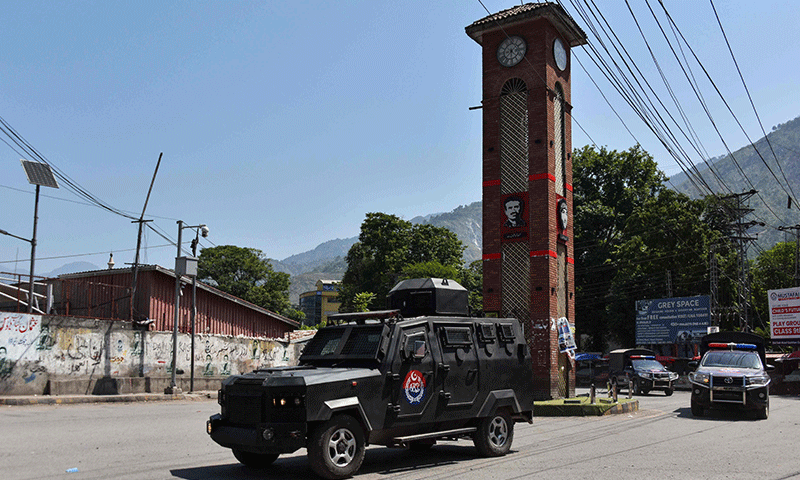
ISLAMABAD, Sept 23: The government’s latest crackdown against political opponents, which continued for the second day on Sunday, signalled a resort to the big stick that could lead to a collision course over the Oct 6 presidential election.
It was a hard response to planned protests against President Pervez Musharraf’s ambition to become the country’s longest serving ruler, coming within two weeks after a similar, but bigger, roundup of opposition leaders and activists before former prime minister Nawaz Sharif was deported to Saudi Arabia on Sept 10.
The move, to detain scores of leaders and activists of the All Parties’ Democratic Movement (APDM), came two days before the alliance had planned to demonstrate outside the Supreme Court on Monday to protest against alleged government pressure on a nine-member bench hearing a challenge to Gen Musharraf’s right to hold both offices of the president and army chief and to contest for another presidential term.
The action of confining activists in jail or rest houses declared as sub-jails and police stations under the Maintenance of Public Order Ordinance, or expulsion of some from Islamabad, betrayed a preference for use of force rather than a vision to resolve an issue that threatens a prolonged political turmoil.
Political sources said they feared the crackdown could be more intense and widespread as the lawyers had threatened to begin the second stage of their pro-democracy movement by besieging the Election Commission with an APDM sit-in on Sept 27 when President Musharraf’s nomination papers are to be filed.
In what some politicians have called a sign of government’s frustration in the face of opposition threats to resign from the National Assembly and the provincial assemblies to block the election, the authorities seem to be hoping for a repeat of the APDM’s failure to put up a respectable show to back up a seeming adventure by Mr Sharif -- to end his exile to steal a march on possible rivals -- rather than earlier public outpourings against the aborted presidential move to sack Chief Justice Iftikhar Mohammad Chaudhry.
But political sources said things could take any turn over how the Supreme Court ruled over petitions challenging the president’s dual offices and his candidacy for what would be his first election for the office he had held after removing then president Mohammad Rafiq Tarar in 2002 and if the Pakistan People’s Party (PPP) joined the protest movement after apparent failure of its talks with the government for a constitutional package.
If he honours his promise to the Supreme Court to give up his army uniform ‘if re-elected’ as president -- he changed his mind after a previous promise to do it by Dec 31, 2004 -- he will fall behind, in the matter of a uniformed presidency, both Ayub Khan and Ziaul Haq.Political sources said the president could have partly neutralised the looming showdown if a constitutional and legal package negotiated with former prime minister Benazir Bhutto but opposed by the APDM and the leadership of the ruling Pakistan Muslim League had been finalised.
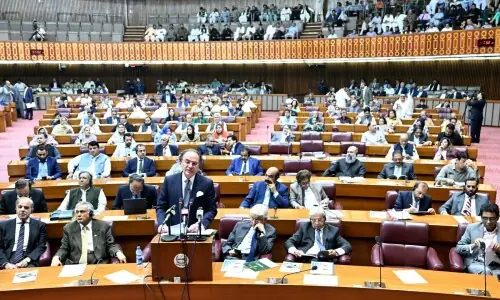
There is no question of Gen Musharraf losing the presidential election if the Supreme Court does not come in his way because of the majority of his loyalists in what is a dying electoral college.
But political sources said resignations or mere boycott of a large opposition would deny him the legitimacy, could hardly help overcome a growing wave of public unpopularity and ensure a new term of constant confrontation with the opposition, in addition to worries from insurgencies in Balochistan and the tribal areas and a growing threat of religious militants who challenge not only his role in the so-called war against terrorism but his domestic policies as well.
There is no sign yet if the disrupted dialogue with PPP will be resumed before or after the presidential election and what fate awaits Ms Bhutto on her planned return home on Oct 18 from 8-1/2 years of self-imposed exile after her party’s latest threat to resign from the National Assembly and the provincial assemblies like other opposition parties if Gen Musharraf goes ahead with seeking election in uniform.
Her spokesman, former senator Farhatullah Babar, said on Sunday that there had been no new move from the government to resume the dialogue over PPP demands that he give up as army chief before seeking re-election, agree to a package to balance powers between the presidency and parliament, lift ban on two-time prime ministers to contest for more terms, and a clemency for politicians for their tenures in office between 1988 and 1999.
“The situation is different now,” he told Dawn. “We are planning our strategy.”