



 0
0

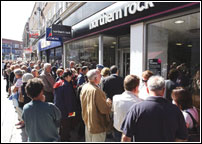 Britons witnessed last week the first ever run on a UK bank in almost 150 years. The bank—Northern Rock which borrowed wholsale and loaned retail one fine morning found that it had nothing to lend because of credit crunch unleashed some six weeks ago by the collapse of ‘sub-prime’ mortgage market in the US.
Unexpectedly the government or more precisely the Chancellor of Exchequer moved in quickly to underwrite with tax payers resources the depositors money. In effect, a nationalisation of private money. It was in fact a three-pronged move by the Chancellor, the Bank of England and Financial Services Authority.
The shares of Northern Rock which only a couple of months ago were being sold at over 700p a piece had tumbled to less than 300p as the depositors queued up in front of the bank to withdraw their money. And predators had started looking around to grab the bank cheap. The government itself appeared to be trying to make a killing at the cost of a down and out bank as its underwriting came at a very high cost, as high as seven per cent in interest—which is being described as a penal rate.
Meanwhile, a debate has started here on whether the government did the right thing by attempting to save a private bank with public money. The argument that is being forwarded in defence of the Chancellor’s move is that there was a serious threat of contagion. The other banks, most of which, were doing well but were also facing the credit crunch were liable to be infected by the collapse of a bank.
According to one analyst Northern Rock, a specialised housing lender saved itself the cost of raising deposits from the public by selling its loans into the wholesale market. This was a profitable strategy until the crisis in subprime US mortgages and securitised finance undermined investor confidence. Northern Rock failed to insure itself against this contingency. Credit – or trust – fled and, with it, its business model.
The drying up of these markets ultimately forced the bank to seek help from the British authorities, who promised to provide financing. But when the public came to know about the rescue plan, it panicked and went for its money in the bank.
On Tuesday the FSA, the City watchdog negated the assumption that it will rescue any troubled British bank if it went down for any reason.
Sir Callum McCarthy, chairman of the FSA, who met Alistair Darling, the Chancellor, and Mervyn King, the Bank of England Governor on Tuesday, told the BBC that a bank could expect help from the regulator only if it was in “comparable circumstances” to Northern Rock.
Sir Callum said the FSA would go ahead with a rescue only if there was a “danger of contagion to other parts of the financial system and other parts of the economy”, hinting that other banks of “non-systemic importance” could not expect similar backing. He said: “The Chancellor has made clear, as he made clear initially in the statement on Friday, that in comparable circumstances the authorities would act in a comparable way”.
Northern Rock was forced to ask the tripartite group of the Bank of England, the Treasury and the FSA for a bailout last week after the cost of borrowing money from other banks became too expensive.
And midway through the week as UK’s financial system was groaning under the first ever run on one of its banks for many years, the US Federal Reserve made a bold attempt to stop the rot that had set in the global system since the collapse of ‘sub-prime’ mortgage market by cutting the core Fed Fund rate by 0.5 percentage points, down to 4.75 per cent.
Problems in the US sub-prime mortgage market grew over the summer, culminating in a full-blown crisis last month. Uncertainty about the size of sub-prime losses has caused investor panic and some financial institutions have suffered extreme difficulty gaining access to financing.
That the decision to cut rates was forced on the Fed and not one that it would have taken willingly is not in doubt. And it is also not in doubt that the continued credit crunch the world over mostly in the developed economies was seriously threatening their individual as well the global growth. So, despite not wanting to do it because of fears of fueling inflation, the Fed was left with no other option but to go for it.
The Fed rightly claimed that the rate cut was intended to “help forestall some of the adverse effects on the broader economy that might otherwise arise from the disruptions in financial markets”. It also cut the discount rate at which it lends directly to banks by 50bp.
As the cut was announced the Wall Street gave its best one-day performance for more than four years, with the S&P, which was up about 0.5 per cent before the Fed decision, closing 2.9 per cent higher at 1,519.80.
Asian stock markets also ended with sharp gains, with the Hang Seng Index in Hong Kong up four per cent to a record close of 25,554.64.
In Europe, the FTSE 100 surged two per cent to 6,404.4 in morning trade, while the Xetra Dax gained 1.7 per cent to 7,705.34 and the CAC-40 jumped 1.9 per cent to 5,656.19.
There were early signs that the Fed action was having some effect on the interbank lending market, which has been extremely tight for a month and a half. Three-month money, which was quoted at 5.59 per cent in London on Tuesday morning, was being quoted at 5.35 per cent in afternoon US trading.
In London, the FTSE 100 raced ahead by more than 150 points in the first few minutes of trading. By 10am it was up 125.2 points at 6408.5, a 1.99 per cent gain. But Northern Rock plunged 17 per cent to 254p, amid concern that it could be taken over at a heavy discount.






























