0
0

 The federal government has approved setting up of a trade, energy and transport corridor between Pakistan and China. For this purpose, a 16-member Policy and Supervisory Board has been constituted under the chairmanship of the President of Pakistan. Plans will be finalised by a Pakistan-China bilateral working group.
A 50-sq km piece of land will be allocated to Chinese developers at nominal rates for establishing special economic zones (SEZs). Incentives similar to the Chinese SEZs may be provided.
A site for China-Saudi oil refinery will be identified and its terms and conditions decided on a priority basis. The energy advisor has been directed to recommend within 60 days the oil concessions for Chinese companies which are expected to bring in at least 200 rigs.
The dry port at Sost near the Pakistan-China border, the seaport, airport and oil refinery at Gwadar, the proposed rail sector projects and the expansion of the Karakoram Highway are moves toward setting up the energy corridor.
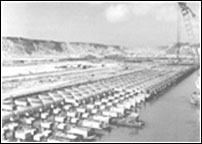
Islamabad has already decided to award the contract for construction of an international airport at Gwadar at a cost of $70 million to a Chinese company — the China Harbour Engineering Company (CHEC).
By virtue of its geo-strategic location, Pakistan can serve as an energy corridor between the Gulf and China and the Gwadar port can become a major outlet for trade between the China, Central Asia and the Gulf region. The proposed $6 billion National Trade Corridor (NTC) envisages improving all sectors of communications, including ports, shipping, aviation.
The Asian Development Bank has agreed to provide $1 billion for the NTC project that would link Karachi to Gwadar and Khunjrab in Northern Areas.
The World Bank and other lenders have already agreed to provide $1.8 billion for the Karachi-Gwadar-Khunjrab section, which is estimated to cost $2.8 billion. The World Bank will provide $300 million within a year.
China’s stakes have witnessed a steady growth in Pakistan over past many years. It has made investments in a wide range of infrastructure projects in different parts of the country, particularly in strategically located Balochistan and the Northern Areas.
It has been focusing on building the strategic transport links between Pakistan’s Northern areas and its remote western regions including Xinjiang. The number of road links between Pakistan and China has risen to eight.
Plans are also afoot for a rail link between Pakistan and China.
The Chinese have already built the railroad up to Tibet and its extension to Pakistan will ensure a faster movement of cargo between the two countries.
The linking of the KKH with Gwadar will need building of new highways and rail tracks passing through Balochistan’s vast expanse.
China and Pakistan are also considering to link the Karakoram Highway to the southern Pakistani port of Gwadar through the Chinese-aided Gwadar-Dalbandin railway, which extends up to Rawalpindi.
Islamabad and Kabul recently signed an understanding for laying railway track between Chaman (Pakistan) and Spinbudlak (Afghanistan). The project will take around one year to complete. Around 10.5 km of track would be laid at a cost of Rs700 million.
Under the accord, Pakistan, in the first phase, will provide the infrastructure to introduce railway system up to Spinbudlak. In the second phase, the track will be extended up to Kandhar and there from up to Khushka through Herat.
Pakistan Railway will complete feasibility study for laying of track between Spinbudlak and Kandhar. It would be a pioneering rail project that will introduce railway system in Afghanistan.