0
0

EU states in hard bargaining over economic destiny
The European Union’s uphill battle to win agreement on a new constitutional treaty by mid-October is not the only issue exercising the bloc’s top policymakers. In parallel to endless in-fighting over the details of the treaty, the 27 EU governments are engaged in fierce battle over the future economic direction of the bloc. And while it looks likely that the EU institutional crisis will be resolved – at least temporarily – in the next few months, the battle for Europe’s economic destiny will be a long-running one.
The EU debate over the new constitution may be grabbing the headlines at the moment but Asian governments and business should start paying attention to the angry inter-EU jostling over trade and economics.
Reasons for the upsurge in EU protectionist sentiment are not hard to find. The current near-death state of the World Trade Organization’s Doha Round of trade talks has given added ammunition to Europeans seeking to shelter their industries and agriculture from foreign competition. Rising protectionist fervour in the US almost always finds an echo – albeit sometimes belatedly – in Europe. And while the anti-globalization doomsayers get all the limelight, those lobbying for a more open, liberal Europe receive little attention from the public or from governments.
Asians should in particular scrutinise recent statements by French President Nicolas Sarkozy and German Chancellor Angela Merkel which call for a more aggressive EU stance against foreign governments whose policies undermine the competitive position of European business.
Sarkozy and Merkel want the EU to develop a joint “foreign economic policy”. They say such a stance will improve EU competitiveness vis a vis states which use non-tariff barriers and restrictions to curb EU exports and investments while at the same time utilising their public/sovereign funds to invest in sensitive national European industries.
The focus – for the moment – is clearly on protecting European industries from unwanted takeovers by state-controlled investment funds from China, the Middle East and Russia. But if Sarkozy and Merkel get their way, all foreign countries deemed to be obstructing European exports or taking up too large a stake in the European economy, could be open to EU retaliation. “This is about reciprocity,” Merkel pointed out after talks with Sarkozy last week. “We are for open markets but they should be open everywhere.”
When France and Germany sing the same tune, the EU listens – and acts.
As such, German proposals to restrict investments by sovereign wealth funds will be scrutinized by the European Commission later this month. One option on the table according to Neelie Kroes, the European Union’s Competition Commissioner, is the establishment of a committee to monitor potential investments in sensitive European industries, a follow-up to calls by Germany’s economics minister Michael Glos that foreign companies wanting to buy more than 25 per cent of any large German firm should be required to seek government approval.
Sarkozy is looking for more, however. A report commissioned by the French President and issued in Paris recently by Hubert Védrine, a former Socialist foreign minister, urges France to fight globalisation by introducing tougher regulation of hedge funds, protecting strategic industries and creating European industrial champions . Vedrine also calls on the EU to be far more robust in applying the principle of equal access in trade deals and to stand ready to protect its industry from hostile takeovers, particularly where there was not equal access. The EU should consider more widespread use of golden shares to block hostile takeovers or otherwise simply choose to designate certain industries as of “strategic” importance, said Vedrine.
If Europe was not more hard-headed about protecting itself, there was a risk that its well-meaning liberal leaders would eventually be seen as the “idiots of the global village”, he added. The report by Vedrine comes only weeks after Sarkozy successfully lobbied EU leaders in July for the removal of the words “free and undistorted competition” from a list of the bloc’s core objectives for the coming years.
Efforts by Paris and Berlin to pull up the drawbridge to Fortress Europe run counter to the European Commission’s efforts to ease European fears over globalisation, industrial delocalisation – including the movement of western European firms to eastern Europe — and above all to combat growing EU concerns over the economic might of China and India.
Opposing France and Germany are several senior EU officials, including
Kroes, EU internal market chief Charlie McCreevy, energy commissioner Andris Piebalgs and trade chief Peter Mandelson. “Protectionism is not the answer,” Kroes said when she delivered an address to government officials and business leaders in Paris at the end of June.
“Protectionism almost inevitably leads to a downward spiral of retaliation. In the long run, we are all worse off.”
A similar warning was issued recently by Meglena Kuneva, EU commissioner for consumer protection, who urged EU states against the use of consumer safety as a disguise for protectionist action against China. “There is a very thin line between protection and protectionism. There are old world protectionists who would like to hide behind the skirts of consumer safety…Europe has made the choice for an open society and an open economy. This has brought and continues to bring tremendous benefits to European consumers, taxpayers, workers and enterprises,” she added.
Mandelson has also cautioned that Europeans still have not really worked out how to be political about globalisation — except, in most cases, by opposing it. “If producing cheaply in China helps generate profits and jobs in Europe, how should we treat these companies when disputes over unfair trading arise?” Mandelson asked, adding: “How do we define what is a European company in a world of global supply chains and multi-national assembly lines?”
Qasmi’s robust satire, gut humour
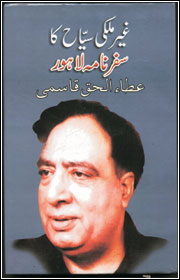 Ataul Haq Qasmi’s robust satire has a plebeian gusto. Like the public eye under which society moves in a procession, nothing escapes his notice. Whether the larceny is committed in the palace or the felony in the mosque, if it is the leader who slips or the led who falter, you may be sure he is watching. He finds humour in funerals and the comic in death. His view of things makes life easier to live.
Two of Qasmi’s latest collections, Wassiyat Namey (Wills) and Ghair Mulki Sayyah ka Safar Nama Lahore (Foreign tourist’s travelogue of Lahore) have an all-Pakistan sweep. With his gut humour, de-intellectualised on purpose as if, he explores a whole gamut of subjects from culture to religion to politics, professions, customs and traditions.
His caricatures are drawn from knickknacks and trinkets in the godown of our national foibles. Then a generic name is given to the figure that immediately snaps before your eyes a shot of the character in flesh and blood. Here is Pir Sahib Hathora Sharif, a religious divine telling his son that God has assigned a quota of fools for every one, therefore he will never be out of business; the Malikul Tajjar tells his son that all traders were good Muslims and would never strengthen the hands of an un- Islamic government by paying its taxes; Chiraghdin Sahafi advises his son who is editor of daily Garbar to write two pro-government columns for every anti-government column he writes for the daily Fasaad to present an example of balanced journalism. Dr Chhura (Dr Cut Throat) admonishes his son for not prescribing surgery for common ailments and not using all test equipment in his clinic before giving his prescription.
Qasmi goes on and introduces Haji Meraj Din, Iqtidar Hussain Lota, Jura Dakait, actress Chhamak Chhallo and Adeeb Nazuk Khayali. They are all our next door neighbours passing on their wisdom to their next generation. Chiraghdin Sahafi’s stress on balanced journalism immediately brings to mind the awkward somersaults the hosts of our TV talk shows perform to keep both parties humoured.
Qasmi uses all imaginable sources to show the interesting facets of society from all angles. Dogs, donkeys, horses, lions and rats, all report their findings and comment on events according to their viewpoint. Since we have become used to the vagaries of our life and hardly notice anything odd in our behaviour, our popular customs and traditions in which we indulge without thought, he brings in a foreign tourist to tell us what looks and sounds unusual to him. His observations make a colourful gallery of our folk wisdom, our cultural heritage, the kaleidoscopic spectacle of our day to day life. From marriage customs to funeral rites, he does not fail to record even the views of the cynics amongst us. The tourist was under the impression that the country he was visiting was the Islamic Republic of Pakistan, just as the green passport said. But a religious divine told him it was not at all Islamic and a political leader said it was not a democracy. What stunned him was the view of a commoner who claimed it was not even Pakistan, the country of their dreams. He also noticed that the country was full of such cynics. The tourist remarked that the line from a Pakistani movie seemed to sum up Islam as practised in the Muslim world. The line was: Stealing is my profession and Namaz my duty.
The tourist wanted to know what the Urdu columnists were writing about. When these were read out to him in English by his friend he was surprised to find how some Western columnists were writing for Urdu newspapers under assumed Pakistani names. It was very amusing that decent Pakistani ladies did not like to call their husbands by their name but called them their son’s father. It reminded him of documents addressed ‘to whom it may concern’. The softening of mangoes to suck their juice through the mouth without breaking the skin was called aam pola karna. But this same phrase was used to describe what the men meandering through crowds of women in the narrow streets of Bano Bazaar were doing. This showed the Lahoris’ exquisite sense of humour.
Though there were not many fair skinned people around, still, dark skinned people were looked down upon. Eligible members of the fair sex had difficulty finding suitable matches if their complexion was a shade darker. Dark skinned men were called Butt Sahib in jest and a black male goat or a black rooster were sacrificed to duck misfortune and black pots were hung on new buildings to dodge the evil eye. The tourist was introduced to another Butt Sahib having his breakfast at a stall of the food market. First he had harissa, then a double plate of trotters with two kulchas, then khud (goat’s or cow’s palate) with two more kulchas chased by a giant copper tumbler of lassi in which four pairas had been sunk. When asked what the Butt Sahib did for a living he was told what he had just witnessed.
Lahoris are also fond of cracking and telling jokes which are mostly of a smutty nature. An old one that is their favourite is about the eunuch who when he died and asked by the angel to present his account countered, “what should I account for?”
| © DAWN Group of Newspapers, 2007 |