



 0
0

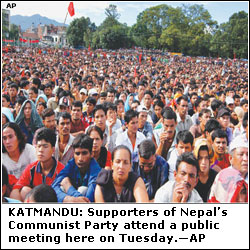 KATHMANDU, Sept 18: Maoists stormed out of Nepal’s government and vowed to disrupt upcoming elections on Tuesday after other parties refused to bow to the ex-rebels’ demand for the monarchy to be immediately abolished.
In a blow to Nepal’s 10-month-old peace process, the ultra-leftists said they would stage street protests — and threatened violence if provoked — to force unpopular King Gyanendra to step down and make the country a republic.
“We will violate the election commission’s code of conduct and disrupt all their plans for elections in November,” said the Maoists’ second-in-command, Baburam Bhattarai.
Under the terms of last year’s peace deal that ended a decade of civil war, the future of the monarchy was supposed to have been decided by a constitutional body due to be democratically elected in November.
But the Maoists claimed the king’s supporters are planning to undermine those polls and want the monarchy to be ousted immediately.
At a rally attended by around 5,000 cheering Maoists, Bhattarai called for strikes in the run-up to the polls, which are to elect a body that will rewrite Nepal’s constitution and decide the future of the monarchy.
“Our protests will be peaceful but if anybody tries to make it violent we will retaliate with the same kind of actions,” Bhattarai warned in his speech to the red flag-waving crowd.
“We think the government is staging a drama.” Bhattarai said that unless a republic was declared before the polls, the election would be a farce.
“We have pulled out from the government this afternoon as the talks failed to reach an understanding on the immediate abolition of monarchy and a proportional election system,” senior Maoist official Dev Gurung told AFP.
Analysts say the Maoists had staged the move because they were expected to fare poorly in the polls. Last month, Maoist leader Prachanda called for the elections to be delayed until next April.
“The Maoists have realised that their power is diminishing,” said Lak Raj Baral, a political science professor at Tribhuvan University.
Although the ex-rebels have stopped short of threatening to pull their fighters and weapons out of United Nations supervised camps following their retreat from government, protests are also expected there.
Maoist cadres have for months been complaining of pitiful living conditions in the camps — underscoring the difficulties they have had in evolving from a force of hardened guerrillas into a mainstream political party.
Politicians from Nepal’s mainstream parties were dismayed by the decision.
Most want the 238-year-old monarchy to go, but have been sticking by the principle that such a decision should only be taken after democratic elections.
“We hope that the Maoists will review their decision as it could pose a serious setback in the holding of the upcoming polls,” Finance Minister Ram Sharan Mahat said.
The leader of the Communist Party of Nepal (Unified Marxist-Leninist), Nepal’s second-largest party, was also critical of the Maoists — who are still on the US list of foreign “terrorist” organisations.
But Communist Party leader Madhav Kumar Nepal said “the doors for talks are still open and we hope to try to hammer out the differences through more dialogue.” Baral said the Maoists’ move was “a very unfortunate political development” for the extremely impoverished country, which is only slowly recovering from 10 years of civil war.
Gyanendra came to the throne in 2001 after an apparently drink-and-drug fuelled Crown Prince Dipendra killed most of his family, including the former king, and then himself.
Gyanendra seized direct control of the nation in February 2005, but was forced aside by mass protests and further isolated by the peace deal.
He has already been stripped of most of his powers, as well as his official title of head of state.—AFP



























