0
0

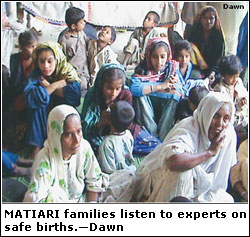 KARACHI, Sept 16: The birth of a strong desire to progress has changed the life for the better in Union Council Biddi Kaka, taluka Saeedabad, district Mitiari. The way forward is difficult, they know, but they are no longer ready to accept man-made adversities as their fate and want to change the status quo.
This change has emerged with the health education, being imparted in the area by the Aga Khan University, which is aimed at saving the life of newborns. “Education enhances the quality of life but health awareness does a greater job; it actually saves a life. The project has brought about positive changes in household practices and also changed the way people view pregnancy. With a community health committee in place, an expectant mother has now become the responsibility of the entire community,” says Hussain, who has been elected as president of his UC’s community health committee.
Holding a Masters degree in Islamic History, Hussain is a primary school teacher in Biddi Kaka where the project was launched one and a half years ago. Talking about the project, he says that life has become so meaningful now that people have started sorting out the issues that had stunted the growth of the community for long.
The impact of this eight-year project in Mitiari is evident from the contentment of an area resident, Mah Bibi, who says, “Poverty has little to do with the misery that we are in and even with meager resources we can improve our health and save new life. With increasing awareness, our husbands have become more considerate towards us. They don’t let us work in fields during pregnancy and insist that we eat with them rather waiting to consume the leftover,” she adds.
It was surprising to note that there was not a single woman who complained about her husband’s behaviour while narrating the experience of the health education project. “They take great care of us and we never have had any incidence of karo kari,” the women were unanimous in their assertion.
The project is not limited to Biddi Kaka as 901 villages in Hala, Saeedabad and Mitiari talukas have been benefited so far from the project which was initiated phase-wise seven years ago. As a result of this intervention, deliveries by traditional birth attendants at public-sector facilities have increased from 20 to 34 per cent and there has been 20 to 25 per cent drop in stillbirths and newborn deaths in the pilot phase (2003-05) in 350 villages. The project’s extension to 1,200 villages is underway and likely to complete next year.
Health status of newborns
When asked why the newborns health sector was chosen for intervention, a member of AKU team Dr Sajid Soofi said Pakistan figured very low in this respect in the region. And, though, there had been a steady decline in infant mortality rate (IMR), the poor health status of newborns had almost remained unchanged over the last 60 years, he said.
According to a report titled, Maternal and Child Health in Pakistan, Challenges and Opportunities, 2004, children constitute almost half of the country’s population and almost 10 out of every 1,000 children born in Pakistan do not live to see their second birthday. “Of these a significant proportion of children die within a few days of birth while a few die during the process of childbirth. The neonatal mortality accounts for 61 per cent of all deaths in infancy in Pakistan. (Infant mortality is 80 per 1,000),” the report says.
Three-pronged strategy
The AKU team, headed by Dr Zulfiqar A. Bhutta, had conducted surveys of the existing health infrastructure and evaluation of perinatal and neonatal mortality in Mitiari district in 2000. Working on the hypothesis that improved training of lady health workers in coordination with community support can reduce neonatal mortality in rural Pakistan, the team planned intervention by dividing the area into 16 clusters, based on the health system. The project funding was given by many international donor agencies, including Save the Children-US.
The Hala and Mitiari talukas baseline perinatal survey indicates that perinatal mortality rate was 90.2 per thousand births with almost 65 per cent of all neonatal deaths occurring at home and 63 still births out of every thousand. The major cause of such deaths was found to be birth asphyxia (lack of oxygen to brain) which was also the case in other rural areas where most deliveries took place in the hands of traditional birth attendants. Other causes included sepsis, diarrhea and pneumonia.
Project Supervisor Dr Shah Mohammad says that training in resuscitation and newborn care has been given to doctors and paramedics in the public sector. Under the project, community mobilization teams have been formed, health units provided with material support and refresher training modules have been developed for lady health workers in recognizing the problems, basic management and referral. So far, he says, over one thousand care providers, including doctors, lady health workers, traditional birth attendants, community health workers have been trained.
The two unique aspects of the project, however, were the establishment of information systems at Mitiari and the formation of community health committees at the grass-roots level. For the establishment of information systems, surveillance teams comprising young girls from the community were formed for door-to-door collection of data about recent births, deaths and referrals after intervals.
While the surveillance work provided employment to many young girls, community health committees did a significant task by pooling up money from villagers, whatever little they could give, to help women and newborn infants in need. The community health committee keeps prior information about births and arranges transport for expected mothers accordingly.
Myths shattered
About their past practices during pregnancy and delivery, the women said that newborns were bathed soon after their birth and were given ‘ghutti’. Breastfeeding was delayed; there was no concept of hygiene and ayas often cut the cord with glass or stone. “We never took any special care during pregnancy. But, now we know that regular antenatal check-ups are necessary for the life of mother and her baby. For baby’s better health, we are asked just to double the quantity of bread or whatever is available to us,” adds another woman.
Challenges & lessons
Besides access to far-flung areas, working with a diverse range of players and finding motivated young individuals to perform arduous and rigorous research tasks in sweltering weather conditions and logistics were the major difficulties, says Dr Bhutta, adding that the task of collecting in-depth information and setting up the research infrastructure was the challenge that has been accomplished by the staff with great aplomb.
He appreciates the villagers’ response as none of them, except a few, refused to set up a community health committee. The local government, he says, had gone out of way in their support to the project.
The team leader believes that a process has begun through this project that may have great lessons for the rest of the country in terms of its impact and implementation in other areas. “Perinatal and newborn care is far more difficult to tackle and resilient to change. We have demonstrated that this is not so. We have also shown for the first time that a public-private partnership of health workers is possible and that civic society can be motivated to become a partner in improving the health status of women and children in Pakistan. We have the worst statistics in this area and this project is also one of the first to show that what can be achieved at a large scale and with so little investment,” a visibly content Dr Bhutta says.