0
0

 KARACHI, Sept 4: Karachi, one of the mega-cities of the world, is perhaps the only one devoid of any significant public artworks.
It would be fair enough to blame decades of religious fanaticism, quite similar to that of the Taliban that had resulted into the destruction of the Bamiyan Buddhas, for the prevailing situation in the city.
Fortunately, winds of change have started to blow as the local artists are all geared up to revive Karachi’s public artworks.
Drawing an analogy between the Taliban and the past governments in Pakistan, Shahid Rassam said that fanatic and ruthless government functionaries had done the same to Karachi’s statues long ago.
Rassam is one of a handful of local artists working for the revival of the city’s public art, which had flourished under British rule in India and survived for a couple of decades until the early years of military dictator Ziaul Haq.
The city’s public art crumbled under Zia’s rule, as culture became an early casualty of a regime that nurtured religious fanaticism. The rot had set in under Zia’s predecessor, Ayub Khan, the first in a long line of military rulers, who held power from 1958-1969.
Commenting on the dearth of public artworks in the metropolis once dotted with huge statues, a former city official Saifur Rehman Grami said that the religious extremists launched the first campaign against beautiful statues in Karachi during Ayub Khan’s rule and the city was then stripped of most of its street artifacts. Scores of sculptures depicting British rule are now little more than a folk memory after being uprooted and destroyed.
The monuments survived sporadically until Zia seized power in a military coup in 1977 as Pakistan reverted to military rule. His 11-year tenure encouraged sectarianism and religious extremism prospered as he imposed curbs on cultural activities and gave extremists the freedom to ruin the remnants of Karachi’s glorious statuary, said Rassam.
An artistic ‘nightmare’
Describing Zia’s regime a nightmare for the art and culture, he said that it was during that period that the city suffered the most.
“Even many years after the creation of Pakistan most of these statues were allowed to be erected at various gardens and public places but since the late 1970s the wave of extremism uprooted all these monuments,” Grami says.
Mohammad Ahsan, a resident of the old city areas, said that he had witnessed the destruction of his locality’s history.
“Khori Garden was one of the most beautiful parks of old Karachi. There were many statues of those who played a great role in making Karachi the cleanest city in the world, including a huge statue of Queen Victoria. All these monuments were either destroyed or displaced in the 1970s and 80s and the old fountains and water troughs were completely ruined,” he says.
However, in the mid 1990s a large number of old statues and monuments were discovered heaped in a municipal storeroom, most of them extensively damaged.
“We had found some broken pieces like limbs and busts lying neglected under the debris of the municipality’s stores, but found it impossible to put them together,” Grami says.
What could be salvaged and restored, had been provided a safe haven at the city’s Mohatta Palace Museum, but their absence from their original sites around the city had created an artistic vacuum, he added. However, municipal officials say that, politically, it is not “the appropriate time” to re-install these statues.
“We could not restore them this time round because of a possible reaction from religious fanatics and indoctrination against cultural entities in the general mindset of society,” says a municipal official.
Nazim’s bold stand
In a country, once again under military rule and wracked by political and religious turmoil, City Nazim Mustafa Kamal has made a bold stand to “invest” in culture as a buffer against rising extremism.
“We have started investing in culture, encouraging cultural activities, as it is the only way to combat extremism and terrorism,” Kamal says.
In this regard, the city hall has commissioned two statues from Rassam to be erected in the heart of city -- a Whirling Dervish and a woman in chains symbolising earth’s vulnerability in the universe.
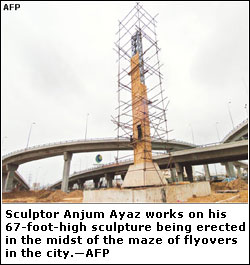
Anjum Ayaz, another internationally-recognised sculptor, is busy erecting his latest monumental work in the midst of a maze of flyovers in the city’s eastern neighbourhood, Korangi.
His 30-ton, 67-foot-high monument depicts sea, birds, animals, people, rituals, holy verses and galaxies.
Ayaz, whose works stand in Tokyo, Beijing and Dubai, has voluntarily created and installed a dozen mini-sculptures at the city’s busy Seaview beach in what he says is a bid to bring art into the public domain.
“I am committed to my cause to work for the people,” says Ayaz.
A Karachi city hall official, who wished not to be named, held religious fanatics, responsible for the ruination of these artefacts in the name of Islam.
“And their terror is still reigning so supreme that most artists and authorities seldom dare think about a revival,” says Talat Hussain, a Pakistani artiste who teaches at the National Academy of Performing Arts in Karachi.
He said that these works were part of the heritage of fine art and of Karachi itself, and one could not erase the colonial period however much one tried.
Mr Hussain said that nothing in history should be destroyed, not even the statues of despotic English rulers as they reminded us of our past lives as slaves and goaded us to protect our freedom. —AFP