0
0

 KARACHI, Sept 3: Having endured over five years’ detention at Guantanamo before being cleared of having links with the Al Qaeda or the Taliban, 40-year-old Abdul Aleem Siddiqui then suffered another six months at Rawalpindi’s Adiala Jail. The imprisonments have taken their toll: Siddiqui lives under constant fear and says that he feels broken.
“Relations with my family are not what they used to be and I’ve developed a medical condition,” he said at a press conference organised by the Defence of Human Rights Organisation here on Monday.
He was surrounded by the family members of several missing persons.
During his years of incarceration at Guantanamo prison, Siddiqui spent 17 months at the notorious Camp 5 where, he said, the worst forms of torture are practised. “I was not allowed to sleep during the first two months of my detention. They kept us naked in the extreme cold for hours,” he told the gathering. “My investigator referred to Pakistan as a state that would soon disappear from the world map and they gave us books containing maps that did not show Pakistan.”
Arrested from Afghanistan during what he maintained was a business trip, Siddiqui said that the treatment meted out to him at Adiala Jail was awful. “Even after my release, when no case is registered against me, I am under constant surveillance,” he said sadly. “I am supposed to report to the police station, produce witnesses and submit my surety. I cannot leave town without informing the police. The special breach officer who visits my [Sadiqabad] house told me that we are married for the next 30 or 40 years so I had better come to terms with the situation.”
Still no trace
Present at the gathering were the sister and five-year-old daughter of Attaur Rehman, whose whereabouts have until recently been unknown. Said to be wanted in the Daniel Pearl case, Rehman was arrested five years ago from his Nazimabad house, claimed his sister, but authorities have only recently shown his arrest from Kashmore.
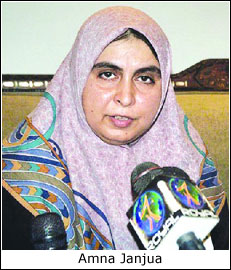
DHRO chairperson Amna Janjua, whose husband Masood Janjua is also a missing person, said that organisation represents the cause of over 400 missing persons and their families. Ms Janjua explained that while the missing persons suffer psychological and physical torture, their families have run out of resources and cannot make ends meet. She appealed to people to support such families who, despite their struggle, have not yet lost hope.
“We know that the government will not give us our rights but we have to fight and with the corporation of the chief justice, we hope to achieve our goal,” she affirmed.
The chief organiser of the DHRO, Khalid Khawaja, said security agencies kept raising fake cases against him for six months. “Despite clear directives of the Supreme Court, I was picked up by the agencies,” he said, seeking security from the government.
Mr Khawaja praised the chief justice’s role in Abdul Basit’s recovery and hoped that others would soon be found. He pointed out, however, that while some persons are being released, others are still being picked up.
‘Ethnic cleansing’
In a show of solidarity, Jameel Bugti accompanied Khalid Khawaja and Amna Janjua. He told Dawn that people in Dera Bugti in particular and Balochistan in general even avoid talking on the phone since they are all monitored. “I have not been able to visit my ancestral town since last year,” he commented. “Our people are called Mohajir Bugti since nearly 90,000 Bugtis have been displaced, which has been recognised by a UN report. Even General Musharraf had to acknowledge displacement to this scale.”
According to Mr Bugti, the Hindu community of the area has been forced to take refuge in Kandhkot areas and the Dera Bugti operation was followed by looting of the Hindu community. He added that 66 people had died with his father Nawab Akbar Bugti and described the ongoing operations as “ethnic cleansing aimed at achieving control over the province’s natural resources.”