



 0
0

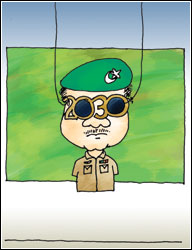 Why do military regimes have visions of great things to do when they are at the fag end? “Don’t send me packing just when I know what needs to be done” is the plea. Planning Commission always comes handy to engineer such visions, this time literally, as it is all engineers at the top, some generals, even an award-winning poet, but no practitioner of the dismal science called economics.
No wonder, the existence of this top-heavy corps of engineers in the commission has led to a tunnel vision, a mere projection of the present into future with the obvious prescription that the present political arrangement must also continue for its realisation. Every thing that has failed delivery – rule of law, equity and justice, security, trickle-down – has been promised by 2030. But all these are empty boxes, or poorly designed tunnels, as if one is deliverable without the other and the political economy of change does not matter.
But the political economy matters the most. Exactly forty years ago, the country was made to celebrate a not very dissimilar period of reform and development. However, the chief economist of the time went public to tell his bewildered audience in the April of 1968 that the economy was largely controlled by 22 families. The ordinary people saw in this speech the articulation of what they experienced in their daily existence. They now believed the government that there had been growth in the economy, but that there was this other Pakistan that was monopolising its fruits.
The chief economist had to leave. Now that the real issue was out in the open, there was some recognition at the official level of the widening gap between the rich and the poor and the two provinces. But it was rather late in the day. A regime at its fag end brought out a document called the Socio-Economic Objectives of the Fourth Five Year Plan in November 1968. It said all the right things and promised that the Fourth Plan would be different from the previous plans in that the strategy would shift from quantity of growth to quality of growth. It was widely circulated and the public at large was asked to debate its contents.
The response of the public was overwhelming. A debate did take place, but of a different sort. It took place on the farms where peasants and the landless toiled in an unending cycle of misery, despite the so-called land reform. It happened on the shop floors in the factories where in the words of Sahir “heaps of silk are spun so that the daughters of the land yearn for its strands.”
The debte was also taken up by lawyers for the restoration of the rule of law. Student came out in large numbers agitating, in the words of Sarmad Sehbai: “Kiyun ilm ke rastey mein hai deeware hakoomat.” Students were followed by their professors. School teachers were not left behind, some badly beaten up by police. Women were part of this mainstream debate rather than a group apart. Journalists joined the fray to press for freedom of expression. From within the government, clerks came out beating their chests, chanting ‘hai, hai’. Vast segments of population had been excluded from the growth process. All of them voted with their feet. The debate continued until the Field Marshall announced his resignation.
Comes the next one in uniform, Yahya Khan, and again at the fag end, he launched in the National Economic Council the Fourth Five Year Plan 1970-75. Not only that this plan incorporated all the socio-economic objectives announced in 1968, it went as far as to admit that “People would rather have a slower growth rate than tolerate a further growth in inequalities in income distribution.”
It showed concern for regional injustice and estimated the GDPs of East Pakistan as well as that of Punjab, Sindh, NWFP and Balochistan to show the extent of disparity between the provinces. The provinces were promised justice, as were the workers through a progressive labour policy and the common man by emphasising consumption planning. The historians of planning in this country describe this plan as an aborted plan. Indeed the credibility of the system based on the greed of the few collapsed completely, leading to the break-up of the country itself in 1971.
There is now, in 2007, Vision 2030 when the end is nigh. The sentiment is widespread that the growth process has been non-inclusive in the extreme. Instead of 22 families, the trigger is the claim about 25 per cent poverty. A chief economist had to leave again!
Leaving the main argument of the Vision 2030 for regime continuity aside, it is deeply flawed in regard to the three main areas requiring serious long-term thinking even to sustain the non-inclusive growth process. These areas include, in the order that follows, energy, water and the future of the cities.
On energy, the Vision looks like an atomic energy vision. It misunderstands one-third of the energy battle, which is its conservation and efficient use. I need add nothing to a leader-page article by Dr M. Asif (Dawn, August 24), which describes the 2030 vision on energy as a piece based on little knowledge. As if it required a proof that little knowledge is dangerous, the arrogant response from the Planning Commission (Dawn, August 28) provided that. It only conceded that references were not provided but that such documents don’t need to. A rejoinder by Dr Asif (Dawn, August 31) suggests that these references do not exist!
In a sharp contrast to energy, water for irrigation gets about a page and a half, most of it devoted to productive use of water, which is laudable but not enough. It just emphasises the need to add to storage, but does not say how. The implicit assumption seems to be that the prescribed political continuity will somehow achieve the consensus that has eluded it in the past eight years of absolute rule. Like energy, this is a sector requiring large investment, but the modes of financing have been completely ignored. Again, in a document loaded with rhetoric on fairness, equity and justice, silence has been considered golden on the issues of water rights and distribution.
The worst part of the document is its confusion on the future of cities and urban development, although the document allocates it a very large space. Keeping perhaps the coming elections in view, it was this muddled thinking which occupied a position of prominence in the inaugural speeches. The message that came out was that rural development is necessary to stop rural-urban migration. This has not happened in the past 60 years and is not likely by 2030. As a matter of fact, it has not been the feature development experience anywhere, including China, despite the draconian measures adopted in the later.
The Vision itself admits in its projected numbers that the urban population, despite its under-estimation in the base year, will be two-thirds of the total population. With almost no change projected for the share of services, manufacturing is projected to rise from 18 to 30 per cent. It is obvious where the opportunities for the people will be and it will be rational for them to vote with their feet.
Yet the Vision has to guard itself by saying that this development is not at the expense of rural development. Development – if it is genuine development — is of the people wherever they are. Failure to recognize this can only produce a tunnel vision.
The author is Mahbub ul Haq Professor of Economics at GC University. Email: perveztahir@yahoo.com





























