



 0
0

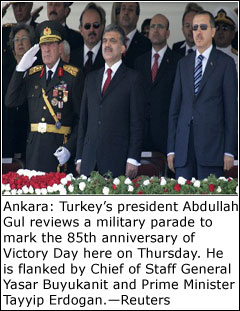 ANKARA, Aug 30: Turkish President Abdullah Gul attended the army’s Victory Day on Thursday, but his wife, who wears the Islamic headscarf, was not invited in a fresh snub by the secular establishment.
Since Gul’s election by parliament on Tuesday, the army has failed to accord its new commander-in-chief, a former Islamist, some of the traditional signs of respect — a stance that has been criticised even by Gul’s opponents.
First lady Hayrunnisa Gul, whose headscarf hardline secularists view as a symbol of political Islam, was absent from the Victory Day parade, as was the wife of Prime Minister Recep Tayyip Erdogan who also covers her head.
The military has always refused, since Erdogan’s Justice and Development Party (AKP) came to power in 2002, to invite the wives of government officials who wear headscarves.
But this was the first time the wife of a president was not invited.
Gul sat between Erdogan and chief of general staff Yasar Buyukanit, but the three barely exchanged remarks as they solemnly watched the ceremony.
Gul’s wife was also expected to be absent from a traditional Victory Day reception hosted by the military on Thursday evening, her name reportedly omitted from the invitation sent to the president.
A headscarf ban in Turkish government offices and universities is strictly enforced by the military. Officers whose wives cover up are not promoted and sometimes cashiered.
Gul’s election was a major victory for the Islamist-rooted AKP over army-backed hardline secularists who blocked his first presidential bid in April, arguing that the party was seeking to erode the separation of religion and state.
Gul, who was foreign minister since 2003, has repeatedly denied the charges and pledged loyalty to the secular system.
The generals had sent an immediate signal of intent on Tuesday when, in an unprecedented gesture, they snubbed his oath-taking ceremony.
The army, which has unseated four governments in as many decades, had warned on the eve of the parliamentary vote that installed Gul as president that “centres of evil” were seeking to erode the secular system.
On Gul’s first full day in office on Wednesday, Buyukanit and other commanders pointedly failed to give him the customary salute as they mounted the podium during a graduation ceremony at an elite military academy.
Buyukanit and other top commanders also sat immediately after shaking Gul’s hand, refusing to remain standing until the president took his seat as protocol requires.
“The person who is the army’s commander-in-chief was not shown the respect he was due,” the popular daily Vatan wrote on Thursday. “We understand why Gul is treated with suspicion... (but) we hope the armed forces will correct their attitude in a way to help President Gul prove his commitment to the secular republic.” The Aksam newspaper issued a similar appeal: “The generals were not expected to adapt to the new situation at once, but they should reconsider some of their attitudes.” Gul has done enough “to pave the pave for reconciliation at the helm of the state,” it added.
Aug 30, or Victory Day, marks a major military victory against invading Greek troops in 1922 that paved the way for the establishment of modern Turkey.
The AKP, to which Gul belonged until he became president, has disowned its roots in a now-banned Islamist movement, pledged commitment to secularism and embraced Turkey’s bid to join the European Union.
The party does, however, favour broader religious freedoms and some of its actions, such as failed attempts to restrict alcohol sales, lift the headscarf ban and criminalise adultery, have fuelled suspicions about its intentions.—AFP



























