



 0
0

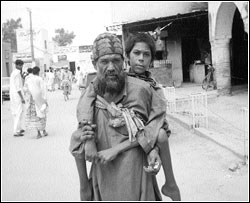 MUZAFFARGARH, Aug 25: They work for each other and at the end of the day share the earnings equally. The business partners are: 40-year-old Muhammad Latif and 10-year-old Muhammad Abbas, both from a small village in Mandi Yazman, Bahawalpur.
Latif is a sturdily-built man who carries paralyzed Abbas on his back and begs from city to city. This correspondent spotted them begging in the district court where litigants and lawyers were giving them charity generously. In return Abbas foretold his charity givers that their investments had resulted in melting the heart of the judge and they would come out of the courtroom victorious.
Latif wears a green overalls with a lot of pockets on it. Coins and other currency notes keep them bulging. When this correspondent approached them for an interview, Latif made the most of the opportunity and agreed to a sitting for lunch. At the district court canteen, he ordered one chicken korma for himself and another for Abbas.
During the meal, he said he was the neighbour of Abbas in Chak 9 and as a proof he showed his computerised identity card. Beside the identity card, Abbas keeps the visiting card of parliamentary defence secretary Maj (retired) Tanveer Husain with him. On the back of the card it is written, `Do not disturb him, he is my man.’
“The card helps me out whenever police or government officials hamper my work,” said Latif.
Abbas has three brothers and his father died when he was just five. His other brothers are normal but he was hit by polio in his infancy which left him crippled for life.
Latif has three sons and two daughters. He says he is very fond of travelling and visiting new places. Until three years ago, financial constraints did not let him leave the village where he worked as a daily wager with different masons. On a fine day, the idea of using Abbas as a begging source dawned upon him. He asked Abbas’s mother to rent out the boy to him and he would only beg in other cities. Both parties, however, agreed to halve the daily earning.
“Now I carry Abbas on my back and earn by begging,” he said.
He said no bus conductor or train guard demanded fare from them. “Sometime bus drivers and train officials give us charity.”
They travel through the year and return to their village after two months just to leave for green pastures.
Their country-wide tour starts from Yuzman where they stay overnight. The next stay come in Alipur and then Muzaffargarh. From here he will go to Kotaddu, Layyah, Karror Lal Essan, Bhakkar, Kundian, Mianwali, Talagang, Attock, Rawalpindi, Islamabad and then Muzaffarabad.
Their other beggaring routes culminate in Karachi, Quetta and Peshawar.
During the day, the partners visit courts, jail premises, hospitals and main bazaars. He said hotspots for beggars are courts and hospitals. Latif does not feel fatigued while carrying 35-kg Abbas and keeps on moving throughout the day. He stops at places only to collect charity. But wedding ceremonies are such events where Latif stays for one hour.
He said on working days, they earn Rs800 to 1,000 every day and if lady luck gets along with them, they end up pocketing even over Rs2,000.
Three holy months — Ramazan, Muharram and Rabiul Awal — are very special as their average income in these months shoots up to Rs3,000 a day.
Latif is grateful to Abbas as he has proved a source of income for him. So is Abbas to Latif.
“Uncle Latif is a good man and he gives me two times meal and tea.”
They spend their day at workplaces and at night they sleep in the open. Latif says he likes to sleep at railway stations or bus stands because these places remain crowded every time and no one can rob them of their “hard-earned” money. He said whenever they collected up to Rs50,000, they sent it to their homes through post office fax service. He said it was a risk to keep a big amount in pocket and that “robbers are not kind to beggars”.
Both keep transparency in their monetary matters as at the end of the day they count their income and divide it instantly.




























