0
0

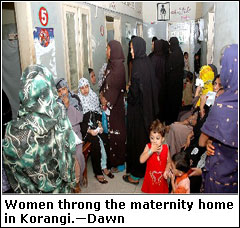 KARACHI, Aug 26: Staff shortages, water availability and disrupted electricity have greatly affected the services of the Korangi Maternity Home, the only government-run health facility in the town. The centre, which also hosts the town’s tuberculosis diagnosis and treatment service, is daily visited by a large number of patients but constant power outages and the unavailability of drinking water add to their woes as they stand in a long, dark corridor awaiting their turn.
“The weather is pleasant today otherwise we would not have been able to stand here for so long,” complained one of the women in the queue. “There is no water or electricity at the moment. Not that electricity would have made much of a difference since there is no ceiling fan either.”
According to Deputy Town Health Officer Dr Zafar Ali, the electricity problem is critical, particularly during deliveries when the procedure takes place in the light of torches and candles. “These tense episodes could end if we were provided a generator,” he commented.
Patients also complained about the facility’s filthy condition and one of them claimed that after a long time, it had just been cleaned before Dawn’s visit. “The place was littered with empty drip bottles, plastic bags, disposable injections and other garbage,” she claimed. One proof of this statement was a small room inside the ward which was full of stained bed sheets and empty drip bottles, giving the impression that these items had been hurriedly dumped there.
Dr Ali conceded that the administration failed to ensure cleanliness but pointed out that little can be done to improve the situation since only one sweeper has been sanctioned for the facility.
Raising other problems, he told Dawn that the facility is desperately in need of another female doctor. Before the appointment of the doctor who works there currently, the maternity home made do with just a lady health visitor and a staff nurse for two years, he said. Not that there’s a shortage of doctors appointed to the facility, he added. “On paper, there are 12 to 15 staff members including doctors, a pathologist, a radiologist and a dispenser who have been on the payroll for a long time,” he complained. “But they are actually working at other healthcare facilities.”
“This problem is not restricted to our facility. There are many health setups in rural and semi-urban areas where the appointed staff is actually employed elsewhere. Transport problems and the fear of poor conditions prevent doctors from working in far flung areas and at times, appointments are soon followed by transfers,” added Dr Munawwar Ali, who has recently taken charge as the facility’s medical superintendent and looks after the Directly Observed Treatment Strategy (Dots) programme.
Located in Korangi 2½, the 15-bed maternity home was inaugurated by the then mayor of Karachi, Abdus Sattar Afghani, over two decades ago. It also houses the town health offices on its second floor. Deputy THO Dr Ali explained that the city district government has not provided them with office space yet and they intend to shift as soon as possible since the floor is was originally meant to house an operation theatre. “We need an operation theatre and more female doctors,” he said. “A request in this regard has been sent many times to the high-ups, but to no avail.”
Currently, the over 70 normal deliveries performed every month are managed by two staff nurses, three lady health visitors and four midwives working in shifts. Dr Sadia Khayyam, the only lady doctor, leaves by 2pm.
“I am not on call and only attend to patients in the morning,” she asserted. “The staff here is extremely competent, more experienced than many doctors.” She added that there is no problem in referrals and that a Sindh government hospital is located nearby while high-risk cases, including first pregnancies, are sent to either JPMC or Civil Hospital Karachi since there is no operation theatre, incubator, ventilator, nursery or paediatrics section here.
She pointed out the poverty, the lack of education and awareness about family planning are major impediments to improving women’s health. She referred to a 40-year-old woman who was undergoing an examination for her 10th pregnancy and said that multiple pregnancies are common despite the influx of so much relevant information on the media. “Pregnancy at an older age risks both the woman and the baby’s life,” she commented, “but we can’t lecture this woman now lest she goes to an unskilled midwife.”
Though the administration claims that TB is more common among women in the reproductive age bracket, they have nevertheless kept no records of expectant mothers with TB. “I can’t give you the exact figures but I can say that four to five pregnant women afflicted with TB come every three months for delivery,” said Dr Zafar. “Special precautions are needed for such cases since TB is an air-borne infection. We provide free treatment and all babies are vaccinated against TB when they are born.”
Women are considered more vulnerable to the disease because of malnutrition, poor sanitation and over-crowded living environments. In view of the increasing numbers of hepatitis and TB patients, Dr Zafar feels that the government must introduce screening for TB, hepatitis and HIV/AIDS at all health facilities.
The maternity home is also badly in need of renovation. Though charges for antenatal checkups, vaccination and ultrasounds are nominal, many patients claimed that their relatives paid Rs600 instead of the Rs100 official charges for a delivery. About this malpractice, the administration maintained that patients don’t lodge an official complaint and are often found admitting that they gave extra money to the nurse of their own free will.
For equipment sterilisation, Dr Zafar claimed that there is an autoclave which they said is locked up. When this scribe insisted on seeing the machine, a staff member confessed that actually, a boiler is used for this purpose.
While the city government plans to spend a huge amount of money on various health projects in the city, one feels that a wiser step should be to pay attention to the existing facilities that are failing to meet their objectives.