



 0
0

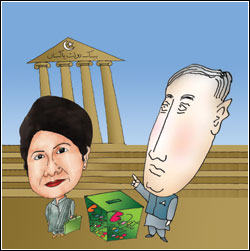 WHAT does one make of a setting in which a federal minister is announcing the latest SME policy with the secretary of his ministry on one side and the State Bank governor on the other?
Only the other day, the governor had pronounced the end of the credit budget and sectoral targets and here she was making specific commitments in full public view for a sub-sector.
In official quarters, the governor is assumed, with or without her consent, a member of the government economic team. The governor is a formal member of all economic decision-making bodies. All this is in addition to the tutorial group called the Fiscal and Monetary Coordination Board held every year by the prime minister in his capacity as finance minister. The governor, for whose education the show takes place, is but one ordinary member.
Is this consistent with the autonomy envisaged in the State Bank Act, shouted from the rooftop by the government as the greatest piece of the first (or is it the second? Or the third!) generation reform?) People have seen Allan Greenspan appearing before the Congressional Committees. But has anyone ever seen him standing in a White house queue or sitting in the conference halls of the Treasury or the Office of Management and Budget? The superior judiciary is returning to the old tradition of keeping a safe distance from the executive. Isn’t the custodian of our money and the watchdog of that devil called inflation expected of somewhat similar conduct? At any rate, the role of the governor is much more than printing ill-designed notes presented to the executive for photo-ops.
Why this autonomy is important becomes self-evident in the light the monetary policy statement for the current six-month period. Borrowing by the government from the State Bank is the most inflammatory material in the chemistry of inflation. To prevent a repeat of the high-rise inflation of 7.8 per cent in the outgoing year, the State Bank expects the government to retire Rs62.3 billion of past borrowing, enforce quarterly ceiling on borrowing in future and make greater use of less liquid longer term financing for its deficit.
To say all this is the statutory right of the State Bank. It is only pinning the government down to an inflation target of 6.5 per cent fixed by the government, not the State Bank. Again, given the government’s own-determined GDP target of 7.2 per cent, the State Bank wants to follow the age-old policy of keeping the monetary growth in line with the nominal GDP growth. This target works out at 13.7 per cent.
As a result of a similar exercise last year, the money supply growth target was pitched at 13.5 per cent. The actual was way above at 19.3 per cent. As a matter of fact, it has been the same story since the military take-over. The State Bank says as much when it talks of the challenge from, “pressures build up from the high monetary expansion of 15.2 per cent (compared to the target of 12.8 per cent) in FY06 and even steeper monetary expansion in the preceding years when on average money supply expansion regularly slipped in the range of 18.6 per cent to 19.6 per cent annually.” Those were the days of “Aish-o-Ishrat!”
What is so different this year? The government has already budgeted a joy-ride on spending. What to speak of retiring bank borrowing, the government has a target of borrowing Rs131 billion. It will take some longer term debt (Rs42 billion) to finance the deficit, but the route is unfunded debt in the form of net capital receipts on national savings schemes. The balance of Rs75 billion of the stated deficit is to be covered from privatisation proceeds, an uncertain prospect.
The king-size Public Sector Development Programme is over- programmed: The Planning Commission puts the operational shortfall at Rs35 billion and the finance division at Rs50 billion. As much as Rs34 billion are for the special political programmes – the erstwhile Peoples or Taammeer-e-Watan now coming under the Khush-hal Pakistan series. General Naqvi of the NRB used to describe such programmes as an example of political corruption. He won’t be very happy to know that on top of Khush-hal, this government of good governance blatantly announces “initiation of unapproved but crucial projects.” Changes in provincial cash balance with the State Bank have been shown as a receipt item. No wonder, the sum of the development programmes announced in the respective provincial budgets exceeds the provincial component shown in the PSDP.
This government spending spree will be accompanied by a massive dis-hoarding of money by general public for the very reason public sector will be on the rampage – elections. Somebody should inform the State Bank that there are three elections to take place this year, including the mother of all elections.
That is where monetary policy understates the inflationary potential of the current year, unless the State Bank wants to go to the empowered Supreme Court praying for the strict observance by the federal government of the Section 9A of its Act.
The author is Mahbub ul Haq Professor of Economics at GC University, Lahore. perveztahir@yahoo.com






























