



 0
0

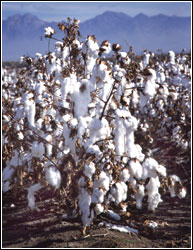 Pakistan may miss the cotton production target of 14.20 million bales for this year because of the pest attack, which is reported by growers to have affected the crop on at least 25 per cent of the total area of eight million acres under cultivation, ahead of the start of full-blown harvest.
“The crop is under attack of Cotton Leaf Curl Virus (CLCV) and mealy bug at various places in Punjab,” the AgriForum Pakistan says.
“The agriculture department officials from nine districts in the province have corroborated the reports of mealy bug attack on the crop,” AgriForum chairman Ibrahim Mughal tells Dawn. But, he says, it is too early to predict the extent of damage to cotton crop, the mainstay of Pakistan’s economy.
“The extent of damage being caused by the pest to the pick varies from one place to another,” he says. “The key point to note is that the government, especially its plant protection department and ministry of food, agriculture & livestock, has done little to ensure provision of insecticides needed to kill mealy bug despite repeated warnings from the growers about the appearance of the pest since the beginning of this month,” he says.
The insecticide required to combat mealy bug, the farmers claim, is available in some areas for Rs1,300 per litre against its actual rate of Rs600 a litre because of its acute shortage in the market.
“The current situation reminds one of similar mealy bug attack last year, which largely contributed to the country missing the cotton output target by a hefty 800,000 bales,” says Mughal. “Government failed to act on time even last year and the growers either paid a very high price to purchase insecticides to eliminate the pest or could not get it at all and suffered huge losses.”
Mealy bug was spotted on the cotton crop for the first time in 2005, but it did not cause much damage to the crop that year. None of the research institutes in Pakistan could identify the pest or suggest measures for its elimination. The insect was sent to England for identification.
The growers say even B.T. cotton is not resistant to mealy bug, which is considered by the farmers to be a major threat to cotton crop because it comes in 3-4 layers. The insect lays eggs and hatches them in a natural basket attached to its body. It multiplies rapidly as eggs are hatched in 6-10 hours. Its occurrence not only curtails the crop size, but also increases the production cost as the farmers are required to apply 3-4 sprays of insecticides to kill it and control the damage.
While the growers are trying to underline the threat of mealy bug to the cotton output, the textile industry is making efforts to downplay the farmers’ claims. The reason is pretty obvious: The reports of reduced crop size can trigger panic buying by the mills and shoot the commodity’s rate to new levels as was witnessed on August 10 when the lint prices surged to the historical level of Rs3,500 a maund (37.32kg) on fears of its tight supply owing to heavy rains in Sindh.
“Mealy bug or other pests should not have affected more than 1- 2 per cent of the total area under cotton cultivation,” says a spinner, who refused to give his name. He like many other spinners, is pretty confident that the country will be able to reap a good crop and attain the output target for this year. But he also warns the government to take effective measures to control the damage to the crop by the pest attack.
Unnerved by the unexpected surge in the cotton prices, the All Pakistan Textile Mills Association (Aptma) advised spinners struggling under increasing costs of production to take advantage of the provision in the labour laws to temporarily lay off labour for 14 days for reducing their cotton consumption to narrow the gap between demand and supply of the commodity.
At the same time, the yarn spinners also arranged for the import of around 2,000 tonnes of Uzbek cotton warehoused at the port of Bandar Abbas, Iran, at about Rs3,000 a maund. Some 8,000 bales are already said to have reached Pakistan during the last few days.
Nevertheless, the reports of imported cotton landing Pakistan have failed to contain the fluctuations in the cotton market. Although the lint rates eased to Rs2,900 per maund early last week, the price again jumped to Rs3,350 per maund in the second half of the week before sliding to Rs3,125 (Punjab) and 3,025 (Sindh).
“Rains in Sindh and tight supply from early pick are causing the cotton prices to fluctuate in the domestic market. If we examine the cotton price outlook for the next harvest on the basis of the global scenario, we are hoping to see its rates to come down sharply,” says a senior Aptma office-bearer.
He pointed out that New York Cotton Futures for Dec have dropped to $0.64 a pound from $0.68. “Commodities are crashing the world over on fears of impending recession in the global economy owing to the crisis spawned in the world markets by the recent crisis in the United States’ sub-prime mortgage market. The big investors and hedge funds are liquidating their assets in the commodity markets to make up for their losses in the stock markets. A bearish trend is visible all around the globe,” he says. “We are looking at New York Cotton Futures for Dec sliding to $0.54-55 a pound sooner than later. How can Pakistan remain unaffected by the global developments? The cotton market in Pakistan too has to cool down.”
Pakistan Cotton Ginning Association (PCGA) chairman Sohail Haral says the supply of the commodity in the domestic market is expected to remain tight till at least Sept 20. “The price fluctuations are caused by rains in Sindh as well as tight supply of the commodity ahead of full-fledged commencement of its harvest in October.” He says on 78 ginning factories out of a total of 1,200 in the country are operating at present due to slow supply of 7,000 to 8,000 bales a day.
He says only early pick of B.T. Cotton, which according to the AgriForum has been sown on 2.4 million acres in non- core cotton areas, is reaching the market at the moment. He also warns the government that if the growers are not provided pesticides needed to control the damage caused by mealy bug, CLCV and other pests, the crop output could be affected adversely.
As the spinners are making hectic efforts to somehow keep down the price of their main raw material, the growers are crying for a better price for their product. “The farmers are getting only Rs1,250 per maund for their crop at this time against their input cost of Rs1,500,” claims Mughal. He says the mealy bug attack has increased the farmers’ costs on account of their huge spending on pesticides, which are short in the market and are available only at more than double the actual price.
The growers also blame the textile industry of manipulating the price, a charge that is denied by Aptma officials. “We have nothing to do with price manipulation. We are the largest consumer of local crop. If the farmers are worried about import of cotton, they should stop fretting on this account because they are also free to export their product. The textile industry needs cheaper raw material to survive. If the domestic cotton market is going up for one reason or the other despite falling commodity prices in the global markets, we shall import as much fibre to meet our needs as possible. We want the farmers to get a good rate for their product. But it should not be done at the expense of the industry,” says a former Punjab Aptma office-bearer.
He also demands that government must allow import of all varieties of Indian cotton via Wagha in order to ease the domestic prices. “We need to create a balance to safeguard the interests of both the industry and the farmers. That is in the best interest of the country and its efforts to increase exports as well as its people. Anything contrary to this will take us nowhere,” he warns.





























