



 0
0

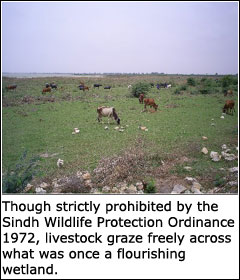 KARACHI: Multi-party managerial control, the lack of coordination and mismanagement have reduced Haleji Lake, once a wetland internationally recognised as significant, to a shadow of its former self.
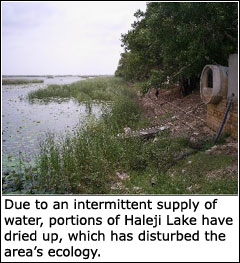
Haleji Lake is classified as a Ramsar site under the Ramsar List of Wetlands of International Importance. Currently, however, the lake holds very little water and large portions are choked with aquatic grass and weeds. Dried-up sections are covered in wild vegetation and being used as grazing grounds for livestock.
Located some 100 kilometres from the city off the Thatta-Karachi national highway, Haleji Lake was constructed by raising protective embankments around a natural depression by the British in the first half of the 20th century, in order to ensure the water supply for troops stationed here during WWII. In more recent times, the lake served as a water source for Karachi. However, since the Karachi Water and Sewage Board (KWSB) constructed a canal as an alternative supply of water, the lake has been neglected and its importance appears to have dimmed in the KWSB’s eyes. As a result, the Ramsar site is in grave danger.
Passing the buck
 The Sindh Wildlife Department has declared the lake a wildlife sanctuary where the shooting, trapping or poaching of birds or fish is banned under the Sindh Wildlife Protection Ordinance 1972, which also prohibits livestock grazing in the area.
Responsibility for the maintenance of the lake, however, appears to be a grey area. SWD staff said that clearing the reservoir of weeds and looking after its water supply is the KWSB’s responsibility, a charge borne out by at least two mechanical weed-cutting boats owned by the KWSB, which Dawn noticed rusting in the lake.
However, a KWSB official informed Dawn that despite repeated requests, the irrigation department has not released sufficient water for a long time. “The quantity of water is not enough to fill the lake and it is also of poor quality,” he commented. Furthermore, he claimed that the SWD itself had disallowed de-weeding on the grounds that the birds would be disturbed or their eggs would be destroyed.
Depletion of wildlife
The decline of the wetland has also affected the wildlife dependent on it. Earlier, the lake would annually attract over 160,000 migratory waterfowl belonging to over 220 different species. In recent years, this number has dwindled to a few thousand, reflecting a disruption in migratory patterns. Native to the cold Central Asian regions, the waterfowl follow the Indus Flyway, one of the major migratory routes. Haleji Lake used to be one of the locations where the birds spent the winter in relatively warmer climes, but the site’s poor condition is clearly no longer conducive.
The final blow was dealt when during the tenure of former provincial chief minister, Muzaffar Hussain Shah, a commercial fishing contract was awarded despite the fact that such activities are banned in Heleji Lake under the 1972 ordinance. Though the contract was cancelled after conservationists raised hue and cry, the contractor nevertheless managed to wipe out the lake’s fish stock in a mere one week of illegal activity.
Little wonder, then, that migratory waterfowl now have little interest in the lake that was declared a bird watchers’ paradise by the then international president of the WWF (now the World Wide Fund for Nature), Prince Philip the Duke of Edinburgh, when he inaugurated an information centre at Haleji Lake in 1982.
Bureaucratic wrangling
Haleji Lake has fallen victim to mismanagement and a lack of foresight. The SWD spent a large sum constructing two huts on the site to facilitate nature enthusiasts but then handed them over to the Sindh Tourism Development Corporation, saying that the latter could better manage them. After a few years, the SWD recently constructed another hut/rest-house, again at a large cost and with the quality of construction leaving a lot to be desired.
SWD secretary Mahboob Alam Ansari told Dawn that he recently saw for himself the poor condition of Haleji Lake and has called for a report, in addition to having asked the conservator to explain the poor construction of the hut/rest-house.
That is not all that requires attention, however. A watchtower to give visitors a better view of the lake is badly deteriorated, its stairs broken and floors damaged. Numerous herds of livestock graze over the dried-up portions and SWD staff at the lake say that they probably belong to neighbouring communities.
A senior SWD official said on the condition of anonymity that the new hut will facilitate visitors to Haleji Lake and was constructed at a cost of less than a million rupees.
“The huts given to the STDC are old and of little use to the SWD,” he said, adding that he would look into the issue of livestock grazing at the site and call for a report. According to this official, the SWD has been urging the KWSB and the irrigation department to fill the lake but the water supply is insufficient and irregular. De-weeding, he said, is the KWSB’s responsibility. While officialdom wrangles over responsibility and red tape, conservationists point out that
Haleji Lake may yet be restored to its former glory through the provision of water, regular de-weeding, the introduction of fresh fish stocks and the strict implementation of laws.—Photos by writer




























