0
0

 KARACHI, Aug 21: The Supreme Court asked the city district government, the traffic and regular police, the Defence Housing Authority and other civic agencies and the cantonment boards on Tuesday to remove all encroachments in their jurisdictions forthwith ‘in accordance with the law’ and prevent roadside parking to ensure smooth flow of traffic in the city.
The order was passed by an SC bench comprising Justices Rana Bhagwandas and Mohammad Nawaz Abbasi as a short-term measure to ease the traffic situation.
As for ‘the long-term, holistic’ approach to the city’s longstanding and complicated problems suggested by City Nazim Syed Mustafa Kamal, the bench directed the Sindh chief secretary to convene periodic meetings of ‘all stakeholders’ to discuss and resolve them or propose measures for their solution and submit reports to the court. The first such meeting is to be held on Aug 25 followed up by a report to the court for consideration on Aug 27, the next date of hearing.
The bench observed that the crux of the problem was non-implementation of laws, rules and court orders. It was going to take notice of non-compliance of a 1996 SC order on pollution.
The city nazim said a committee headed by the Sindh governor had been set up as ordered and its report would be submitted to the court by Oct 10.
As for the bar on entry of heavy traffic during day-time, it would not apply to the Northern Bypass, which the nazim said was meant for all manner of traffic round-the-clock. In response to a query by Deputy Inspector-General (Traffic) Wajid Ali Khan about the movement of heavy water tankers, the bench asked him to regulate it in such a way that the normal traffic was not obstructed.
The ban has been imposed for a month under Section 144 of the Criminal Procedure Code. The bench said the order should be renewed every moth till further orders.
Nazim’s problems
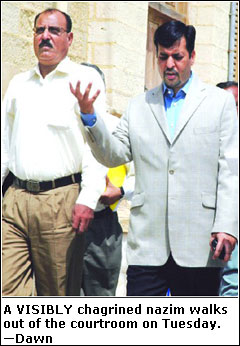
Thanking the court for taking notice of the traffic problem, the city nazim earlier submitted that ‘the mess’ the city faced was the consequence of decades of neglect. The city contributed 68 per cent of the revenue to the national exchequer but received little for its development. Bhit Shah, a 300-year-old locality, was being provided potable drinking water only now. Roads had to be dug up to lay water and sewage lines, a more basic need. Two hundred kilometers of pipelines had been laid and drinking water provided to various areas at a cost of Rs17 billion.
The city district government, Mustafa Kamal said, had control over 34 per cent of the city area. Numerous other agencies, including the Site Limited, several cantonment boards, the Defence Housing Authority, the Karachi Port Trust, the Port Qasim Authority, the Pakistan Railways and the Civil Aviation Authority, were responsible for the bigger chunk of 76 per cent. A concerted approach was impossible in the absence of a central municipal authority. A new link road (New M.A. Jinnah Road) from the Quaid’s mausoleum had been built but he could not prevent car showrooms from parking their vehicles to clog it.
The bench remarked that he was recounting his problems as a city nazim while the court was interested in solution to the citizens’ problems. Mr Kamal said the problem of dispersal of municipal authority had an adverse impact on civic problems and the rights of citizens. Karachi, the city nazim, said was probably the only megacity the world over where the city government had no control over its traffic police.
‘Muk-muka’ phenomenon
Referring to Justice Rana’s observation that a traffic sergeant was busy doing ‘muk- muka’ (bargaining over illegal gratification) with a rickshaw driver as a big trailer passed by unchecked on a Defence road, he said it was a common scene across the city. But he had no authority to take action even against a constable if he found him indulging in taking bribe or neglecting his duty. However, he called a meeting of the four senior superintendents of traffic police and persuaded them and the transport department to set up a complaint centre in collaboration with the city government to address traffic complaints round the clock.
Explaining the complexity of the problem, the nazim said a ban on heavy traffic entry during daytime was imposed earlier also. The result was that the movement of goods to the only port was reduced to 40 per cent. Sixty per cent of the shipments were cancelled. The national economy could ill-afford such a drastic reduction in shipments.
Besides the Northern Bypass, he said, the city government was working on an elevated expressway, signal-free corridors and other projects.
A fleet of CNG buses had been imported but the city government did not want them to become a part of ‘the present system’. He wanted the new buses to provide such a decent facility that car owners felt compelled to prefer public transport over their private vehicles.
He also requested the court to help the city develop a mass transit system, which was the only long-term solution to the traffic problem. The various problems were inter-related and Karachi needed a “holistic package of reforms”, the nazim said.
Mass transport system
Ms Ali Akbarbhai and Roland D’Souza of the Shehri NGO emphasised the need for a mass transport system.
They said adequate legal framework was available for traffic control and regulation but there was no enforcement of laws and rules. Encroachments, they added, were the biggest single source of congestion. At times, only 30 per cent of the road width was left for the traffic to move, particularly in Saddar.
They called for immediate removal of encroachments and an end to illegal parking. The suggestion found favour with the bench.
The Shehri representatives also proposed the establishment of a commission to look into the civic and environmental problems.
The bench, however, rejected the idea as ‘commissions are formed to shelve problems’.