



 0
0

 According to the definition found in the WTO accord on Trade Related Aspect of Intellectual Property Rights (TRIPS), `geographical indications[ (GI) are, "indications which identify a good as originating in the territory of a member state, where a given quality, reputation/characteristic of the good is essentially attributable to its geographical origin.".
In other words an indication--including the name of a town--, identifies a product as having a characteristic peculiar to the place of production. For example, a drink has a flavour because of being produced from certain ingredients containing special characteristics due to local environment, the name of that place would identify that it contains the patent flavour.
Similarly, a piece of furniture with carvings by local artisans could be famous as a symbol in vogue to signify as it emanates from these artisans. In order to encourage continued production of such goods by protecting their GI from being misappropriated by people of other regions, TRIPs accord puts WTO members under obligation to enact laws guaranteeing protection to GIs and there are two such basic obligations with respect to GIs.
First, Article 22 of the TRIPs accord stipulates that member countries must provide opportunities to owner of the registered GI to prevent the use of a mark misleading public with respect to the geographical origin of goods. Second, Article 23 of the accord, with certain exceptions, deals with preventing the use of GIs in respect of wines and spirits indicating the names of places where these were not produced. This prevention is stipulated regardless of whether the use of the names of such places would mislead the public or not. In other words the use of name of a geographical place other than the place of manufacture is not allowed at all as GI in case of wine and spirits. In case of other goods this can be allowed provided the public is not misled about the origin of the goods.
The use of a GI may act as a certification that the product possesses certain qualities or enjoys certain reputation due to its geographical origin. A product known for its origin from a certain geographical place enjoys such status mainly due to three factors: (i) an area of the land, (ii) its inhabitants, (iii) and the practices followed by them for its production. GIs have been used to leverage on the popularity of quality of a product attained due to the combination of these three factors.
In ancient Egypt brick makers would use GIs on bricks to indicate originresistance of bricks and stones with which pyramids were made. In Europe, great importance is attached to the agrofood products made in various European countries. "Champaign" is often quoted as a leading example of the GI pertaining to the French town in relation to producing of a popular wine.
It is for the fame of a product resulting from its geographical origin and for a GI serving as an indicator of both-- origin and quality-- that, according to a Eurostat survey, customers pay a premium price for such products.
Encouraging production under GIs by extending them legal protection leads to establishment of industrial base in rural areas, which, in turn, improves rural economy and prevents migration of rural population to urban centres.
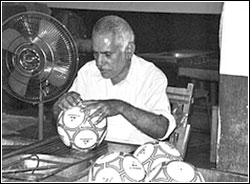
In Pakistan, there are so many products with geographical indications which are produced in different parts of the country. GI protection to these products would lead to further economic developments of the areas in which these are being produced. Some of these products are listed below:
Basmati rice; Sindhri mangoes; Shikarpuri pickles; Qasuri methi; Bannu spices; Chinniot furniture; Sialkot’s footballs.
According to a UNDP study, Pakistan does not have any GI protection system while other countries can extend protection to Pakistani GIs only on reciprocal basis; it is due to this handicap that Pakistani GIs remain unprotected and other countries are using the same GIs for their commercial benefits leaving Pakistan with no option to knock the doors of WTO Dispute Settlement body in the event of violation of its GIs..
The same study reveals that to improve Intellectual Property Rights Regime, Pakistan drafted Geographical Indication of Goods (Registration and Protection) Ordinance in 2001, but this draft could not be promulgated as it was found to be "vague and ambiguous".
Drafting such an ordinance is indicative of how urgent it was deemed in 2001 to introduce GI protection.. On the other hand, nonenactment of the GI law even after lapse of six years indicates that the plan was put on back burner; the circumstances underlying this delay need to be examined in order to prevent any future loss to Pakistani GIs.
As a matter of fact, the plan for introduction of GI laws was pursued in the wake of the exclusion of "Super Basmati" rice from the list of varieties of rice eligible for EU abatement scheme, under which EU import duty on certain varieties of Pakistani basmati and the Indian basmati rice was totally exempted. Subsequently, eligibility of Super Basmati under the scheme was restored.
During the negotiations, the European Commission offered to help Pakistan in registering GI of basmati rice with the EU. The last date for completing the formalities with the commission was June 30, 2005, which remained unmet for want of GI protection laws in Pakistan. Meanwhile, in view of paucity of time, an effort was made to register basmati rice in Pakistan as a collective trade mark as an alternative for GI registration. However that too could not serve the purpose. Thus, an opportunity to register GI of Pakistani Basmati rice in European Union was lost.
For protection of GI of agricultural products and foodstuffs in EU, the option left with us is to enact GI laws in conformity with standard GI laws in general and with those of EU in particular. The EU GI law is governed by Council Regulation (EEC) No 2081/92 of July 14, 1992. This law provides a harmonised GI law for member states. However, "third countries" may seek protection of their GIs in European Union if they meet the requirements stipulated in EU GI law.
It is important to be mindful of the fact that the commission does not directly receive an application for GI registration from a person or group associated with the GI. An application is to be filed with the member state or the third country concerned for forwarding to the commission. In order to fulfil this condition it is necessary for the third country to have its sui generis GI law in force; in other words any makearrangement under any other law will not serve the purpose,
At the International Symposium--2007 on Geographical Indications in Beijing, the Secretary General of the Organisation for an International Geographical Indications Network (OriGIn), representing producers, cited 13 Asian countries and 12 Latin American countries which had adopted sui generis systems in recent years as evidence of a growing demand for specific GI protection to coexist with trademark regimes.
It is in the interest of acceleration rural development in Pakistan that the matter of protection for geographical indication through sui generis laws may be accorded its due priority, and the GI laws drafted in consultation with experts and stakeholders.






























