0
0

ISLAMABAD, Aug 16: Speaker Chaudhry Amir Hussain on Thursday lost patience with ministerial absenteeism in the National Assembly, where a government on its last legs too seemed running out of steam in the face of an uncertain political future.
“What is this? Neither the federal minister, nor the minister of state nor the parliamentary secretary is present,” an angry speaker said before a bittersweet discussion about a news report that the government planned to import sugar from India.
“And the ministers who are present are busy talking to each other,” he said about their apparent lack of interest in the business of the house at time when most members seemed worried more about their fate in the next general elections to be held after the present National Assembly runs out its five-year term on Nov 15.
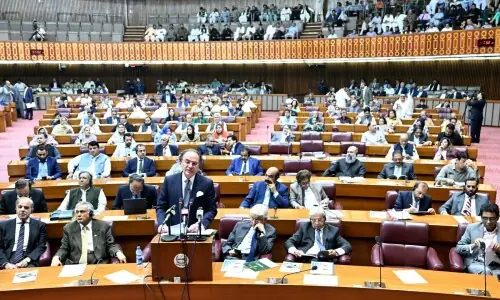
The ruling benches had very poor attendance, leaving the opposition in majority, but there was no issue at hand for a vote that could embarrass the government as no legislative business was taken up to continue debate on devastating floods for the second day.
The day was marked also by more opposition criticism of the government for alleged lapses in providing relief to the flood sufferers, a near agreement between the ruling and opposition parties on a proposal to set up a house special committee chaired by the speaker to talk to the Election Commission to guard against the registration and casting of bogus votes in the next elections, and some exchanges of angry shouting between members of the Muttahida Majlis-i-Amal (MMA) and the Muttahida Qaumi Movement (MQM).
“There is a limit to sharafat (politeness),” Mr Hussain remarked in an apparent reference to his tolerance in the past for a chronic absenteeism on the treasury benches, after finding that neither Commerce Minister Humayun Akhtar Khan, nor his number two Hamid Yar Harraj nor the concerned parliamentary secretary were present to respond to a call-attention notice on the sugar issue.
On a request from the chair, Kashmir Affairs Minister Tahir Iqbal could only state what he called the general government policy to allow sugar imports to bring down domestic prices while ensuring that sugarcane growers too got their due. But it was hard for him to reply to a query about what had happened to sugar imported last year or the position of stocks.
At this stage the commerce minister entered the house to assure the house that no sugar import was planned yet, but after a snub from the speaker for not being present in the beginning.
The minister said although decisions about sugar imports were taken by the prime minister’s secretariat and the finance ministry, he had information that “there is no decision (for such an import) this time”.
The announcement seemed to please the five members of the People’s Party Parliamentarians (PPP) who said in their call-attention notice that the reported plan to import sugar from India in November during the sugarcane crushing season at home had caused “grave concern” among the public.
But the minister said he could not say anything about the future, although he promised to convey “the sense of this house” about sugar imports to the quarters concerned.
The speaker refused to accept the commerce minister’s explanation that he arrived late in the house because the call-attention notice on sugar was the last item on the day’s agenda.
“This is no justification,” Mr Hussain retorted, saying the ministers must come to the house early because one could not be sure when matters concerning their ministries would be taken up or they should intimate the chair if they were busy in the Senate or elsewhere.
MMA parliamentary leader Liaqat Baloch proposed that the speaker form an 18-member committee of the house under his chairmanship and representing all parties to talk to the Election Commission to ensure that the Supreme Court directive waiving the condition of a computerised national identity card for registration of a voter should not lead to registration or casting of bogus votes.
Ruling Pakistan Muslim League’s Farooq Amjad Mir and several other members from both sides of the house agreed with the proposal except MQM’s Israrul Ibad who said no such committee was needed although his party would support a joint committee to discuss ways to ensure free and fair elections as already proposed by Prime Minister Shaukat Aziz and PML President Chaudhry Shujaat Hussain.
However, after a considerable discussion, during which some members cautioned against acting in a manner that could be viewed as interference in the case before the Supreme Court, the speaker promised to study the issue and consult both sides of the house to “see what can be done”.
The house decided to extend the debate on floods until Friday, when it will meet at 9.30am.