



 0
0

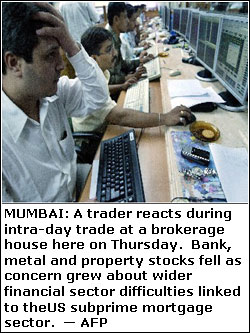 LONDON, Aug 16: World stock markets plummeted on Thursday as credit crunch fears mounted, sending Wall Street sliding and London into its steepest one-day fall since the run-up to the Iraq war.
In Asia, Seoul, Mumbai and Hong Kong shares plunged and there were also steep falls in Tokyo, Shanghai etc.
Share prices across the world skidded lower as investors reacted to more bad news linked to the US housing market, with no end in sight to the turmoil that has gripped financial markets for the last week.
“It’s been a pretty horrible day. Some very decent stocks have just been sold off wholesale simply to raise liquidity,” said analyst Tom Hougaard, chief market strategist at London spread-betting group City Index.
“It really does feel like capitulation selling.”
In the US, the leading Dow Jones Industrial Average index fell to about 12,600 points, marking a 10pc decline from a record high struck just a month ago.
Around midday, the Dow was down 1.72pc, the tech-rich Nasdaq down 2.03pc, while the broad-market Standard & Poor's 500 index lost 1.79pc.
In London, the FTSE 100 index of leading shares closed down 4.10pc at 5,858.90 points, its lowest closing level since September 25 and its biggest fall since March 12, 2003, shortly before the outbreak of the Iraq war.
The biggest fall before this was after September 11, when the FTSE lost 5.72pc.
The Paris market shed 3.26pc, the Frankfurt Dax fell 2.36pc, while other markets across Europe fell by 2.0-4.0pc.
In Asia, on Thursday Seoul shares closed down 7.0pc and Tokyo stocks tumbled 1.99pc to an eight-month low, but the main Nikkei index clawed back some ground in late trade to end above the key 16,000 points level.
Hong Kong share prices closed sharply down 3.3pc. Chinese share prices fell 2.14pc.
Indian share prices plunged 4.28pc, the market's sharpest one-day drop in more than a year as investors reacted to a US credit crunch linked to risky home loans, dealers said.
They said banking, metal and property shares fell on concern that credit costs may also rise in India.
The Mumbai stock exchange 30-share Sensex index fell 642.70 points to 14,358.21, the biggest one-day tumble since May 18, 2006, when the market fell more than 825 points.
“Investor sentiment has been hit. We will have to watch trends in coming days to see how deep this correction could be,” said Naresh Garg, chief investment officer with the Sahara Mutual fund.
“While the financial risks are real, the long-term India story appears intact,” he said.
By Thursday’s close, the Sensex was down 9.5pc from its record intraday high of 15,868.85 set on July 24.
The world’s sixth-largest steel maker Tata Steel saw the biggest fall among index stocks, plunging Rs66.35 or 10.34pc to Rs575.35.
India's largest bank State Bank of India fell Rs93.3 or 5.78pc to 1,521.6, while the largest property stock DLF fell Rs19.2 or 3.19pc to Rs584.05.
Problems with high-risk subprime housing loans in the United States are encouraging investors to pull money out of assets they perceive as risky -- such as oil and shares -- in favour of safer government bonds.
Credit Suisse analyst Jonathan Wilmot said world stock markets could be facing a “correction” -- a temporary slide in share prices caused by investors reassessing risk -- but added that the outlook was unclear.
“Today is the day which could mark the watershed between a 'healthy' correction to riskier assets and something far more sinister which could lead to real economic distress,” Wilmot said.
Wall Street investors woke up to a double dose of bad news tied to the housing market.
The US government reported that new home construction dived to a 10-year low in July, and Countrywide Financial -- America's leading mortgage lender -- said it had tapped an 11.5-billion-dollar credit line to boost its finances.
Shares in Countrywide plunged 14.98pc to $18.10 in morning trading in New York as investors panicked over the latest sign that the crisis was widening.
Investors are worried about a global credit crunch as more and more banks and investment funds around the world reveal their exposure to the slumping US housing market.
Many have made bad investments linked to subprime housing loans -- loans to people with poor credit histories -- and now face huge losses because of defaults by US borrowers.
The fear is that banks will suspend normal lending practices as they move to cover their losses, thereby restricting access to credit for investors and companies.
“We have seen pressure on global markets as analysts are finding it difficult to calculate the extent of the losses involved,” Barclays Capital analyst Henk Potts said.
He added: “Until analysts have a much better understanding of the losses and their potential impact the volatility will remain.
“One thing markets don't like is uncertainty and it is the uncertainty which is causing the volatility.”—AFP






























