



 0
0

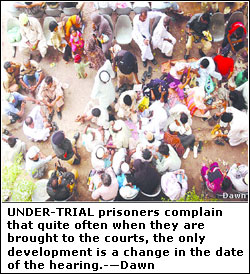 KARACHI, Aug 3: While it is the responsibility of the state to provide prompt recourse to justice, delays are common in the processing of cases, particularly in the lower courts. In a survey conducted by Dawn, 80 per cent of the nearly two dozen under-trial prisoners (UTP) interviewed complained that when they are brought to the courts, the only development is a change in the date of the hearing.
The slow processing of cases is blamed on a number of factors, including the absence of lawyers and prosecution witnesses, incomplete police challans, the non-availability of judges and delays in producing UTPs.
UTPs implicated in different cases told Dawn that they cannot afford the expenses incurred during running cases and some claimed that their cases have not been decided for up to two years. The prisoners also complained about the prisons’ staff and accused them of forcing UTPs to pay money in order to be sent to the courts in the first van. “The ones who fail to pay are sent in the last trip,” alleged the prisoners, “so they are produced when court time is over and are merely given a new date.”
As former Justice of the Supreme Court of Pakistan Nasir Aslam Zahid pointed out, every citizen has the right to inexpensive and expeditious justice. Referring to Section 37-d of the constitution, Mr Zahid said that the state must provide inexpensive justice, education, health care, etc but successive governments have not made this a priority.
According to Mr Zahid, the conviction rate in Pakistan stands at 10 per cent due to issues such as corrupt police personnel, the lack of evidence, vested interests on part of the investigation officers, the non-production of prosecution witnesses and police officials who, if promoted or transferred to another station, rarely bother to attend court.
Mr Zahid pointed out that there are not enough judges who, along with prosecutors, are not offered proper facilities or salaries. “The salary of a judge should be up to Rs100,000 and judicial colonies should be established close to the courts,” he said, adding that if these issues are resolved, the number of prisoners in jails across Sindh would fall from 200,000 to two or three thousand.
Similarly, former judge of the Sindh High Court (SHC) and General-Secretary of the Sindh High Court Bar Association (SCHBA), Shaikh Munir-ur-Rehman, stressed upon the need to appoint more judges. He said that between 80 and 100 cases are put on the SHC’s cause lists every Monday and the disposal rate is about 10 per cent.
The president of the Karachi Bar Association (KBA) and member of the Sindh Bar Council (SBC), Iftikhar Javaid Qazi, told Dawn that the judiciary, lawyers and the police are equally to blame for delays in justice. “Police officials do not produce the challans on time and delay the production of prosecution witnesses,” he said, adding that judges are often overloaded. “The 114 judges in the City Courts are assigned election duties or have other administrative responsibilities,” he said. “At least 500 to 600 cases are pending in every lower court and every judge has to conduct between 30 and 40 cases a day, which is an impossible task.”
The KBA leadership has asked its members to avoid unnecessary adjournments and help dispose of the maximum number of cases. Mr Qazi added that the system of producing UTPs must be improved and funds from the ‘Access to Justice Programme’ should be used in training lawyers and judges. Appreciating the Bar and Bench Coordination Committee formed by the SHC, Mr Qazi asked for the early establishment of the judicial complex which, he said, would solve many problems.
Similarly, the General-Secretary of the Islamic Lawyers’ Forum, Iqbal Aqeel, suggested that “the system can be improved if judges of the High Courts monitor or inspect cases on a monthly basis.”
KBA Vice President Qadir Khan, chairman of the World Reforms Commission Maqbool-ur-Rehman and lawyers Ahsan Khan Afridi, Munir Chitrali and K.K. Javaid Khan also suggested appointing more judges, and spoke out against the ‘thana culture.’
These views are shared by the Deputy Inspector General (DIG) Investigation Manzoor Mughal, who said that the police are bound to produce the challan within 14 days (in some cases, within 17 days) but judges are overloaded. “Resultantly, witnesses’ statements can sometimes not be recorded which discourages them,” he said, pointing out that witnesses have to attend courts at their own expense. However, he conceded that police personnel are also responsible for delays in justice.
When approached for comments, some judicial magistrates stressed the need for the regular production of UTPs in court and said that witnesses and challans are not produced within the stipulated time.



























