



 0
0

Mazharul Islam: outposts of fame
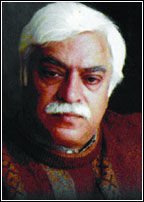 THANKS to Christopher Shackle’s deft translation, Mazharul Islam’s short fiction is receiving attention in Britain where South Asian English writers despite intense competition among themselves and stiffer with natives have been able to claim a substantial share in literary readership which is enlarging with younger talent from the diaspora entering the field.
But translations have always had a hard time finding readers and a viable market in foreign climes. For a translation to attract readers abroad it is essential that it be passably good and the writer has at least had some kind of an introduction to literary circles there if his or her name has not already crossed the national boundaries of fame. This is particularly true of South Asian literatures of its various major languages which have either largely remained untranslated or have generally appeared abroad in bad translations, in what Shackle calls the “halfway house of a South Asian English which is neither quite South Asian nor quite English”.
This situation offers an interesting contrast to South American and European literatures which have been so effectively and creatively rendered into English that quite often we have read them as English literature proper. Such has not been the fate of literatures produced in the Subcontinent’s major literary languages, in particular Urdu. I would say Mazharul Islam has been singularly fortunate in finding a British scholar of Professor Shackle’s stature to translate a selection of his work whose knowledge of South Asian languages is not only vast and deep but who possesses a perceptive feel for the cultural ethos of the land. The Season of Love, Bitter Almonds and Delayed Rains in the translator’s “British English” is highly readable. It may sound rude but I am enjoying Mazharul Islam more in translation. Perhaps English bleaches out the loud theatrical colours that are characteristic of our Eastern expression.
There may be more but I have chanced upon two significant comments in the British press, one by Hirsh Sawhney and the other, a rather longish piece by Jon-Ivan Palmer. Both note the author’s strong affinity to the mystic and folk traditions that have marked creative expression of the artists and artisans alike in an ancient land where mystery and romance dominate the people’s imagination.
Cast in this ancient mould Mazharul Islam’s stories, his prose poems and odd pieces of autobiography engage contemporary themes and dilemma’s in a surreal web that defies disentanglement or explanation of any kind. Sawhney finds a “heartfelt, poetic critique of Pakistani society” in these tales that “defined by diverse elements — sufi poetry, Punjabi folklore, Picasso and Kundera” — “chillingly” reflect “all of humanity’s shortcomings.” Palmer who calls Mazhar a “camel load of anomalies” describes his stories as “not simple ethnic tales or cultural whitewash but profound human dilemmas standing next to Sophoclean tragedy and Homeric epic.” He calls him a “one man archaic revival” whose “stories move like caravans across a desert of imagination, crafted from the ancient struggles of Punjabi natives.”
Reading these reviews it struck me our indigenous writings in Pakistani languages should appeal more in their English translation to readers abroad than original English writings of South Asians who it appears are honing their creative talents and producing works solely to meet with the needs and demands of the market as well as what they deem to be in vogue for winning them one or the other literary award or, at least, getting recommended or short-listed for some such mentionable qualification.
A literary piece tailored to attract the attention of award giving agencies or to get on the best-seller rungs cannot be genuine literature. Gimmickry is one thing and creativity another. I was reading this story, The Dancers, by Suhayl Saadi in the current issue of Pakistani Literature that the Academy of Letters has just released to present new English writings from Pakistan. It isn’t much of a story that one would take the trouble to go through its rambling account of a dance party that doesn’t quite build up to the end but is interesting as an study of the tricks and artifices being employed by authors to strike a smart pose and to look original and novel. Saadi sprinkles his third person narration in formal English with Scottish conversational expressions like the vodka wis wearin aff and aw ae sudden, she began tae miss her papa without any rhyme or reason and even without putting the odd intrusions within commas.
Writers do possess the licence to be creative but rules of literary expression and the grammar of description that Tolstoy, Sartre, Hesse and Joyce never disobeyed should not be taken lightly by those who still need to mention a local PEN award among their distinctions.
Here also the trend of writing for awards is catching on as also to get special allowances for published works and dubious PhD’s that anyone who can cut and paste can clobber together from readymade sources to hoodwink university dons. Long ago when the sum of 10,000 was big money that the Adamji award offered, a very respected writer set himself to producing the most voluminous piece of fiction to claim it, but failed. That wearisome country yarn still enjoys the distinction of being the most unread tome of the 20th century. Now the awards on offer by the Pakistan Academy of Letters are numerous for all categories of the written word and run into a million or more that must be distributed compulsorily as an annual ritual. Yet, it must be said that quite a few of our writers are indifferent to such conferments and write for the pleasure of writing. The thematic novelty and cultural diversity of their work can find readers abroad more keen on knowing life in Garhi Khuda Bakhsh than how Asians are doing in Glasgow. They need good translators who are at home with contemporary British English. PAL with its limited resources is helping raise such a crop from local talent but the backlog of work is indeed formidable.
For a life less human
KILLING a tree must come easily to the people disfiguring the city beyond recognition. But then power politics in Karachi is not for the faint-hearted who, given a choice, would prefer not to stomp three-day-old choozas to death to fulfil some grotesque rite of passage.
Others have no such qualms about snuffing out life and revelling in wanton destruction. It takes all sorts, clearly, to make this wicked world go round.
When the carnage of May 12 could happen, what’s the big deal about chopping down a tree? There are people in this city who will gun you down (an act of mercy, really) after drilling your knees and slashing body parts just as readily as you and I might tuck into a packet of chilli-chips. Should you fear them? No. Will they last forever? Definitely not. Chilli-chips have a short shelf life, what with the humidity and all.
The death throes of trees cut down in their prime are heard only by those whose ears and minds have not yet been fouled irreparably by the clamour of the concrete jungle. The agony is lost, of course, on the people who see and treat Karachi as just so much real estate. Paisa, bhaisaab.
Maybe this avarice has something to do with deprived childhoods or could it be that they are just criminals, plain and simple? In any case, the ringleaders have prospered mightily in recent years. Not the people, mind you, just the head honchos. Their hovels have been transformed into palatial residences in Defence and Gulshan-i-Iqbal. Magic, I tell you.
The helpmeet, true to form, takes a particularly bleak view of things. She is convinced that the day is not far off when the sea will turn black, all the fish will die and the only things left living in this blighted city of ours will be cockroaches and human beings (“two sides of the same coin, if you ask me”).
My own take is less sombre, at least on a Tuesday afternoon. But this much I know: you cannot continue killing all the trees in Karachi and hope that we will still be left with room to breathe. At this rate, we are going to end up living in a dustbowl with high-rises stuck in concrete and not a mynah in sight.
I’ve often wondered — well, at least once anyway — why human beings have so little respect for other living things. Does the problem lie in the fact that we are not part of the food chain in the true sense of the word? Would we have cause to think differently if one of our kind was occasionally devoured by a non-human animal? Maybe, maybe not.
A man came to fix a pipe the other day and the entire time we were talking he kept picking leaves off a potted plant and mushing them up between his fingers. I watched this with growing unease until the urge could be resisted no longer: “yeh zinda cheez hai,” I blurted out. For added emphasis I pointed to the plant, shaking a good deal from coconut to toe and making my meaning clear, or so I thought, to even the dimmest of plumbers.
Complete blank. The man had no idea what I was talking about and probably thought me a fool, an opinion unfortunately shared by so many others. I get the same bewildered response when I throw pebbles at people who chuck stones at dogs. Must have something to do with my communication skills.
What really got my goat the other day was a man hitting a lamb. A lamb, I ask you.
I wondered if I had ever encountered anyone more fundamentally loathsome, and swiftly concluded that I had. The maulvi sahib who used to try to feel me up while teaching the good book came to mind, as did the troubled man at the doctors’ hostel who liked spitting in people’s drinks when they weren’t looking.
Cruelty to animals is on display everywhere, on the roads where draught horses and donkeys are whipped and abused, in bylanes where dogs are pelted with stones, and in many homes where pets are beaten or neglected. None of this comes as a surprise.
We have lost touch with the animal in us. Why does ‘beastly behaviour’ have negative connotations when animals are, in actual fact, much nicer than human beings? They don’t invade Iraq, take over children’s libraries, blow themselves up in busy marketplaces, force you not to shave or engineer stock market crashes.
Enough said, for now.
imalik@dawn.com
| © DAWN Group of Newspapers, 2007 |



























