0
0

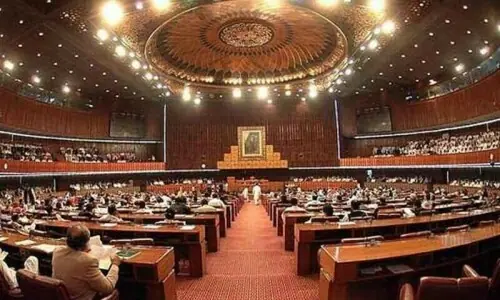
ISLAMABAD, July 30: The present National Assembly, if it survives till August 12, will achieve the distinction of becoming the legislative body with the longest life-span in the country’s 36-year parliamentary history starting from the first general election held on the basis of adult franchise under the Legal Framework Order (LFO) of military ruler Gen Yahya Khan in 1970.
The nation went into eight general elections during this period, but not even a single National Assembly could complete its five-year constitutional term and to achieve this unique distinction, the present assembly is further required to survive for another three months till November 15.
Before the present assembly, only the first National Assembly that came into existence as a result of 1970 elections had so far completed four parliamentary years.
This was the first assembly elected on the adult franchise and population basis and comprised 313 members. The first session of the National Assembly led by Zulfikar Ali Bhutto was held on April 14, 1972 due to the delay caused by the separation of East Pakistan.
Mr Bhutto announced the holding of elections before time and advised the president to dissolve the National Assembly on January 10, 1977, for an early general election. The life-span of the Bhutto’s assembly was four years, eight months and 27 days, which is still the longest.
On August 12, the life-span of the present assembly will be four years, eight months and 28 days as the members took oath on November 16, 2002.
Despite the fact that the assembly is about to complete its term, its performance remained dismal in all respects. A majority of the business items submitted by treasury and opposition members lapsed without even coming up on the agenda.
Besides this, the proceedings of the assembly had to be suspended by the speaker several times due to lack of quorum.
According to a report based on the assembly’s four-year performance, 88 government bills are pending before the assembly that had so far passed only 42 government bills and one private member bill, out of 139 bills and ordinances laid by the government and 200 private bills submitted by the members to the National Assembly Secretariat.
It has been observed that the focus of the assembly remained only on fulfilling the requirement of the constitution under which the lower house is required to be in session for a minimum of 130 working days in a calendar year.
The record shows that the assembly remained in session for 131 working days in the first parliamentary year, 130 days in the second, 132 in the third and again 132 days in the fourth parliamentary year.
In the first six months, the assembly could not pass even a single bill due to a strong protest of the opposition members over the controversial Legal Framework Order (LFO). It passed the first bill, namely the Removal From Service (Special Powers) Amendment Act 2003, on April 21, 2003.
The data shows that the members had submitted a total of 40,091 questions, out of which 22,773 lapsed and only 8,816 were answered by the concerned ministers. The speaker disallowed 7,426 questions on various grounds.
Similarly, the members submitted some 2,410 adjournment motions seeking discussion on important matters of public importance but discussion was held only on 100 of them.
The assembly passed 52 resolutions, out of the total 5,038 received by the secretariat.
The present National Assembly also has some interesting features like it has the highest number of members (342), including 60 reserved seats for women. Moreover, this assembly also has a unique distinction of electing three prime ministers from the same party — Zafarullah Khan Jamali, Chaudhry Shujaat Hussain and Shaukat Aziz.
Another unique feature of the assembly was tabling of four no confidence motions, two against the speaker and one each against the prime minister and the deputy speaker.
The life of the second assembly that came into being after the controversial 1977 election proved to be the shortest in the history as it remained in existence for only three months and nine days, from March 26 to July 5, 1977, the day when the then chief of the army staff, Gen Ziaul Haq, imposed martial law in the country after suspending the 1973 constitution.
During 12-year period from 1985 to 1997, the nation went into five general elections with none of the assembly completing its term. Four assemblies were dissolved by the presidents using their powers under the controversial Article 58-2(B) while the last assembly headed by Nawaz Sharif was dissolved by Gen Musharraf after a military coup on October 12, 1999.
Following table shows life-span of all the assemblies: