



 0
0

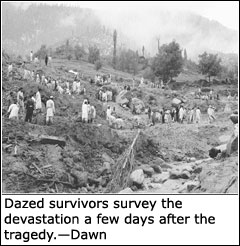 UPPER DIR, July 29: The lack of a disaster management system has exposed the government’s inability to deal with natural calamities, such as lightning and floods which killed at least 52 people in the Banria village of Upper Dir district last week.
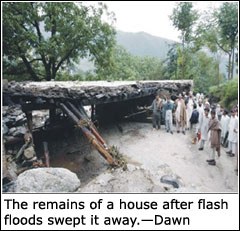
The lightning coupled with flesh floods had also damaged 21 houses, a mosque, standing crops, orchards, cattle head and farmland.
The lightning had hit the lush-green village at 4.22pm on July 20 which triggered flash floods, killing at least 52 people, including 22 children and 12 women, and wounding 22 others. A number people are still missing.
The mountainous village has no road link which caused difficulties for relief workers to carry out rescue operation. The government’s failure to react to the incident immediately and launch a rescue and relief operation had angered the victims who said that no government official had come to the village until next day.
Neither the army nor the civilian government came to Upper Dir for carrying out rescue operation. This correspondent saw only five people busy digging the bodies out of the rubble the following day of the incident.
The local administration had asked the government to provide sniffer dogs to identify places where bodies were buried, but the federal government said that a team of technical experts equipped with deep-vision cameras were ready to fly to Upper Dir, but it did not turned up leaving the troubled people in lurch.
The relief operation could not be initiated and the affected people were running from pillar to post for shelter, food and medicines. They complained that they had not been given relief goods.
 The people involved in the rescue work were ill-equipped which hampered the relief operation. Soon after the incident, the locals retrieved 15 bodies. Some 13 more bodies were recovered late in the night.
Twenty-eight people were buried in graves in one row while the rest were buried beside them in the same graveyard.
A six-year-old girl and a man were pulled out alive from rubble after 24 hours.
Further disappointment was caused when the injured were not given proper treatment at the District Headquarters Hospital. They were left to their fate. “Treatment is poor. We were not given usual treatment at the hospital let alone making special arrangements for us,” seriously wounded Akbar Zada complained.
The lightning had killed 27 persons of a family headed by Niaz Mohammad. Fifteen grandsons, three daughter-in-laws, his wife and two daughters, his married sister and her four children were killed in no time. His 16-room house was as erased as it has even no remains.
The aged long white-bearded Niaz Mohammad would not speak when one asks question from him. He often remains silent but is bold enough to endure the death of his family members.




























