0
0

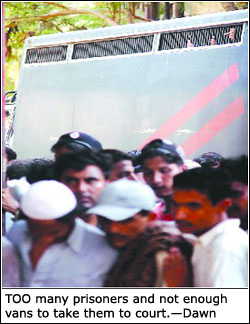 KARACHI, July 25: Despite an official announcement that vehicles would be made available to different prisons across the province for the transport of under-trial prisoners (UTPs), the vans are yet to materialise. Meanwhile, UTPs miss court hearings and face a number of other problems because the poor transport system forces them to unnecessarily wait for their turn to be produced in court.
Sources in the court police told Dawn that in Karachi, only 16 vans are available to ferry an average of 812 UTPs daily and six of the existing vans are in a very poor condition.
As a result, they said, vans designed to accommodate 30 to 35 people are crammed with up to 60 prisoners. “Now that court timings have been extended, the demand for the production of UTPs will increase further,” said a source, “but it will be impossible to meet unless the number of vehicles is increased.”
The problem is one of serious proportions and leads to avoidable delays in the dispensation of justice, but nothing is being done to resolve it. In a seminar held last year at the Judicial Academy, officials of the Sindh Home Department announced that 136 vehicles would be provided to custody centres across Sindh by mid-March 2007, yet the promise remains unfulfilled.
Prisoners, meanwhile, say that they usually miss at least one hearing before their turn comes around. They further claim that poor prisoners are the badly affected since officials can be bribed into producing UTPs in court on the appointed date.
A number of people incarcerated in the city jails blamed the authorities for causing their cases to drag on because they are not produced in court on time. Demanding that judges and judicial officers take action in this regard, they suggested that cases could be conducted inside the prison when there is a shortage of transport vehicles. A UTP also pointed out that “our friends and relatives usually go to the courts to visit us but get frustrated when they find that we have not been brought in.”
When contacted by Dawn, the deputy superintendent of Central Prison, Raja Mumtaz, said that jail authorities are not involved in the production of UTPs in court. “It is the courts police’s duty to produce them in court and provide the record to the jail staff,” he said. “Once the courts police have fulfilled the legal requirements, we are bound to let them take the UTPs and cannot interfere,” he added, referring to the allegations that prisoners are taken to court out of turn.
In the context of this issue, a judicial magistrate commented that “negligence or the intentional non-production of prisoners is an immoral and illegal act; the officials concerned should have to answer for such discrimination.” He accused the police of forcing inmates to offer bribes to ensure that they were produced in court on time, adding that “at times, UTPs even offer food, which is sad because it places an additional burden on poor prisoners.”
Mr I.A. Rehman, the director of the Human Rights Commission of Pakistan, told Dawn that such delays in producing UTPs in court is a serious issue that is repeatedly raised by his organisation and given regular coverage in HRCP publications. “Even the high courts have directed the government to provide the courts police with a sufficient number of vehicles, “he said, “but the government is not serious about solving these problems.” Expressing concern over the pathetic state of prisons and prisoners’ vans, Mr Rehman said that the government has a binding responsibility to solve such major issues, and added that due to poor systems of communications, UTPs were kept behind bars without having received convictions.
Investigations conducted by Dawn have revealed that there is no provision for the maintenance of vehicles used by the courts police. Basic requirements such as a workshop, service facilities or a mechanic have not been met and the current system is entirely ad hoc. The budget fund for oil, repair and spare parts is yet to be approved or made available and court police must themselves make all such arrangements to produce UTPs in court.
Officials of the court police said that the transport of 812 UTPs requires at least 32 vans, two of which are required for taking inmates to hospitals. In addition to the duty of picking up and dropping UTPs from the Central Prison, District Jail Malir, the Youthful Offenders Industrial School [juvenile jail], the Dar-ul-Aman, the Juvenile Remand Room Nazimabad and the Special Prison for Women, the vans are also used for emergency duties in the city. The officials added that in case a van breaks down on its way to or from the courts, no replacement vehicle is available and inmates are forced to suffer the sizzling heat on the road.
These officials proposed that in order to minimise the problems, juvenile offenders should be shifted from the remand room to the Youthful Offenders Industrial School and women from the Dar-ul-Aman should be sent to the Special Prison for Women.
By contrast, however, SSP Security Dr Amin Yusufzai said that most of the courts are located on the premises of the City Courts and on an average working day, the court police bring only 400 under-trial prisoners. He claimed that an additional hundred prisoners’ van, both large and small, are to be procured next year and added that the production rate of UTPs in courts was 87 per cent in 2006 but had dropped to 80 per cent this year. The reason, he said, was that lawyers had been boycotting court proceedings. According to Dr Yusufzai, the real problem is the small capacity of the lockup in the City Courts premises, and the shortage of manpower. He told Dawn that he has written to the authorities suggesting a multi-storeyed custody centre in the City Courts so that men, women and children could be lodged separately and in larger numbers. He added that when the city was divided into five zones, the proposed strength of the courts police was 600 but it was in practice only 300, pointing out that the rules required a certain number of policemen on board a prisoner van but the manpower shortage does not allow this.