0
0

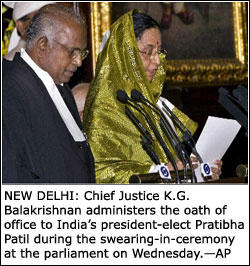 NEW DELHI: India’s first female president was meant to be a boost for women in a country where they often face rampant discrimination. But Pratibha Patil, who was inaugurated on Wednesday, has elicited only a lukewarm welcome from other women, with many saying her lacklustre political career and rocky road to the presidency have given them little more than a symbol — and not a leader who represents them.
Ms Patil, 72, a former lawyer, legislator and governor of the north-western state of Rajasthan, was the candidate of India’s governing Congress party and its allies, and on Saturday she won 65.82 per cent of the votes cast by national lawmakers and state legislators.
“It is a special moment for us women, and men of course, in our country because for the first time we have a woman being elected president of India,” said Congress party leader Sonia Gandhi, who chose Patil for the job, when the results were announced.
While India has had several women in positions of power — most notably Sonia Gandhi and her mother-in-law, Indira Gandhi, who was elected prime minister in 1966 — women still face a great deal of discrimination.
Daughters are often seen as a burden mostly because tradition requires that a bride’s family pay the groom’s family a large dowry of cash and gifts. Their education is often neglected, and many don’t get adequate medical treatment when ill.
Last year, an international team of researchers estimated up to 10 million female foetuses had been aborted in the past 10 years in India.
The result is a gender ratio increasingly skewed in favour of men — there were 927 women for every 1,000 men, according to the 2001 census, down from 945 women per 1,000 men in 1991.
Patil’s victory had been inevitable but her presidential campaign was one of the most bitter in recent history.
She defeated incumbent Vice-President Bhairon Singh Shekhawat, the candidate of the opposition Bharatiya Janata Party, in a contest marked by unprecedented mudslinging.
The Indian president is largely a ceremonial leader, but is vested with powers that can be significant in times of political crisis. The president is also the supreme commander of the armed forces.
Her victory, projected as a step forward for Indian women, didn’t impress many analysts and ordinary Indians.
“She was chosen for her loyalty and has moved from one post to another because of that same loyalty,” said Madhu Kishwar, the editor of Manushi, a feminist and human rights magazine.
“I have always believed that it’s not everything to just have sari-wearing creatures in politics. It’s more important that politics stands for and enables honest, upright people to survive. But sycophancy is the only token that works,” she added.
Shradha Biyani, a marketing executive, felt the same about India’s new president. “I feel that having a woman as the head of state is in some way reflective of how progressive a society is, but Pratibha Patil is not a right candidate.”
But there are others who believe a woman occupying the 340-room colonial-era presidential palace will have an impact, even if it is only symbolic.
“In a democracy like India symbols matter a lot and so her election will have an overall positive impact,” said women’s rights activist Ranjana Kumari.
Still, Ms Patil has faced criticism from opposition politicians, who say she lacks the national stature for the job and that her only qualification was unswerving loyalty to the powerful Nehru family.
Ms Patil’s emergence on the national stage highlighted several scandals involving family members, including two who are under investigation by police.
Her comments ahead of the election calling on Indian women to abandon wearing headscarves were roundly denounced by Muslim leaders and by historians — who disputed her assertion that women only started wearing headscarves in India to save themselves from 16th century Muslim invaders.—AP