



 0
0

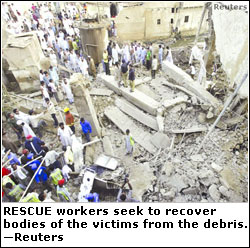 KARACHI, July 24: A boiler in a North Karachi factory exploded early Tuesday morning, killing nine people, including three brothers, and injuring 25 others. The blast destroyed the factory completely and shattered the windowpanes of adjoining houses.
A large section of the boiler was flung into the air and landed some 250 yards away on a house that then collapsed, injuring a woman and her four children. The Taimuria police have arrested the factory owner, Akhtar Hussain Baloch, and registered a case against him.
The explosion occurred at a towel-dying and bleaching factory in a katchi abadi [shantytown] in Malik Anwar Goth, Bengali Para, Sector 15-B, North Karachi. In addition to destroying the factory – though its adjoining office was only partially damaged – the massive blast caused the destruction of 10 adjoining quarters that were rented out to bachelor labourers. Furthermore, according to SP North Nazimabad Naeem Shaikh, drums containing concentrated sulphuric acid had been stored next to the quarters and as the boiler exploded, the drums burst and sprayed the entire area with acid.
As a result, a factory worker and eight other labourers, all of whom had been sleeping in the quarters, were killed by the falling rubble and the lethally dangerous acid. The deceased included Alao Khan (22), Aqueel (18), Mohammad Bux (24), Zahoor Hussain (27), Ashfaq (20) and brothers Abdul Rauf (18), Mohammad Farrukh (20) and Mohammad Hanif (25). The bodies were badly burned by the sulphuric acid and could not be retrieved until rescue workers had removed the rubble; the mutilation was such that identification was very difficult.
The fire brigade, police and officials of the labour and industries department reached the spot while the dead and injured were taken to Abbasi Shaheed hospital by Edhi and Chhipa ambulances.
Lying on a hospital bed swathed in bandages, factory labourer Akbar told Dawn that “the boiler operator went off to say his prayers and, in the meantime, the boiler exploded.” He said that he had been in a restroom next to the factory and suffered burns and injuries when the walls collapsed.
Sajid, who lives some 200 yards from the site of the incident, said that “there was a horrible explosion as though a bomb had exploded. We were terrified. The windowpanes of our home were shattered and the walls developed cracks. When I came out of my house, I saw that the factory had collapsed and injured people were crying in pain.”
Factory owner Akhtar Hussain failed to produce a valid boiler clearance certificate and presented the police with an old one that was issued in July 2005 and expired on June 30, 2006. The certificate was issued in the name of the Chief Boiler Operator of the factory, Faraz Nasir, but this name does not appear on the list of the factory’s employees. However, two non-diploma holding boiler operators, Sohail and Ahsaan, were injured which, the police said, showed they had been away from the boiler when it exploded.
When Dawn contacted the Chief Boiler Inspector of the industries department, he introduced himself as Sultan but disconnected the phone call without commenting on the incident.
According to sources in the labour and industries department, the boiler which exploded was issued a safety clearance certificate on September 17, 2006, which was valid for one year. However, they claimed, the boiler’s safety valve was not working properly and the scene of the accident showed no signs of fire that would suggest that it had exploded because of the accumulation of pressure inside the boiler.
They told Dawn that the boiler was smashed to pieces and its welding joints had given way. “The explosion could have taken place because pressure accumulating inside the boiler could not be controlled by the faulty safety valve,” commented sources.
They added that officials of the Chief Boiler Inspector Office inspect boilers in all the city’s factories and issue a yearly certificate. In this factory’s case, the Boiler Clearance Certificate had been issued in the name of the Chief Boiler Operator of the factory who, they said, must be at least a diploma holder.
“It is the first such incident in the city in fact in all of Sindh, since in other incidents, it is not the boiler that explodes but the gas,” claimed an official of the labour and industries department. “In other cases, it is found that the boiler operator ignites the fire beneath the boiler and the operator assumes that it has been lit. In fact, the fire has not caught and gas keeps accumulating. After a while, he tries to light it again, which causes the accumulated gas to explode.
A survey of the locality has revealed that seven or eight factories in the area have boilers and a factory barely 70 yards away from the scene of the explosion remains fully operational.





























